Groups of Christian Martyrs — A Directory

Martyrs of the Roman persecutions (2nd–4th century)
Rome's persecution of Christians was neither constant nor uniform across the empire's history — it flared up in distinct waves, usually tied to a specific emperor's edict or a local governor's zeal, and eased off again in between. That pattern explains why so many of the best-documented group martyrdoms cluster around a handful of dates: 177 in Gaul, the early 200s in North Africa, and the early 300s under Diocletian, whose edicts triggered what became known as the Great Persecution, the most severe and widespread of all.
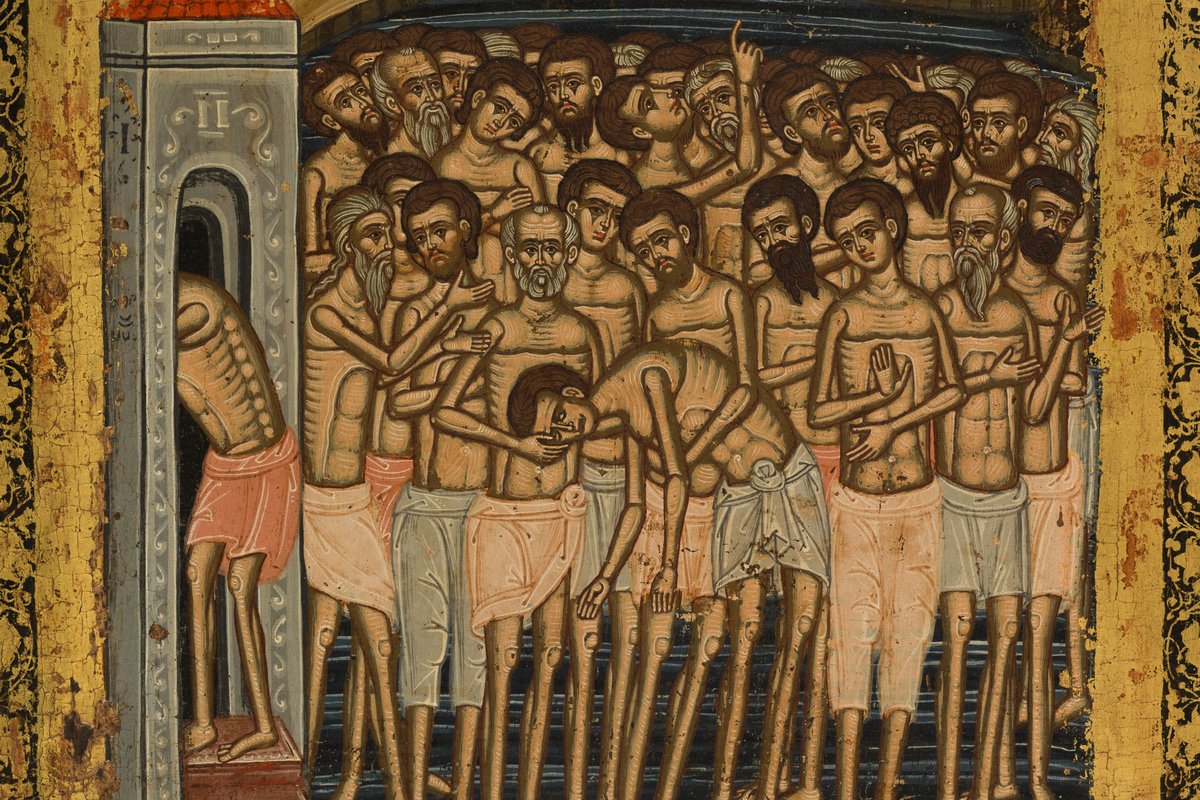
Nikitarea, The Forty Martyrs of Sebaste, 1701–1725, Petit Palais, Paris Musées — public domain (CC0). Used here as a representative image for this directory, since it depicts one of the best-documented group martyrdoms among those covered below.
- Saint Blandina and the Martyrs of Lyon — a young enslaved woman arrested with a larger group of Christians in Roman Gaul and martyred in the arena at Lyon in 177 AD, one of the earliest well-documented group martyrdoms in Church history.
- Saints Perpetua and Felicity — a noblewoman and an enslaved woman, martyred together with three companions in Carthage in 203 AD, in an account partly written, by tradition, in Perpetua's own words while she was still in prison.
- The Forty Martyrs of Sebaste — forty Roman soldiers, condemned to freeze to death on a lake in Armenia around 320 AD for refusing to renounce their faith, remembered together ever since as a single company.
- Saints Cosmas and Damian — twin brothers who practiced medicine without charging the poor, martyred together during the persecution of Diocletian.
- Saint Victoria of Albitina and the Martyrs of Abitina — a North African community put on trial together for continuing to celebrate the Sunday Eucharist in defiance of Diocletian's ban, remembered for the trial record's own defiant line: Sine dominico non possumus — "without the Lord's Day gathering, we cannot survive."
Related, though structured differently since its subjects span several separate persecutions and decades rather than a single shared arrest, is the blog's Virgin Martyrs of the Early Church collection, gathering figures like Agnes, Agatha, Lucy, and Cecilia — young women martyred individually in different cities but remembered together in the Church's tradition and still named together in the Roman Canon at Mass.
The Holy Innocents (1st century)
- The Holy Innocents — the infant boys of Bethlehem killed on King Herod's order while he searched for the child he feared as a rival king, the earliest martyrdom the Christian calendar commemorates, though as victims rather than as believers who chose their deaths.
This entry sits slightly apart from the others on this list. The Holy Innocents didn't choose their deaths the way an adult martyr weighing recantation does, which is why the Church has traditionally distinguished their witness as a martyrdom "by privilege" rather than one earned by a conscious act of faith — a distinction that hasn't stopped their feast, on December 28, from being kept every year within the same octave as Christmas itself, a deliberately jarring placement that keeps the Nativity story from being remembered as only comfortable.
Missionary martyrs of the colonial era (17th–19th century)
Christian missionary expansion into the Americas, Asia, and Africa from the 1500s onward repeatedly put missionaries and new converts at odds with local rulers who saw the new faith as a political threat as much as a religious one — a dynamic that produced group martyrdoms on nearly every continent the missions reached.
- Saint Isaac Jogues and the North American Martyrs — eight Jesuit missionaries martyred among the Huron and Mohawk in New France and what is now upstate New York during the 1630s and 1640s, canonized together in 1930.
- Saint Charles Lwanga and the Uganda Martyrs — 22 young Catholic converts, pages and companions at the royal court of Buganda, burned alive on the order of King Mwanga II in 1886 for refusing to renounce their faith.
What a shared feast day actually means
Every group on this list is remembered on a single shared feast day rather than dozens of separate ones, and that's not just administrative convenience — it reflects how the history itself actually happened. These weren't individuals who each independently arrived at martyrdom and were later bundled together for a tidy calendar entry; they were arrested together, tried together, and in most cases executed within the same hours or days, for the same refusal. The shared feast is the Church's way of preserving that historical fact: whatever their differences in age, background, or how much of their own individual story survives, they met their deaths as one company, not as separate cases that happened to coincide.
Why the historical record varies so much between cases
Not every entry on this list rests on the same quality of evidence, and it's worth being upfront about that rather than treating every account as equally certain. Some, like the Martyrs of Abitina, survive through court records that were apparently copied and circulated by Christians soon after the actual trial, giving historians something close to a contemporary transcript. Others, like the Forty Martyrs of Sebaste, are known mainly through later hagiographic writing composed after the persecution had ended and the empire itself had turned Christian, which means later authors had more room, consciously or not, to shape the story for edification as well as record. None of this makes the underlying witness less real — a shared, ancient, and continuous veneration is itself a form of historical evidence — but it does mean readers researching any individual group should expect a different mix of hard record and pious tradition depending on which entry they're reading.
Trivia
Why are some martyrs canonized as a group instead of individually?
What's the difference between a group martyrdom and just several saints who happen to share a feast day?
Are group martyrdoms harder to verify historically than individual ones?
Do group martyrs share one feast day or separate ones?
You May Also Like
Related Reading