Saint Thomas More

Rising to the second-highest office in England
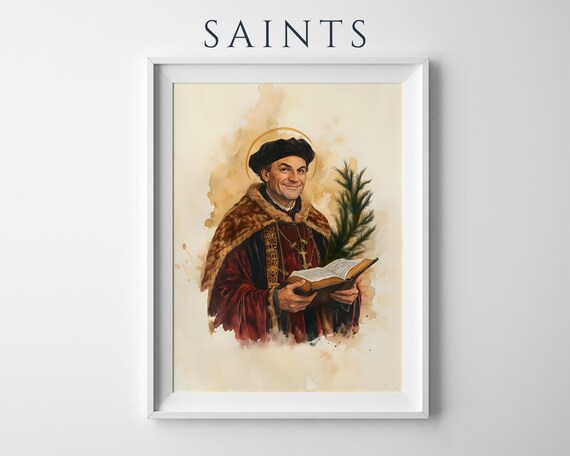
More's career reached its peak in 1529, when Henry VIII appointed him Lord Chancellor of England — one of the most powerful positions in the kingdom, and a role More had built toward for over a decade, having joined the King's Council in 1518 and served as Speaker of the House of Commons in 1523. He was, by any measure, a trusted and capable figure within Henry's government, respected well beyond his role as the author of Utopia, his famous 1516 work of political imagination.
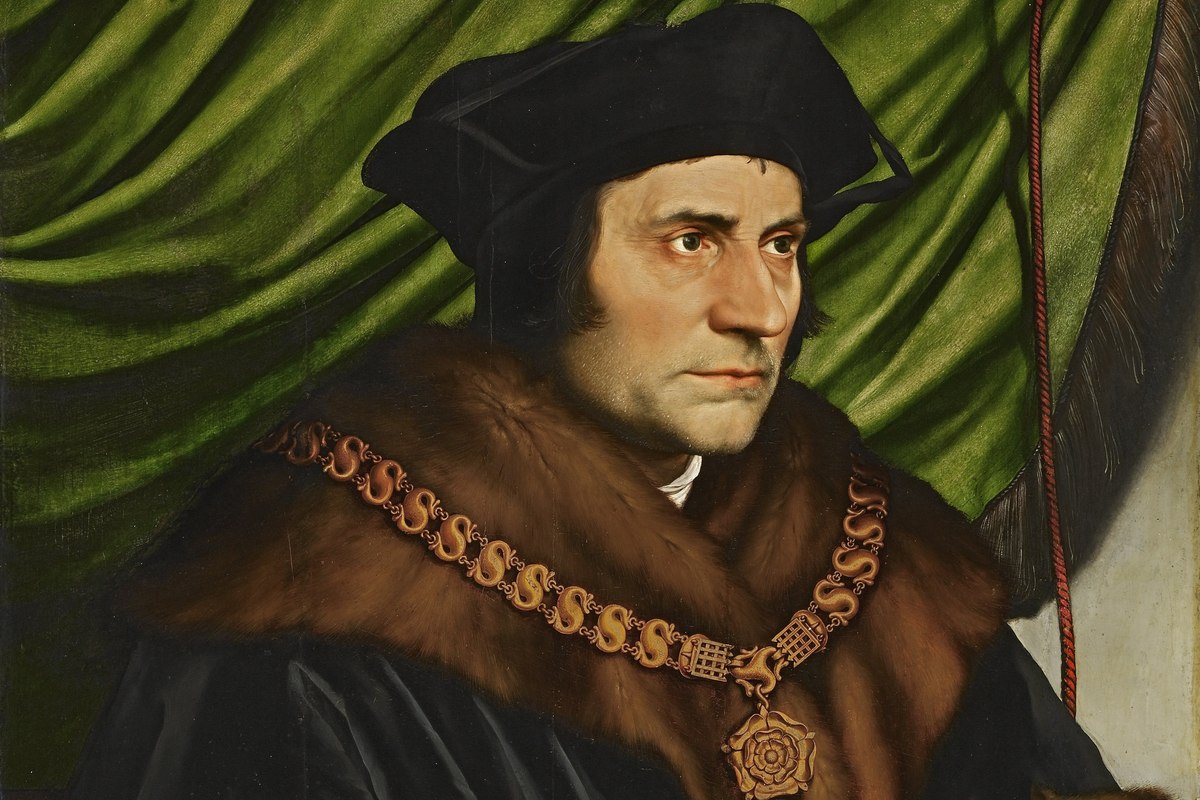
Hans Holbein the Younger, "Sir Thomas More," 1527 — public domain.
More trained originally as a lawyer, studying at Oxford before joining Lincoln's Inn, and for a time considered joining religious life himself, spending several years living alongside Carthusian monks in London and weighing a vocation to the priesthood before ultimately choosing marriage and a legal career instead. That formation left a lasting mark: throughout his later public life, he maintained rigorous personal religious discipline, including regular fasting and the wearing of a hair shirt beneath his official robes, a detail his family only discovered after his death. He was also a celebrated humanist scholar, corresponding for decades with Erasmus of Rotterdam, one of the most influential intellectuals of the age, and was widely regarded across Europe as one of the finest minds in Henry's court — which is part of what made his eventual break with the king so consequential.
A resignation that cost him everything but his conscience
That trust collapsed once Henry moved to break from the Catholic Church, claim headship over the Church of England, and annul his marriage to Catherine of Aragon. More could not support any of it, and rather than quietly complying, he resigned as Lord Chancellor the very next day after reaching that conclusion, retreating from public life to his family home in Chelsea. It was a costly decision even at that stage — walking away from the second-highest office in the realm rather than compromise on a matter of conscience.
The break with Henry had been building for years before it became personal. More had been an early and vigorous defender of Catholic orthodoxy against the spread of Protestant reform in England, even authoring works against Martin Luther, which made his private disagreement with the king's own break from Rome all the sharper — the same man Henry had once relied on to argue for Catholic orthodoxy in print was now watching that same king dismantle the Church's authority in England from within. Resigning cost More his income virtually overnight, and he spent his final years of freedom in increasingly straitened circumstances, quietly declining invitations to Henry's second wedding to Anne Boleyn and to Anne's coronation — refusals that, in hindsight, marked him clearly as someone the king's government could not fully trust.
Silence treated as an accusation
More's retirement didn't protect him. His continued refusal to acknowledge Henry as supreme head of the Church of England — expressed largely through silence rather than public defiance — was eventually treated as treasonous in itself. In 1534, More refused to take the Oath of Supremacy required under the Act of Succession, was imprisoned in the Tower of London, and spent over a year there before his trial, during which he continued to insist that his silence on the matter could not legally be construed as an act of treason. The prosecution's case ultimately relied on the perjured testimony of Richard Rich, the solicitor general, who claimed More had privately denied the king's supremacy in conversation — testimony More himself denounced in court as false, though the jury convicted him regardless, deliberating for less than fifteen minutes. He was tried, and though initially sentenced to the brutal punishment of being drawn, hanged, and quartered, Henry commuted the sentence to beheading. More was executed on Tower Hill on July 6, 1535.
Words chosen for the very end
At the scaffold, More was reported to have said, "I die the King's good servant, and God's first" — a single line that captured, with unusual precision, exactly the tension that had defined his final years: real loyalty to his king, held firmly beneath a deeper, non-negotiable loyalty to something he placed above it. Contemporary accounts also describe More retaining a measure of his characteristic dry humor even on the scaffold itself, reportedly asking the executioner to help him up safely, joking that he would "shift for himself" on the way down. It's a fitting last word — and a fitting last gesture of humor — from a man whose entire downfall traced back not to rebellion, but to the simple refusal to say something he didn't believe was true.
From condemned traitor to canonized saint
More's rehabilitation took centuries. He was beatified by Pope Leo XIII in 1886, alongside a group of other English martyrs of the Reformation era, and finally canonized by Pope Pius XI in 1935, exactly four hundred years after his execution, together with John Fisher, the Bishop of Rochester who had likewise refused the Oath of Supremacy and was beheaded only weeks before More himself. Pope John Paul II went further in 2000, formally declaring More the patron saint of statesmen and politicians — an unusual honor for a man executed by his own government, and a deliberate statement about the kind of public integrity the Church wished to hold up as a model for those in political life. More's reputation has also endured well beyond religious circles: Robert Bolt's 1960 play A Man for All Seasons, later adapted into an Academy Award-winning film, introduced More's story of conscience under pressure to a broad, largely secular modern audience, cementing his afterlife as a symbol of principled resistance that reaches well beyond Catholic devotion alone.
Trivia
What position did Thomas More hold under Henry VIII?
Why did More resign as Lord Chancellor?
Why was More executed?
What did More say immediately before his execution?
What is Saint Thomas More the patron saint of, and when is his feast day?
Related Reading