Noah Building the Ark

A single righteous man in a corrupt generation
Genesis introduces Noah with a description that's short but pointed: "Noah was a righteous man and blameless in his generation; Noah walked with God." (Genesis 6:9, RSV-CE). That description matters because of what surrounds it — the text describes the wider world at this point as thoroughly corrupt, to the extent that God decides to send a flood to start over. Noah isn't chosen because he's powerful, wealthy, or descended from someone important. He's chosen because, in a generation the Bible describes as having lost its way almost entirely, he hadn't.
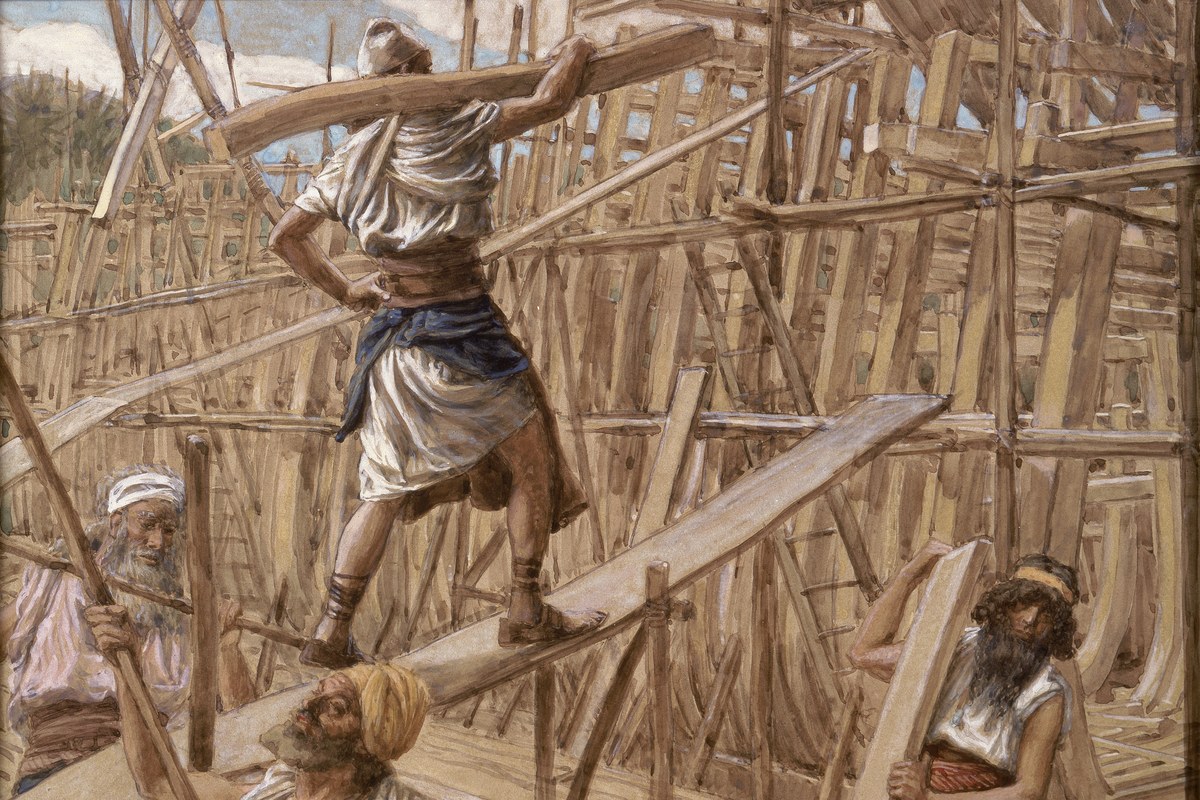
James Tissot, "Building the Ark," c. 1896–1902 — public domain.
Genesis is blunt about just how far that corruption had spread: "the earth was filled with violence" and "When God saw how corrupt the earth had become, since all mortals had corrupted their ways on earth," (Genesis 6:11-12, RSV-CE). It's against that backdrop that God tells Noah directly what's coming and why — not a vague sense of doom, but a specific warning that gives Noah both the reason for the flood and enough advance notice to prepare for it. Being warned at all already sets Noah apart from everyone else in the story; what he does with the warning sets him apart even further.
Detailed instructions for an unprecedented boat
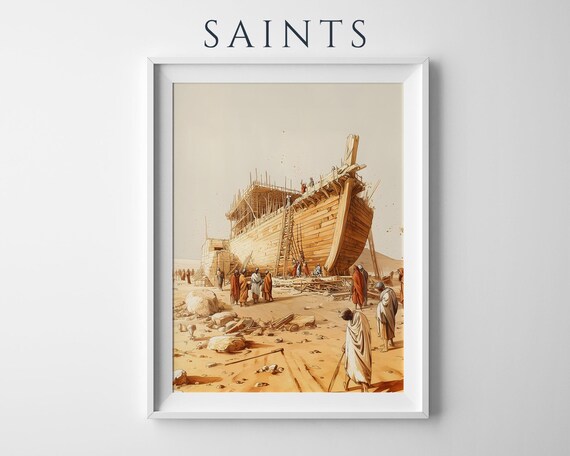
What follows isn't a vague vision but a construction brief: "Make yourself an ark of gopherwood, equip the ark with various compartments, and cover it inside and out with pitch." (Genesis 6:14, RSV-CE) — the beginning of specifications that go on to include exact dimensions and a design for multiple decks. There was no precedent for this kind of vessel and no rain yet on the horizon to justify it. Noah is simply told what to build, in detail, for a danger nobody else could see coming.
The dimensions God specifies are enormous by ancient standards: roughly 450 feet long, 75 feet wide, and 45 feet high by most modern conversions of the cubit measurements given in the text — a vessel far larger than anything a family with no shipbuilding tradition would have attempted without explicit, detailed direction. Genesis also records that God instructed Noah to bring pairs of every kind of animal aboard, along with enough food "that it may serve as provisions for you and for them" (Genesis 6:21, NABRE) — meaning the ark had to be provisioned as carefully as it was built, another layer of long, unglamorous planning behind a story usually remembered only for its ending.
A century of building before a single drop fell
Genesis doesn't state outright how many years the construction took, but the surrounding chronology offers a clue: Noah was 500 years old when his sons were born (Genesis 5:32) and 600 when the floodwaters finally arrived (Genesis 7:6) — a gap of roughly a hundred years. However that time was actually spent, it's long enough that the real test of this story was never really the flood itself. It was the discipline of continuing to build, season after season, decade after decade, with no visible proof that any of it was necessary.
A family that stood essentially alone
Genesis gives no indication that Noah recruited helpers or won over skeptics during those decades of work. The New Testament Letter of Peter later describes Noah as "a herald of righteousness" while the ark was being built (2 Peter 2:5), implying he did speak to those around him about what was coming — but if he did, nothing in the text suggests anyone outside his own household believed him enough to act on it. In the end, only eight people boarded the ark: Noah, his wife, his three sons, and their wives. Whatever Noah said to his neighbors over that long century, the result was the same as it had been from the beginning — a single family, building alone, for a warning nobody else took seriously until the rain actually started.
Noah's ark has become one of the most universally recognized images in religious art, but its lasting power was never really about a boat, or even about animals arriving two by two, or the rainbow covenant God set in the sky afterward. It's about what it costs to keep building something no one around you believes in, for as long as it takes, on nothing but the word that told you to start. That kind of patience is a harder thing to depict than a flood — which is exactly why the moment worth remembering isn't the storm, but the decades of ordinary, unglamorous work that came before it.
The story has also carried theological weight far beyond its own chapters. Early Christian writers, and later the Catechism of the Catholic Church, have pointed to the ark as an image of the Church itself — a single vessel of safety in the midst of a hostile flood, holding together every kind of creature under one roof. Noah is remembered in the Roman Canon of the Mass alongside Abel and Abraham as one of the great righteous figures of the Old Testament, and his story remains one of the most immediately recognizable in all of Scripture — proof that a tale about patience, obedience, and years of quiet, unrewarded labor can still capture the imagination of readers who have never opened a Bible.
Trivia
How long did it take Noah to build the ark?
Why did God choose Noah specifically?
What was the ark actually built from?
Did anyone help Noah, or believe him?
Related Reading