How the Church Recognizes a Saint — The Canonization Process


A process built to be slow, on purpose
Every canonization begins the same modest way: with a bishop, a petition, and a waiting period. Canon law normally requires five years to pass after a candidate's death before a diocese can even open an investigation — a deliberate cooling-off period meant to let initial popular enthusiasm settle so the case can be built on evidence rather than emotion. Popes can waive this waiting period, as John Paul II did for Mother Teresa, but it remains the default starting gate for almost every cause.
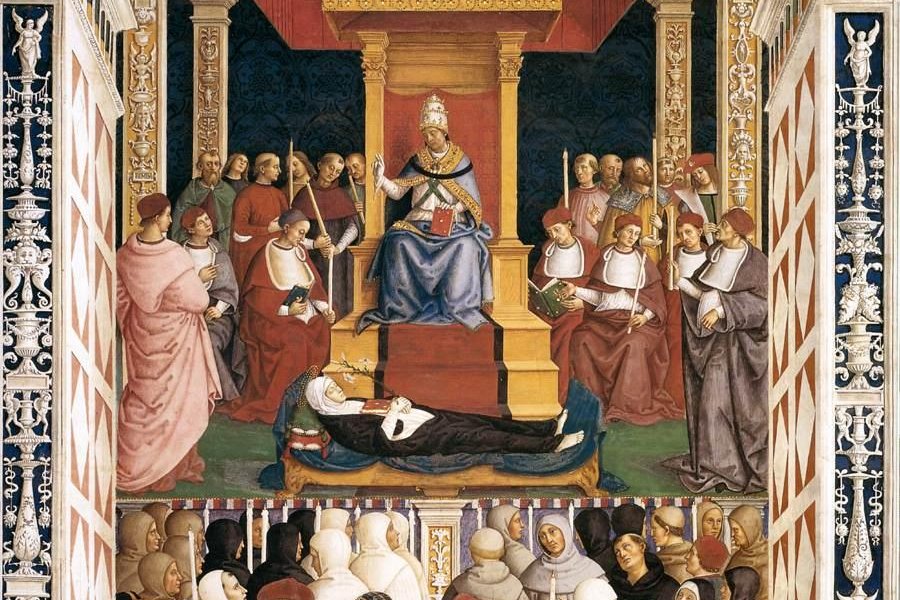
Pinturicchio, "The Canonization of Catherine of Siena," 1502-1508, Piccolomini Library, Siena Cathedral - public domain.
Once that local investigation, called the diocesan phase, gets underway, the candidate receives the title Servant of God — the first of four formal stages. This is not a verdict of holiness. It simply means the Church has agreed the person's life deserves serious, structured study. During this phase, a specialist called a postulator is appointed to gather testimony from people who knew the candidate, collect their writings, and build the documentary record — sermons, letters, diaries, medical records, whatever survives — that will eventually be sent to Rome. For a modern figure like Carlo Acutis, that meant collecting statements from schoolmates and family within living memory. For a medieval figure, it can mean sifting through centuries-old chronicles for details that were never meant to serve as legal evidence.
From Venerable to Blessed: the two miracles
When the diocesan investigation is complete, the case moves to the Congregation for the Causes of Saints in Rome, the Vatican office wholly dedicated to reviewing these claims. If its theological and historical consultors judge that the candidate lived the Christian virtues — faith, hope, charity, along with prudence, justice, fortitude, and temperance — to a "heroic" degree, the pope can declare the person Venerable. This title recognizes a life of exceptional virtue but still stops short of declaring the person is in heaven.
The next step usually requires a miracle. The Church defines a miracle here in a specific, testable sense: typically a medically inexplicable healing, attributed to the candidate's intercession, that a panel of physicians — many of them not even Catholic — cannot account for by natural means after rigorous review. If a miracle attributed to the Servant of God's intercession is confirmed, the pope declares the candidate Blessed, the stage just below sainthood. Blessed Chiara Luce Badano, an Italian teenager who died of bone cancer in 1990, reached this stage in 2010, and her cause remains open today, awaiting the second confirmed miracle required for canonization. Blessed Carlo Acutis passed through the same gate in 2020, before a second confirmed healing cleared the way for his canonization in 2025.
Martyrs generally follow a shorter path at this stage: because the Church considers dying for the faith itself to be the ultimate act of heroic witness, a miracle is usually not required for their beatification, only for the final step toward canonization.
From Blessed to Saint
The final stage requires a second confirmed miracle, occurring after the person's beatification and attributed specifically to their intercession following that beatification. Once that second miracle clears the same rigorous medical and theological review, the pope can proceed to canonization — the formal, solemn declaration that the person is a saint, is now in heaven, and may be venerated by the whole Church, not just a local diocese or religious community.
Canonization is considered by Catholic theology to fall under papal infallibility — the teaching, defined at the First Vatican Council, that the pope cannot err when solemnly proclaiming a matter of faith or morals in this exact, formal way. That weight is part of why the process is so exhaustive: a canonization is not a tribute or an honor in the way a civil award might be. It is the Church stating, as a matter of settled teaching, that a specific individual is in the presence of God and worthy of the whole Church's public veneration.
This full arc — Servant of God, Venerable, Blessed, Saint — played out on the world stage on September 7, 2025, when Pope Leo XIV canonized both Carlo Acutis and Pier Giorgio Frassati together in Rome. The pairing was deliberate: two laymen, not clergy or vowed religious, who died young and whose causes moved with unusual speed for the modern Church precisely because so much living testimony about them was still available to investigators.
Why some causes take centuries and others take decades
The five-century gap between Catherine of Siena's death in 1380 and Carlo Acutis's death in 2006 says less about the strength of their respective holiness than about the practical mechanics of building a case. Catherine's canonization in 1461, shown in Pinturicchio's fresco above, unfolded in an era before formal medical review of miracle claims and centralized Vatican record-keeping existed in their modern form; earlier medieval canonizations sometimes proceeded largely on the strength of local acclaim and a bishop's judgment. The elaborate, multi-stage system described here — postulators, medical boards, formal congregational review — developed gradually, and was significantly tightened under Pope Benedict XIV in the eighteenth century specifically to prevent premature or poorly evidenced declarations.
By contrast, a cause with abundant documentation, close-in-time witnesses, and modern medical record-keeping for verifying miracle claims can move through the same stages in a fraction of the time. That's part of why the causes of Carlo Acutis and Pier Giorgio Frassati advanced within twenty years of their deaths, while other well-known causes — including Chiara Luce Badano's, still awaiting a second miracle — remain open decades after beatification, not because the Church doubts their holiness, but because the particular evidentiary bar for that final step simply hasn't yet been cleared.
What canonization is not
It's worth being precise about what the Church is and isn't claiming at each stage, since the four titles are often used loosely in casual conversation. "Servant of God" and "Venerable" describe a life under formal investigation or judged heroically virtuous — not yet a declaration the person is in heaven. Only "Blessed" and "Saint" involve a confirmed miracle and a papal declaration of the person's place among the blessed. And devotion to a candidate at any stage before canonization, however sincere, remains a matter of personal piety rather than a practice the universal Church has formally approved — a distinction Catholic teaching is careful to maintain throughout the entire process described here.
Trivia
How many miracles does the Catholic Church require to canonize a saint?
What is a postulator, and what do they actually do?
What does 'Servant of God' mean, and is it the same as being a saint?
Can the canonization process be sped up?
Does the Church ever get a canonization wrong?
Related Reading