Saint Drogo, the Hermit Who Watched Mass Through a Wall

A boy blamed for a death he didn't cause
Drogo was born around 1105 in Épinoy, a small town in what was then French Flanders, into a noble family. His mother died giving birth to him, and by his own account passed down through tradition, the boy grew up carrying a heavy, largely self-imposed guilt for her death — a guilt that shaped nearly every decision he made as an adult. As a young man he inherited his family's estate, and rather than settle into the life of a minor nobleman, he gave it away. He took work as a shepherd in the fields around Sebourg, choosing manual labor and poverty over the comfortable position he'd been born into.
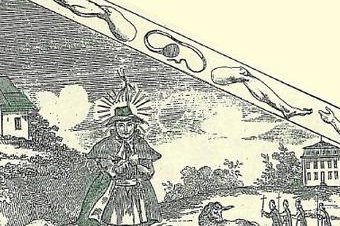
"S. Druon, priez pour nous," devotional engraving, 18th century, Wikimedia Commons — public domain.
That choice says something about the kind of penance Drogo was drawn to throughout his life: not dramatic renunciation followed by public acclaim, but quiet, physical, largely invisible labor. Shepherding in medieval Flanders was unglamorous, solitary work, and it suited a man who — according to tradition passed down in Sebourg — believed he owed a debt no comfortable life could repay.
Nine walks to Rome
Sometime in early adulthood, Drogo began a pattern that would define the middle years of his life: pilgrimage. Tradition credits him with as many as nine separate journeys on foot from Flanders to Rome, a round trip of well over a thousand miles each time, undertaken purely as an act of devotion and penance. Medieval pilgrimage of this kind was not a symbolic gesture — it meant weeks of walking on poor roads, uncertain lodging, and real physical risk, repeated again and again by a man who apparently found in the repetition itself part of the point.
It was during one of these later journeys, tradition holds, that Drogo's health broke. He developed a severe and visibly disfiguring illness — later accounts describe something like a hernia or dropsy, though the medical specifics were never recorded with any precision, since hagiography in this period cared far more about spiritual meaning than clinical detail. Whatever the exact condition, it left him in serious pain and, more significantly for how his story would be remembered, changed his appearance so dramatically that people around him reacted with open distress.
Choosing the wall over the world
Rather than continue living in public with a condition that visibly unsettled the people of Sebourg, Drogo made an unusual request: he asked to be sealed into a small cell built against the outer wall of the parish church. According to local tradition, the community obliged, constructing a narrow cell with a single opening cut through the church wall — a hagioscope, or "squint," a small angled window used in medieval churches to let people outside the main sanctuary see the altar during Mass. Through that opening, Drogo could witness the liturgy and receive the Eucharist without appearing before the congregation or exposing anyone to the sight of his illness.
He is said to have lived there for roughly forty years, subsisting on little more than barley bread and water, praying through the hours the way an enclosed monk would, but entirely alone, walled into a space barely large enough to stand in. It's a form of penance that reads, to modern eyes, as almost unbearably severe — and it is worth being honest, as this story is often told with more sentiment than precision, that no contemporary document survives describing Drogo's interior state during those decades. What has come down is the outward shape of the choice: a man who had once walked to Rome nine times over chose, in the end, to stop moving entirely, and to disappear from public view rather than to burden or frighten those around him.
A patronage built from a single, hard fact about a life
Drogo's patronages read almost like a timeline of his own biography rather than a list of unrelated causes. Shepherds and cattle come directly from the years he spent tending flocks around Sebourg. Coffeehouse keepers and innkeepers trace back, more loosely, to the tavern- and inn-keepers who fed and sheltered him along the pilgrim roads to Rome — a patronage that widened over the centuries as the hospitality trades themselves grew and diversified. And the patronage that tends to surprise people most today, that of the disfigured and the unattractive, comes directly from the illness that drove him into his cell, and from the decades he then spent choosing isolation over subjecting others to a sight he believed they couldn't bear.
That last patronage sits at an uncomfortable but honest intersection: it isn't really about appearance in the modern, casual sense of the word. It's about a man whose body had become a source of visible suffering to himself and apparent distress to others, and who responded not with bitterness but with an extreme form of self-effacement — literally removing himself from sight rather than asking his community to look away. Some later popular devotion has softened this into a gentler patronage of anyone who feels overlooked or unlovely, which is a reasonable pastoral extension but should be understood plainly as later devotional development, not something drawn directly from the medieval sources themselves.
Devotion without formal canonization
Drogo was never canonized through the kind of formal papal process that produces most of the saints venerated in the modern Church's universal calendar; his cult developed the way many early medieval saints' devotions did, through sustained local veneration in and around Sebourg that the Church came to recognize and tolerate as legitimate over the centuries, rather than through a documented canonization decree. That distinction matters for the same reason it matters with saints like Notburga: a life honored by long tradition is not automatically the same thing as a life confirmed through the Church's formal process, and being clear about which is which is part of telling any folk saint's story honestly.
What survived instead of a canonization bull was something arguably more durable: a parish that kept his memory alive for nine centuries, a wall that still marks where his cell once stood, and a name that, however strange the specific patronages might sound out of context, keeps getting invoked by exactly the people his own life touched most directly — shepherds working alone in fields, innkeepers housing travelers far from home, and anyone who has ever felt that the way they look has become the only thing other people notice about them.
Why Sebourg still remembers him
The parish church of Saint-Druon in Sebourg remains the center of his cult today, and the town still marks his April 16 feast with local observances that trace back, in some form, centuries. Unlike saints whose devotion spread quickly across whole regions or countries, Drogo's remained rooted almost entirely in the town where he lived and died — a pattern common among medieval hermit-saints, whose reputation for holiness rarely traveled as far as their relics, and whose stories survived instead through the kind of close, continuous local memory that outlasts almost anything except the place itself.
Trivia
Who was Saint Drogo?
Why is Saint Drogo the patron saint of unattractive people?
Why is Drogo connected to shepherds and coffeehouse keepers?
How did Saint Drogo live as a recluse?
What is Saint Drogo's feast day?
You May Also Like
Related Reading