Basilica of Our Lady of Aparecida

A net that came up empty, then didn't
The story begins on an ordinary fishing trip. In October 1717, three men — Domingos Garcia, João Alves, and Filipe Pedroso — were fishing the Paraíba do Sul River near the small settlement that would later take the name Aparecida, in what is now the Brazilian state of São Paulo. They had been sent out to help provide food for a passing colonial dignitary, and by their own account the river had given them nothing all day. According to the tradition passed down through the shrine, João Alves cast his net one more time and pulled up the headless body of a small clay statue of the Virgin Mary. A second cast, close to where the first had landed, brought up the missing head. When they lowered their nets a third time, the boat filled with so many fish that the men could barely manage the haul.
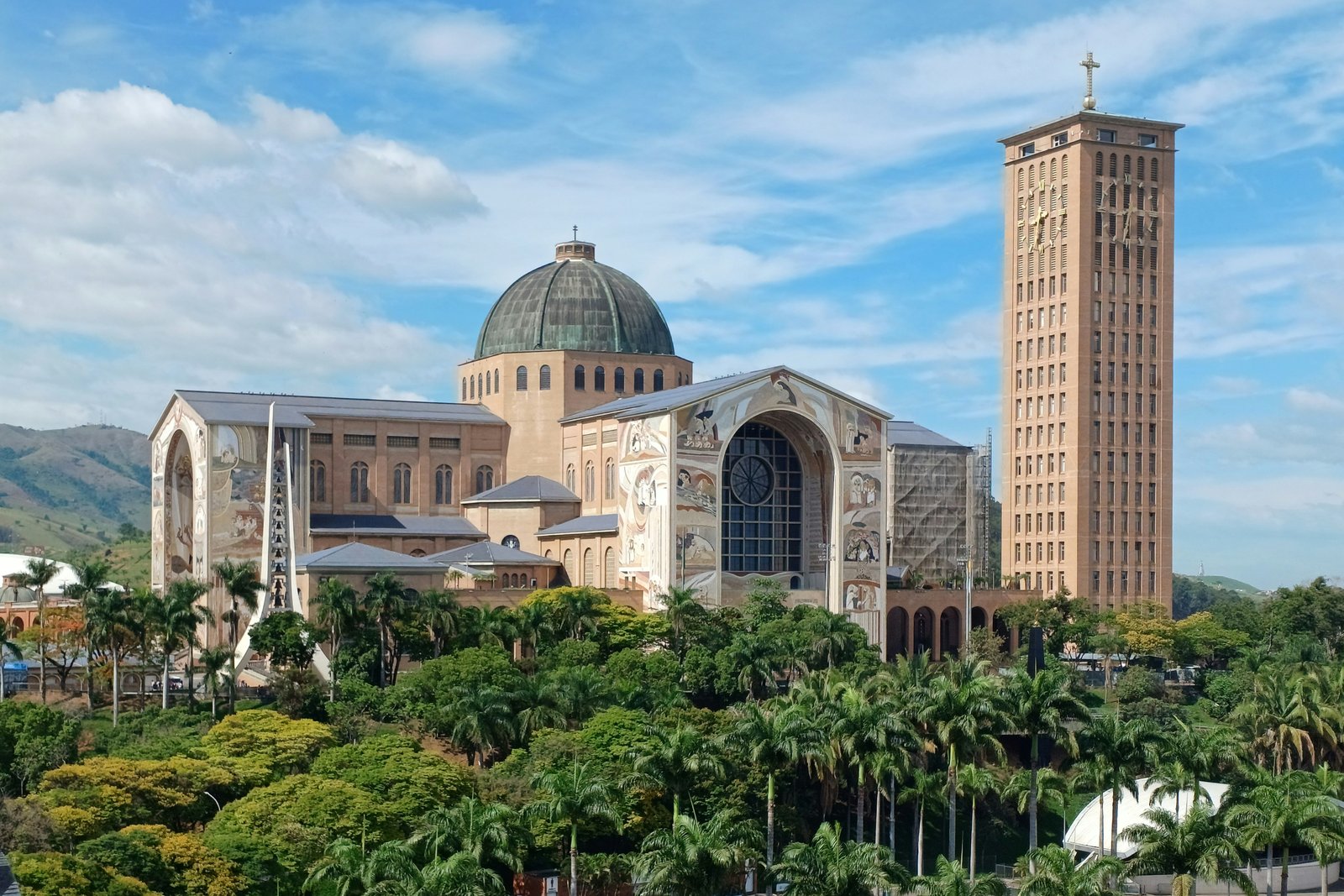
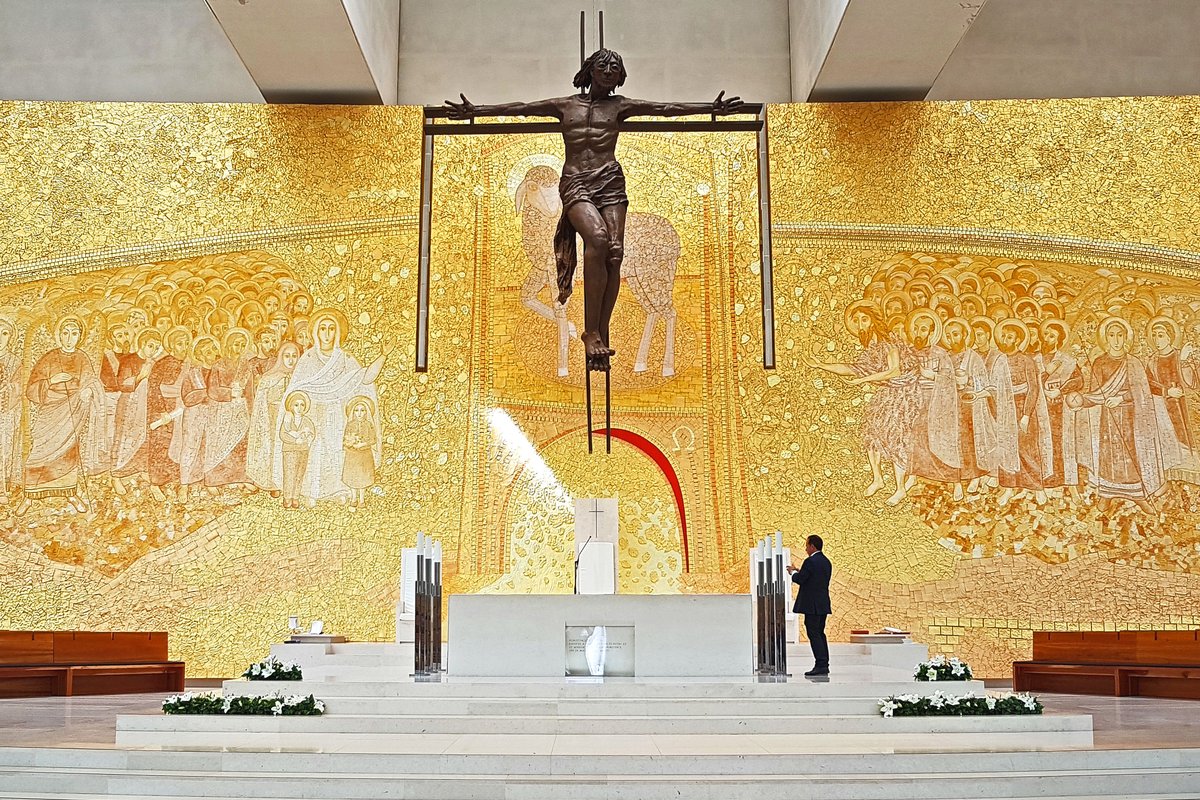
Marcos Elias de Oliveira Júnior, Santuário Nacional de Aparecida, 2025 — CC0 public domain.
That reversal — from an empty morning to an overflowing one — is the detail Brazilian tradition has held onto for three centuries. It echoes a well-known moment in the Gospels, when Jesus tells discouraged fishermen to let down their nets once more and they draw in more than they can hold (Luke 5:4-7), and the parallel has never been lost on the shrine's devotees. Whether or not the fishermen intended the echo, it gave the discovery a resonance that helped the story travel.
From a small chapel to a national shrine
The statue the men found was modest: a dark terracotta figure about 40 centimeters tall, made in a workshop style common to colonial Brazilian devotional art of the period, though its original sculptor is unknown. Local devotion grew quickly. A small oratory went up near the discovery site within a few years, and by 1745 a chapel large enough to be called a church had been built to house the image and accommodate the pilgrims who were already arriving in numbers.
Devotion to what became known as Nossa Senhora da Conceição Aparecida — Our Lady of the Immaculate Conception, "Aparecida" meaning "the one who appeared" — kept expanding through the 1800s and into the 1900s, well past what the original chapel could hold. A larger church, now referred to as the Old Basilica, was completed in the early 20th century, and it still stands near the newer complex, functioning today as a parish church. But even that building couldn't keep pace with the crowds. In 1955, construction began on a vastly larger basilica nearby, built in stages and consecrated progressively as sections were completed, with the work substantially finished by 1980. In terms of sheer capacity, it now ranks as one of the largest Catholic church buildings anywhere, second among basilicas in size only to St. Peter's in Vatican City.
A patroness who looks like the people who venerate her
In 1930, Pope Pius XI formally named Nossa Senhora Aparecida the principal patroness of Brazil, and her feast day of October 12 has since become a national public holiday, one of the few days each year when the whole country pauses for a specifically religious observance. Millions travel to the shrine that week, and millions more mark the day locally in parishes across the country.
Part of what has made the devotion so enduring is the statue's own dark coloring. The terracotta had darkened over its centuries in circulation — partly from the natural tone of the fired clay, partly from candle soot and the silt of the river it was pulled from before later cleaning and restoration. For a country whose population reflects deep Indigenous, African, and Portuguese roots, many Brazilian Catholics have come to see that dark-skinned image of Mary as one that visibly reflects the people who pray before it, rather than a European import. That sense of belonging has helped Our Lady of Aparecida become not just a national religious symbol but a genuinely popular one, invoked across lines of class and race in a way not every patronal devotion manages.
A pope's first stop outside Rome
The shrine's modern significance was underscored in a very public way in July 2013. Just months after his election, Pope Francis — who as archbishop of Buenos Aires had already visited the shrine and spoken warmly of its story — chose Aparecida as the first stop of his first international trip as pope, arriving in Brazil for World Youth Day. In his homily there, Francis returned directly to the fishermen's story, framing the statue's recovery from the river as a sign of how God works through what the world considers broken, small, or easily overlooked — themes that would become recurring notes in his papacy. The visit cemented Aparecida's place not just as a Brazilian devotion but as a shrine with recognition on the wider stage of the universal Church, much as Our Lady of Guadalupe holds a comparable place in Mexican and Latin American Catholic life.
Visiting the shrine today
The basilica complex today includes not only the main church but a wide plaza — the Passarela da Fé, or "Walkway of Faith" — designed to move the enormous crowds of pilgrim season efficiently between transit, lodging, and the church itself. Inside, the original statue is kept in a dedicated chamber above the high altar, visible to pilgrims from the nave, and a constant flow of votive offerings and ex-voto objects left by the faithful lines nearby galleries, physical testimony to favors people believe they've received through her intercession. The rhythm of Masses runs almost continuously through peak pilgrimage periods, particularly around the October 12 feast, when the plaza and surrounding town swell well beyond their normal population to receive the crowds.
For a shrine built around a small, broken object recovered by chance from a river, the scale of what grew up around it — a basilica among the largest religious buildings on earth, a national holiday, a papal visit chosen above every other possible stop — says something about how devotion in Brazil took root from the ground up rather than being handed down from a cathedral or a royal court. It remains, in a real sense, a shrine that began with fishermen and still belongs to ordinary pilgrims.
Trivia
Where was the statue of Our Lady of Aparecida found?
Why is Our Lady of Aparecida shown with dark skin?
Is Our Lady of Aparecida the patroness of Brazil?
How big is the Basilica of Our Lady of Aparecida?
Did Pope Francis have any personal connection to the shrine?
Related Reading