Joseph Interprets Pharaoh's Dreams — Genesis 41

A king who couldn't sleep
Genesis 41 opens two years after the events of the previous chapter, with a simple time marker: "After a lapse of two years, Pharaoh had a dream" (Genesis 41:1, NABRE). He was standing, in the dream, by the Nile — the river that made Egyptian civilization possible, the source of every good harvest the kingdom had ever known — and watched seven fine, fat cows come up out of the water to graze. Then seven other cows followed them, "poor-looking and gaunt," and the gaunt cows devoured the fat ones whole. Pharaoh woke up, fell back asleep, and had a second dream that mirrored the first almost exactly: seven healthy ears of grain on a single stalk, swallowed by seven thin ears "scorched by the east wind" (Genesis 41:2-7, NABRE).
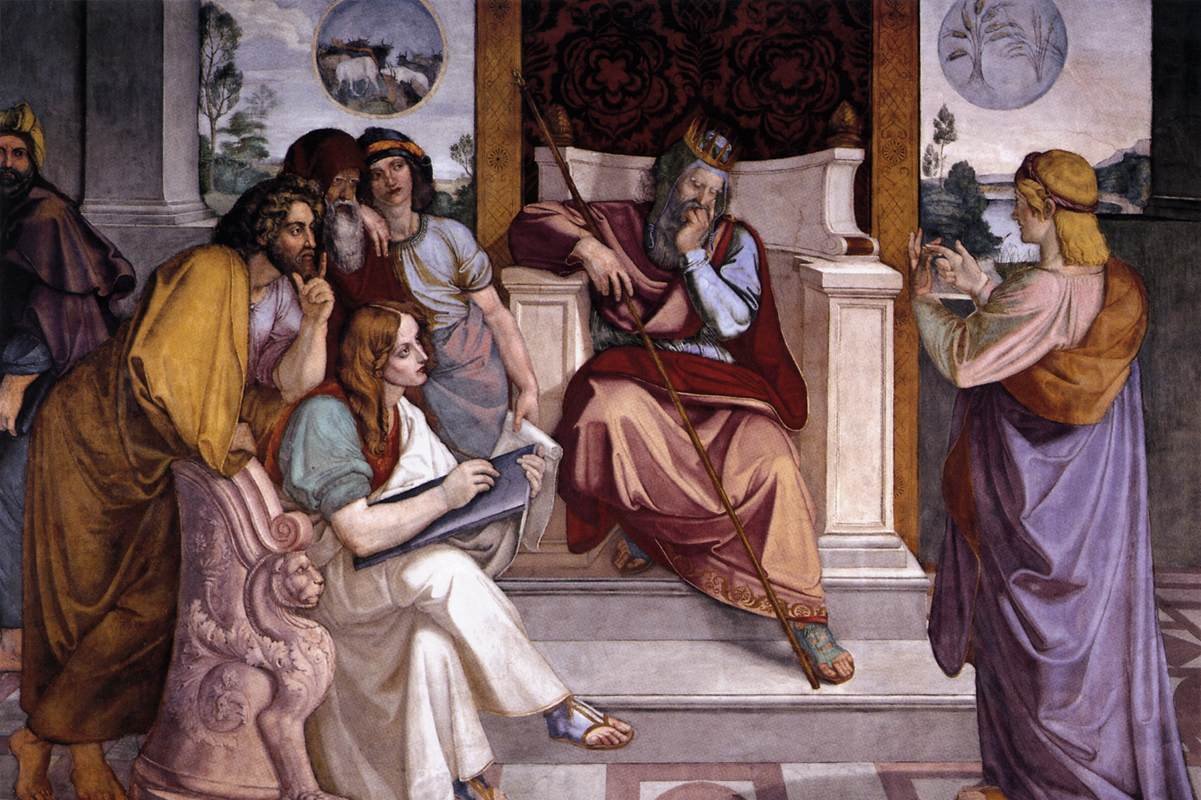
Peter von Cornelius, Joseph Interpreting Pharaoh's Dream, 1816-1817 — public domain.
Waking twice from the same disturbing message left Pharaoh shaken. "Next morning his mind was agitated. So Pharaoh had all the magicians and sages of Egypt summoned and recounted his dream to them; but there was no one to interpret it for him" (Genesis 41:8, NABRE). For a king whose court employed professional dream-readers as a matter of course, that failure was itself alarming — whatever the dream meant, it apparently exceeded what Egypt's own experts could explain.
A forgotten favor, suddenly remembered
It's the chief cupbearer — restored to his post after Joseph correctly interpreted his own dream while the two men shared a prison cell in the previous chapter of Joseph's story — who finally speaks up. "Now I remember my negligence!" he says, and tells Pharaoh about the Hebrew prisoner who had read both his dream and the chief baker's dream with total accuracy, down to the fate of each man (Genesis 41:9-13, NABRE). It's a detail worth noticing: the cupbearer had promised Joseph, back in prison, that he would mention him to Pharaoh — and then simply forgot, for two full years, while Joseph sat in confinement for a crime he hadn't committed. Only Pharaoh's own crisis jogs the memory that Joseph's freedom, and eventually his own family's survival, would come to depend on.
Once mentioned, Joseph is summoned immediately. "Pharaoh therefore had Joseph summoned, and they hurriedly brought him from the dungeon. After he shaved and changed his clothes, he came to Pharaoh" (Genesis 41:14, NABRE). The speed of the scene is part of the drama — a man goes from prisoner to standing before the most powerful ruler in the region in the space of a single verse.
"It is not I, but God"
Pharaoh's opening line to Joseph carries real weight: "I had a dream but there was no one to interpret it. But I hear it said of you, 'If he hears a dream he can interpret it'" (Genesis 41:15, NABRE). It would have been easy for Joseph, standing freshly cleaned-up before a king after years of slavery and imprisonment, to let that reputation stand unchallenged. He does the opposite. "It is not I," Joseph replied to Pharaoh, "but God who will respond for the well-being of Pharaoh" (Genesis 41:16, NABRE). It's a pattern that runs through the whole Joseph narrative: whatever gifts he has — reading dreams, managing households, eventually managing a nation's grain supply — he consistently redirects credit away from himself and toward God, even in front of the one man in Egypt who could have any use for flattery.
One dream, told twice
After Pharaoh recounts both dreams in full, Joseph gives an interpretation that treats them as a single message rather than two separate ones: "The seven healthy cows are seven years, and the seven healthy ears are seven years — the same in each dream" (Genesis 41:26, NABRE). Seven years of extraordinary abundance are coming to Egypt, he explains, to be followed immediately by seven years of famine severe enough that "no trace of the abundance will be found in the land because of the famine that follows it" (Genesis 41:31, NABRE). The fact that Pharaoh dreamed the same message twice, in two different images, is itself significant to Joseph: "That Pharaoh had the same dream twice means that the matter has been confirmed by God and that God will soon bring it about" (Genesis 41:32, NABRE).
Joseph doesn't stop at interpretation, either — he moves straight into practical advice Pharaoh hadn't asked for, urging him to appoint a "discerning and wise man" to organize the storage of grain during the years of plenty so Egypt would have reserves when the famine came (Genesis 41:33-36, NABRE). It's a small but telling shift: Joseph isn't simply explaining a vision, he's already thinking about how to survive what it predicts.
From prisoner to second-in-command, in one afternoon
Pharaoh's response is immediate and total. "Since God has made all this known to you," he tells Joseph, "there is no one as discerning and wise as you are... Look, I put you in charge of the whole land of Egypt" (Genesis 41:39-41, NABRE). What follows reads almost like a coronation: Pharaoh removes his own signet ring and places it on Joseph's finger, dresses him in fine linen with a gold chain, and has him ride in the royal second chariot while attendants call out before him. "Thus was Joseph installed over the whole land of Egypt" (Genesis 41:43, NABRE). He was thirty years old — a detail Genesis notes precisely, marking just how long the road had been from the pit at Dothan to this moment.
Why the story matters beyond its plot
The chapter doesn't end with the promotion. Joseph spends the seven years of abundance doing exactly what he proposed, storing grain "like the sands of the sea, so much that at last he stopped measuring it" (Genesis 41:49, NABRE), and when the famine arrives as predicted, Egypt is the only country in the region with food to sell. "Indeed, the whole world came to Egypt to Joseph to buy grain, for famine had gripped the whole world" (Genesis 41:57, NABRE) — the line that sets up the next chapter, when Joseph's own brothers, the ones who sold him into slavery years earlier, arrive in Egypt needing exactly what he now controls.
Catholic tradition has long read Joseph's arc — betrayed by his own, unjustly imprisoned, then raised up to save the very people who wronged him and, eventually, an entire region from starvation — as a foreshadowing of Christ's own pattern of rejection followed by salvation for others. This is a long-held typological reading passed down through commentators and preachers rather than a formal doctrine the Church requires belief in, but it helps explain why Joseph's story has held such a durable place in Christian imagination far beyond its role as ancient history: a man's worst years become, through no plan of his own making, the exact preparation needed to save the people who caused them.
Trivia
What were the two dreams Pharaoh had?
How did Joseph end up being called in to interpret them?
What did Joseph say the dreams meant?
Did Joseph take credit for interpreting the dream himself?
What happened to Joseph immediately after interpreting the dreams?
Related Reading