The Basilica of Saint Paul Outside the Walls

Buried outside the city gates
Roman law, like the law governing the site that became St. Peter's, forbade burial inside the city walls. Tradition holds that the apostle Paul was beheaded near Rome during the persecution of Nero, likely in the mid-60s AD, and that Christians buried him along the Via Ostiense, the road running south toward the port of Ostia — outside the walls, on land owned by a Roman noblewoman. A modest shrine marked the grave from an early date, and by the 4th century, after Christianity's legalization, the emperor Constantine built a small basilica over the site, much as he had done at Peter's tomb across the city.
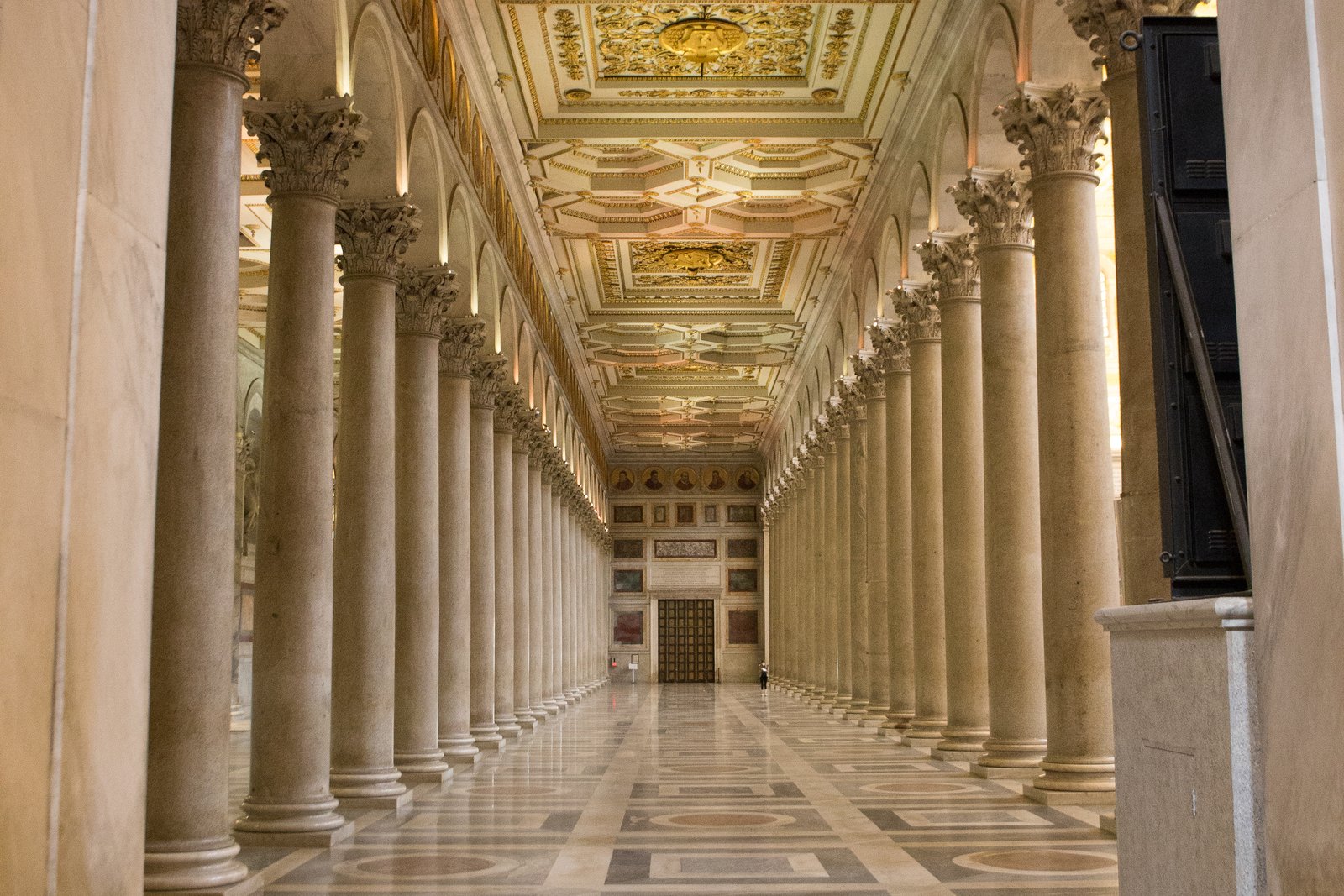
Photo by Pymouss, "Roma - Basilica di San Paolo fuori le mura," CC BY-SA 4.0, via Wikimedia Commons.
That first building didn't last as the resting place of an apostle whose reputation kept growing. Within decades, three later emperors — Valentinian II, Theodosius I, and Arcadius — jointly sponsored a vastly larger basilica, completed around 400 AD, that would remain, with periodic additions and restorations, essentially the same building pilgrims visited for the next fourteen centuries. By the Middle Ages it ranked among the largest and most venerated churches in Rome, second in prestige only to St. Peter's, and it survives in written descriptions and in a handful of surviving artworks as an extraordinary time capsule of early Christian Rome — until a single night in 1823 changed everything.
The fire of 1823
The details are almost mundane for how much was lost: a workman repairing the lead sheeting on the roof left embers unattended as he finished his shift on July 15, 1823. Overnight, the fire spread through the ancient wooden roof trusses and consumed nearly the entire basilica, leaving little more than the apse, the triumphal arch, and a few chapels standing among the ruins. Pope Pius VII, gravely ill, was reportedly never told the full extent of the damage before his death weeks later — his advisors feared the news might hasten it.
What followed was one of the 19th century's great works of architectural restoration, treated less as a renovation than as an act of religious duty. Pope Leo XII and his successors launched an international fundraising effort, drawing donations from Catholic rulers and communities around the world, including gifts of alabaster from the Ottoman viceroy of Egypt and malachite and lapis lazuli columns from Tsar Nicholas I of Russia — a rare moment of ecumenical cooperation on a project meant to recover something the whole Christian world recognized as a loss. Reconstruction followed the footprint and general design of the destroyed basilica as closely as records allowed, and the rebuilt church was formally consecrated by Pope Pius IX in 1854, more than thirty years after the fire.
What survived the flames
Not everything was lost. The triumphal arch at the front of the nave, decorated with 5th-century mosaics donated by the Roman noblewoman Galla Placidia, survived largely intact and remains one of the oldest and most significant works of art in the building today, depicting Christ enthroned among symbols of the four evangelists. The adjoining Benedictine cloister, built in the 13th century in the distinctive Cosmatesque style — inlaid geometric patterns of colored stone and glass characteristic of medieval Roman workshops — also escaped the fire almost entirely and is considered one of the finest surviving examples of its kind anywhere in Italy.
Inside the rebuilt nave, visitors walk beneath a continuous band of mosaic portrait medallions depicting every pope in the Church's history, arranged in unbroken sequence along the upper walls — a tradition maintained and extended since medieval times. A popular story, impossible to verify and almost certainly more legend than prophecy, holds that when the frieze finally runs out of space for a new portrait, the world will end; in practical terms, the space was extended during the 19th-century reconstruction specifically to accommodate centuries more popes, which rather undercuts the drama of the tale.
What lies beneath the altar
The most significant confirmation of the basilica's ancient claim came not from restoration work but from archaeology. In 2006, Vatican archaeologists completed excavations beneath the high altar and uncovered a large marble sarcophagus, dated to at least the 4th century, bearing the Latin inscription "PAULO APOSTOLO MART" — "Paul, Apostle and Martyr." The sarcophagus itself has not been opened for full scientific examination, but researchers were able to insert a probe and identified traces of bone, incense, and fabric consistent with an ancient burial. As with the traditional identification of Peter's remains at St. Peter's Basilica, the Church treats this as strong supporting evidence for a very old tradition rather than a closed scientific case — a distinction worth holding onto, since faith in Paul's burial here long predates any archaeological confirmation and does not depend on it.
Above the tomb rises a 13th-century Gothic ciborium — a canopy structure over the altar — created by the sculptor Arnolfo di Cambio, one of the relatively few medieval artworks in the basilica to survive the 1823 fire relatively unscathed, offering a visible link to the church's centuries as a medieval pilgrimage site before its 19th-century rebirth.
One of Rome's four papal basilicas
Saint Paul Outside the Walls holds a rank shared by only three other churches in the world: it is one of Rome's four papal major basilicas, alongside St. Peter's, the Archbasilica of St. John Lateran, and St. Mary Major — a distinction rooted in ancient tradition and formalized over centuries of Church practice. Like the other three, it has its own Holy Door, ceremonially sealed shut and opened only during Jubilee years, and pilgrims who pass through all four doors during a Jubilee traditionally complete one of the oldest devotional circuits in the Catholic world. For a fuller look at what that status means and how the four churches relate to one another, see The Four Papal Basilicas of Rome.
The apostle honored here spent his ministry, by his own account, enduring shipwrecks, imprisonments, and constant travel to spread the Gospel across the Mediterranean world, writing near the end of his life that he had "fought the good fight," had "finished the race," and had "kept the faith" (2 Timothy 4:7, RSV-CE). A basilica rebuilt from ashes to stand once more above his traditional grave carries an echo of that same persistence — a monument that has itself, in its own much smaller way, fought through destruction and finished its own long restoration.
Trivia
Why is it called Saint Paul Outside the Walls?
Is this one of the four papal major basilicas of Rome?
How much of the current building is original?
What is inside the tomb beneath the high altar?
What are the portrait medallions running around the nave?
Related Reading