Jasna Góra Monastery, Częstochowa

A monastery built for an icon
Jasna Góra sits on a low hill on the edge of Częstochowa, a city in southern Poland, and its name — Polish for "Bright Hill" or "Bright Mountain" — describes both its physical setting and, Poles would say, its spiritual character. The monastery was founded in 1382 by Pauline monks invited from Hungary by a local nobleman, Władysław, Duke of Opole, specifically to house and care for an icon of Mary that had come into his possession. That icon, now known worldwide as the Black Madonna, has remained at the center of the site for over six hundred years, and the monastery grew up entirely around the task of housing, protecting, and venerating it.
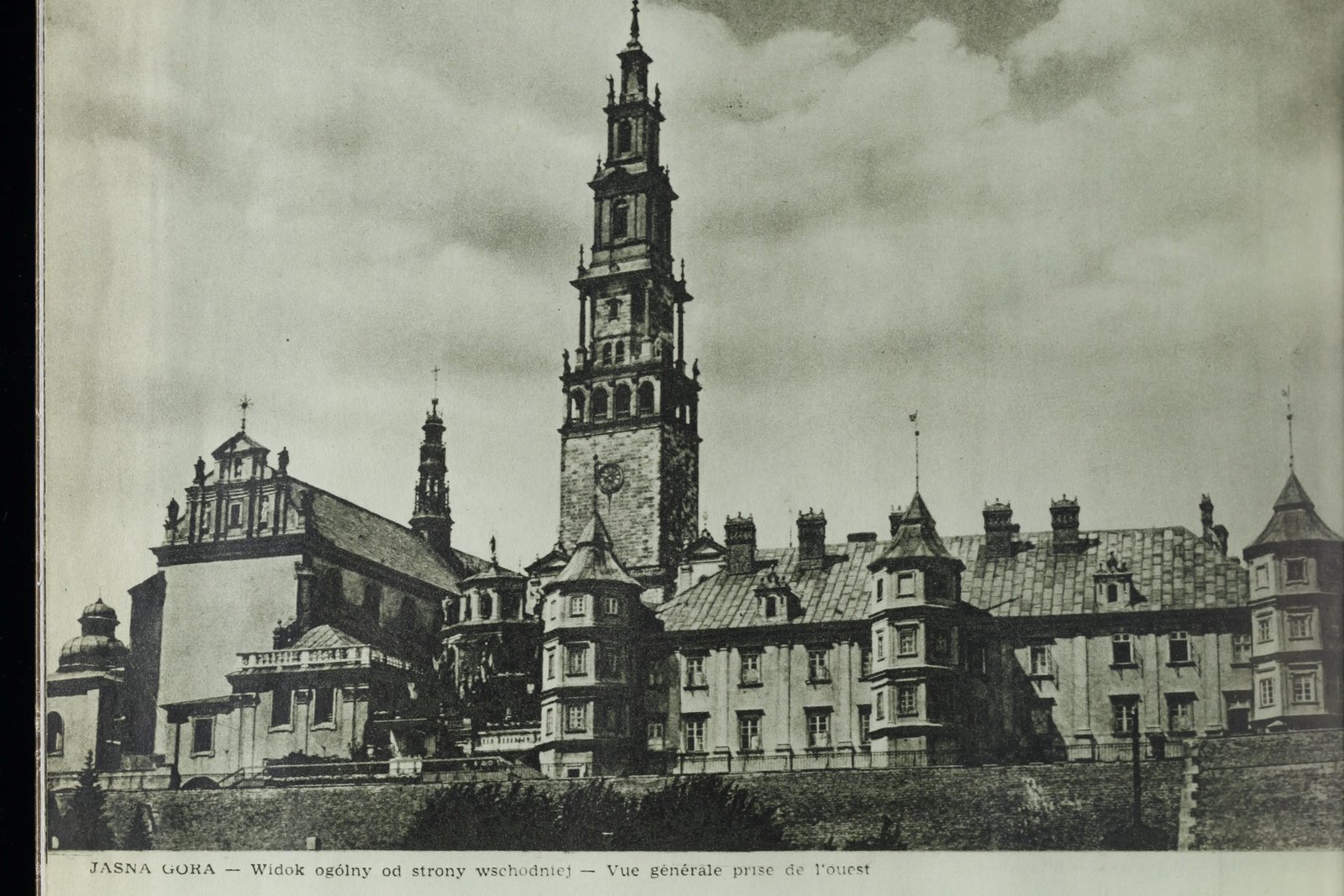
Photograph of Jasna Góra monastery, published 1948 — public domain.
The painting itself shows Mary holding the infant Jesus, rendered in the formal, symbolic style typical of Byzantine icons rather than the more naturalistic Western religious art most visitors expect. Popular tradition attributes the original image to Saint Luke the Evangelist, painted, according to legend, on a tabletop from the Holy Family's own home in Nazareth — a pious tradition, not a claim the Church treats as historically verified. Art historians who have studied the surviving panel generally date it to the Byzantine world, likely somewhere between the 6th and 9th centuries, with the painting restored and repainted multiple times across its long history, meaning the image visitors see today is a much-layered object rather than a single untouched original.
The scars that were never erased
The most striking physical detail of the icon is also its most debated: two parallel slashes cut across Mary's right cheek, alongside several smaller marks elsewhere on the panel. The most commonly repeated explanation ties the wounds to a violent raid on the monastery in 1430, when Hussite-associated raiders or bandits — accounts differ on the precise identity of the attackers — looted the site and, according to tradition, one of them slashed the painting with a sword before his horse reportedly threw him in apparent divine retribution, a detail that reads more as pious legend than verified history.
What can be said with more confidence is what happened next: royal court painters were brought in afterward to restore the damaged panel, and multiple accounts, again resting on tradition rather than documented certainty, describe the slash marks reappearing through repeated attempts to fully repaint over them. Whatever the precise history, the marks have remained visible on the icon ever since, and the monastery has never attempted to fully erase them — a deliberate choice that has turned an act of violence into part of the image's identity, a visible reminder, the way the faithful see it, of both suffering endured and endurance itself.
The siege that made Jasna Góra a national symbol
Jasna Góra's reputation as more than a religious site — as a symbol of Polish national survival — was forged during a single dramatic episode in 1655. That year, Sweden invaded the Polish-Lithuanian Commonwealth in a devastating campaign Poles still refer to as "the Deluge" (Potop), overrunning most of the country within months. Jasna Góra, fortified but lightly garrisoned, became one of the few points of organized resistance left standing. A defending force numbering only a few hundred, led by the monastery's prior, Augustyn Kordecki, held out against a much larger besieging Swedish army for roughly forty days before the siege was lifted.
The successful defense, still celebrated in Polish memory, became a rallying point that helped turn the tide of the wider war and cemented Jasna Góra's place at the emotional center of Polish national identity. In its aftermath, King Jan II Kazimierz made a formal vow before the icon in 1656, dedicating the entire Polish nation to Mary's protection under the title "Queen of the Crown of Poland" — a title still used in Polish Catholic devotion today, and a direct historical line from a single successful siege to a national religious identity that has outlasted partitions, occupations, and the officially atheist Communist government of the 20th century, which never managed to sever Poles' devotion to the shrine no matter how it tried.
A shrine that outlasted an empire
Jasna Góra's significance didn't fade with the centuries — if anything, the 20th century added another layer to its story. Under Communist rule after the Second World War, when the state actively discouraged and at times persecuted public religious expression, Jasna Góra remained one of the very few places where enormous public gatherings with an explicitly religious and implicitly political character could still take place largely unhindered, drawing pilgrims by the hundreds of thousands for major feast days. Cardinal Stefan Wyszyński, the Primate of Poland, used the shrine as a center of quiet, persistent resistance to state pressure on the Church throughout his long tenure.
Karol Wojtyła — later Pope John Paul II — grew up with this same devotion woven through Polish Catholic life, and as pope he returned to Jasna Góra repeatedly during his pastoral visits to his homeland, speaking often and personally about what the shrine meant to him. His close friend and fellow Pole Saint Faustina Kowalska belonged to the same broader current of 20th-century Polish Marian and devotional spirituality that made shrines like Jasna Góra central to national religious life, even as her own Divine Mercy devotion, centered at Łagiewniki in Kraków, developed as its own distinct pilgrimage tradition elsewhere in Poland.
What draws pilgrims today
Today, Jasna Góra remains Poland's principal site of Catholic pilgrimage, drawing several million visitors a year, with the largest crowds arriving for the Feast of the Assumption on August 15 and for an annual walking pilgrimage from Warsaw that has run for centuries, in which pilgrims cover the roughly 140-mile route on foot over several days. The monastery complex itself has grown well beyond its medieval origins into a fortified compound of churches, chapels, a treasury museum, and monastic buildings, all still organized around the same small icon that first brought Pauline monks to this hill in the 14th century.
For Catholics devoted to Mary under her many titles and depictions across the world — from Our Lady of Guadalupe to Our Lady of Fátima — the Black Madonna of Częstochowa stands as one of the most historically layered: an ancient icon, physically scarred by real violence, credited by generations of Poles with real historical deliverance, still standing watch from the same hillside after more than six centuries.
Trivia
What is Jasna Góra, and where is it located?
What is the Black Madonna of Częstochowa?
How did the icon get the scars on its face?
What happened during the Swedish siege of 1655?
Did Pope John Paul II have a personal connection to Jasna Góra?
Related Reading