The Creation of Light — "Let There Be Light"

A command, not a construction
Genesis doesn't open with God building anything. It opens with a description of absence: "the earth was without form or shape, with darkness over the abyss and a mighty wind sweeping over the waters" (NABRE, Genesis 1:2). No light, no shape, no order — just a formless deep and, hovering over it, that "mighty wind," which many translations render as the spirit or breath of God, already present at the edge of nothing.
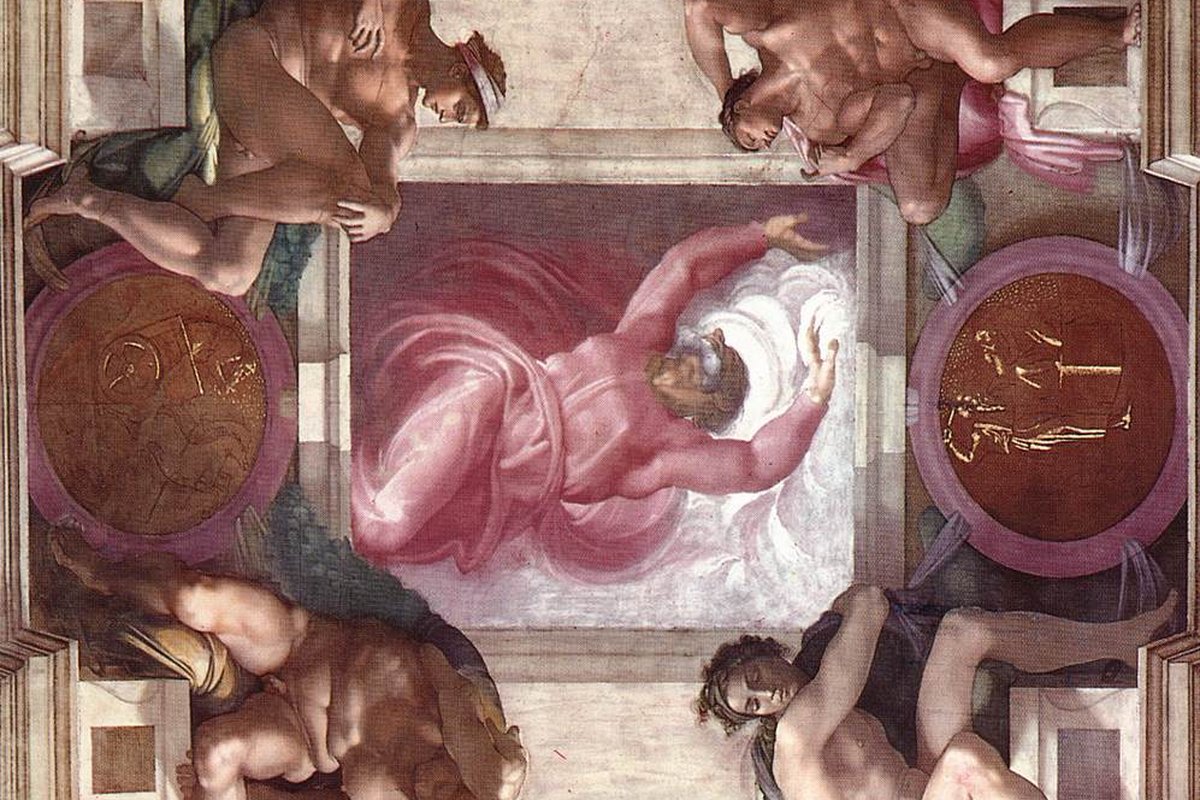
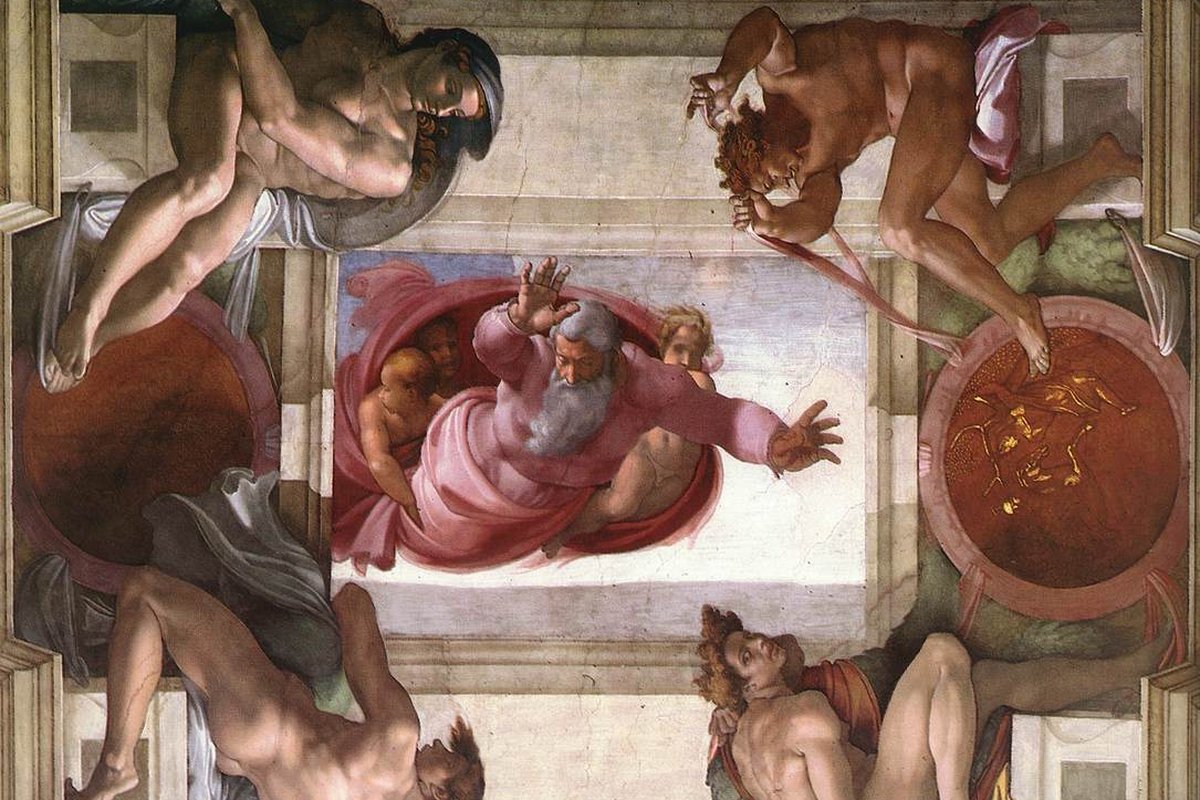
Michelangelo, "Separation of Light from Darkness," 1512, Sistine Chapel ceiling, Vatican — public domain.
Into that emptiness comes the first line of dialogue in the entire Bible: "Then God said: Let there be light, and there was light" (NABRE, Genesis 1:3). There's no effort described, no material, no process. The text doesn't say God made light the way a craftsman makes an object. He speaks, and the thing simply exists. Theologians have long pointed to this as the clearest example in Scripture of what's called creatio ex nihilo — creation from nothing at all — accomplished by the sheer authority of a divine word.
Early Christian commentators made a great deal of that gap between speaking and making. Saint Augustine, writing centuries later in his Confessions, treated this opening command as proof that God's will and God's action are simply the same act — that for God, to speak is to accomplish, with no interval between the two the way there is for any human maker. Augustine also wrestled at length with what it could mean for time itself to begin alongside this first act of creation, since "before" and "after" only become meaningful once something exists for them to describe. That's part of why the text moves immediately from the command itself to the counting of days: the first "evening" and "morning" aren't just scene-setting, they're the beginning of time as a measurable thing, introduced in the same verse as the light that will define what a day even is.
Why the order matters
Readers have noticed for centuries that light shows up on day one, while the sun, moon, and stars aren't created until day four (Genesis 1:14-19). Genesis isn't written as a scientific account of physical processes, and its ancient audience wasn't asking the same questions modern readers bring to it. What the sequence does accomplish is theological: light itself — not any particular light-source — belongs to God directly, prior to and independent of the great lights that will later govern day and night. The sun doesn't own daylight in this account; God does, and the sun is simply appointed to it afterward.
This also sets up a quiet argument running under the surface of the whole chapter. Many of the peoples surrounding ancient Israel worshiped the sun itself as a god — the Egyptians venerated Ra, and Mesopotamian religion gave the sun-god Shamash a central place in its pantheon, to name just two of Israel's nearer neighbors. By placing light before the sun and describing the sun on day four as something made, put in place to "govern the day and the night" (Genesis 1:18) rather than as a deity in its own right, the text pushes back on that worldview from its very first page. It's a demotion delivered almost in passing: the very object entire empires built temples to is reduced here to something closer to a lamp fixture, hung in place after the fact by a God who had already been producing light without it.
Good, and then separated
After the light appears, the text adds a small but important detail: "God saw that the light was good" (NABRE, Genesis 1:4). This is the first of seven times the word "good" appears across the creation account, a refrain that builds toward the summary verdict in Genesis 1:31 — "God looked at everything he had made, and found it very good." Goodness, in other words, isn't a later verdict tacked onto creation. It's built in from the very first thing spoken into being.
God then "separated the light from the darkness" (Genesis 1:4) and gives both a name: "God called the light 'day,' and the darkness he called 'night'" (NABRE, Genesis 1:5). The chapter closes its first day with a phrase that will repeat six more times, marking the rhythm of the whole account: "God called the light “day,” and the darkness he called “night.” Evening came, and morning followed—the first day." (Genesis 1:5).
An opening line that echoes forward
"Let there be light" — famously rendered Fiat lux in the Latin Vulgate — has become one of the most quoted lines in Western literature and art, far beyond its original context, precisely because of what it dramatizes: order emerging from chaos through nothing but a word. The Gospel of John seems to deliberately echo this opening when it begins its own account of Christ with "In the beginning was the Word" (John 1:1), tying the spoken light of Genesis to the person of Jesus described later in the same chapter as "the light of the human race" (John 1:4) — a connection that has shaped Christian reflection on this single verse for two thousand years.
Artists have returned to this exact moment for centuries, usually finding it a difficult scene to actually paint, since there's no landscape, no figure, and no action beyond a single divine gesture. Michelangelo's solution on the Sistine Chapel ceiling, pictured at the top of this article, shows God alone in a swirl of drapery, physically dividing light from darkness with his own outstretched arms — turning an abstract act of speech into something closer to a wrestling match, one of the few times in the whole ceiling cycle that God appears without any other figures sharing the frame. That isolation is itself a kind of commentary: unlike the later creation scenes, where Adam and Eve share the canvas with their creator, this first act happens with no one else yet in existence to witness it.
The phrase also carries a long afterlife in mottos and iconography that have nothing directly to do with theology: several universities, including Yale and the University of California, adopted "Fiat lux" or close variants as institutional mottoes, borrowing the phrase's association with knowledge dispelling ignorance rather than its original cosmological meaning. That secondary life is worth noting precisely because it shows how far a single four-word command has traveled from a description of the days before there was a sun. For readers curious how other Old Testament visions of divine glory and light relate to this opening scene, this blog's article on Isaiah's vision of the heavenly throne explores a related, later image of overwhelming divine radiance.
For a scene with almost no action in it — no characters, no dialogue but one line — the creation of light carries an outsized theological weight. It's the moment the text chooses to open with, ahead of land, plants, animals, or humanity itself: before anything else exists, there is a voice, and there is light answering it.
Trivia
What does Genesis 1:1-5 actually say happened on the first day of creation?
Why does light appear on day one when the sun isn't created until day four?
Is 'Let there be light' a direct quotation from the Bible?
Why does God name the light and the darkness in verse 5?
Related Reading