The Seven Heavenly Virtues Explained


Two lists that became one
The phrase "seven heavenly virtues" describes a pairing of two separate classical lists that Christian tradition eventually fused into a single framework: the four cardinal virtues and the three theological virtues. They didn't originate together. The cardinal virtues trace back to Greek philosophy, especially Plato, who identified wisdom, courage, moderation, and justice as the essential qualities of a well-ordered soul centuries before Christianity existed. The theological virtues, by contrast, come directly from Christian Scripture — most explicitly from Saint Paul's letter to the Corinthians. Catholic moral theology, worked out most thoroughly by Saint Thomas Aquinas in the thirteenth century, took both lists and treated them as complementary halves of a single complete picture of virtue: what human reason and effort can build, and what only God's grace can supply.
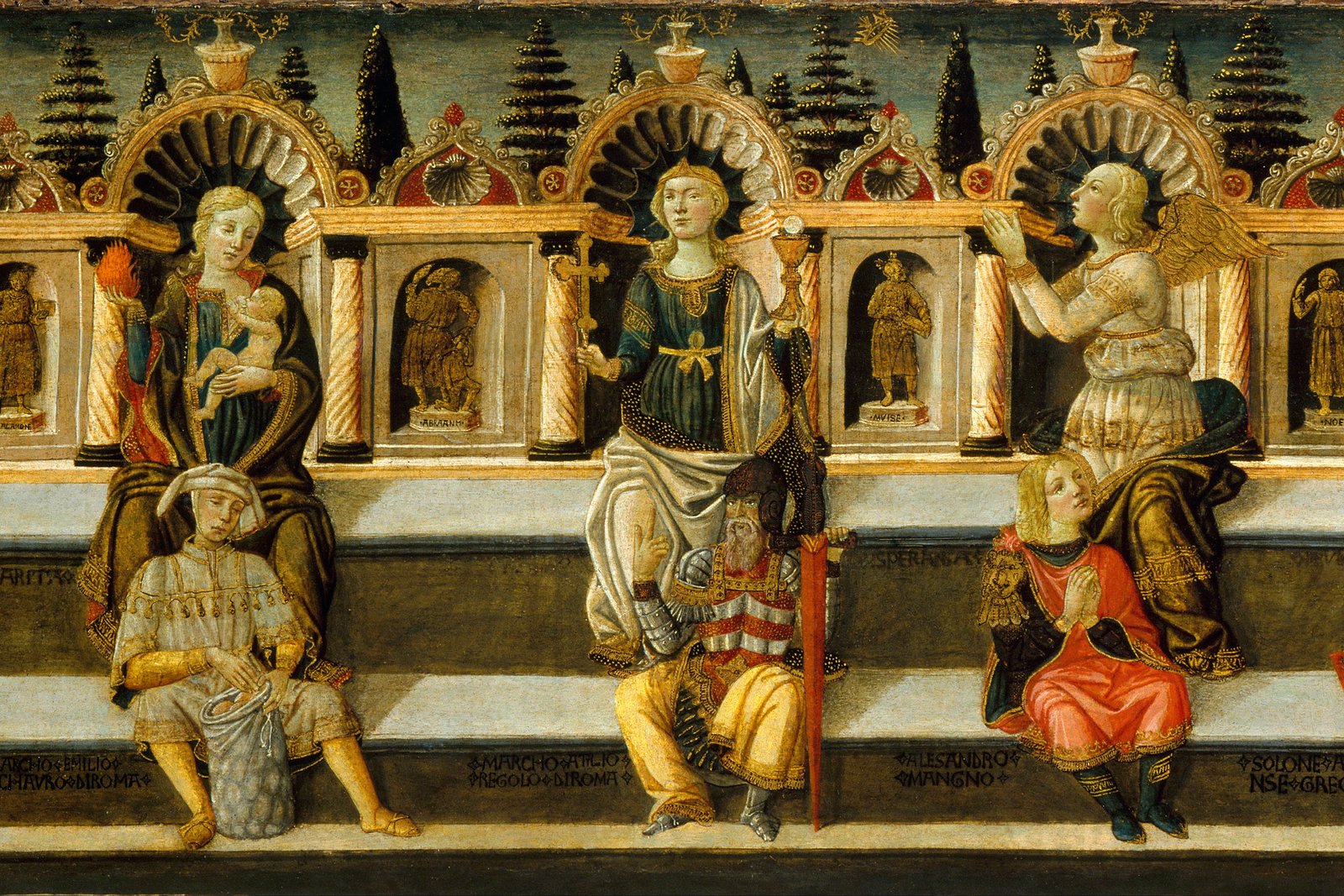
Anton Francesco dello Scheggia, The Seven Virtues, circa 1465-1470, private collection - public domain.
The Catechism of the Catholic Church still organizes its teaching on virtue exactly along this line, treating the cardinal virtues (1805-1809) and the theological virtues (1812-1829) as two distinct but connected sections of the same larger discussion.
The four cardinal virtues
The word "cardinal" comes from the Latin cardo, meaning "hinge" — the Catechism explicitly describes these four as the hinges on which the rest of a moral life turns (CCC 1804). Unlike the theological virtues, these four are considered acquirable through practice, habit, and the ordinary exercise of human reason, even by someone without explicit religious faith.
Prudence is the virtue of practical wisdom — the ability to judge correctly, in a given real situation, what the genuinely good action actually is, and to choose it. The Catechism calls it the "charioteer of the virtues," because it guides how the other three get applied in practice (CCC 1806).
Justice is the constant, firm will to give another person what is rightly due to them — toward God, and toward one's neighbor. It's the virtue that governs fairness in relationships, contracts, and the ordering of a whole society, not just individual disputes.
Fortitude is courage in the pursuit of good, especially the strength to remain firm in the face of difficulty and to persevere in seeking what is right even under pressure, fear, or temptation to give up.
Temperance moderates the pull of pleasure and desire, keeping a person's use of created goods within reasonable balance rather than letting appetite rule. It's the cardinal virtue most directly opposed to gluttony and other excesses catalogued among the seven deadly sins.
The three theological virtues
The theological virtues stand apart from the cardinal four in a specific, important way: Catholic teaching holds that they cannot be developed by habit or willpower alone. They "relate directly to God," as the Catechism puts it, and are "infused by God into the souls of the faithful to make them capable of acting as his children" (CCC 1813) — in other words, they're understood as a gift of grace rather than an achievement.
Faith is the virtue by which a person believes in God and freely assents to everything God has revealed. It is trust that goes beyond what can be proven by reason alone, though Catholic teaching holds that faith and reason are not in conflict — see the Holy Trinity explained for one example of a central mystery of faith that reason can illuminate without fully resolving.
Hope is the desire for eternal life and the kingdom of heaven, together with trust in Christ's promises and reliance on the help of the Holy Spirit rather than on one's own strength alone. It is the virtue most directly tested by suffering, since it holds firm to a future good even when present circumstances give little natural reason for optimism.
Charity, sometimes simply translated as love, is named by Saint Paul as the greatest of the three: "So faith, hope, love abide, these three; but the greatest of these is love" (1 Corinthians 13:13, RSV-CE). Catholic tradition understands charity as loving God above all things, and loving one's neighbor as oneself, for the sake of love of God — the virtue that gives shape and motive to all the others.
Why the pairing with the seven deadly sins isn't exact
Because seven virtues and seven deadly sins sit so neatly side by side in popular imagination, it's easy to assume each virtue directly cancels out one specific sin — humility undoing pride, generosity undoing greed, and so on. That one-to-one pairing does exist in Christian tradition, but as a separate, later list altogether, usually called the Seven Contrary Virtues: humility, generosity, chastity, meekness, kindness, temperance, and diligence, each matched deliberately against one of the seven capital sins.
The seven heavenly virtues discussed here — four cardinal, three theological — are an older and structurally different classification, organized around the sources and nature of virtue itself rather than around opposing specific vices. Both lists are authentically part of Catholic moral tradition, and the overlap between them (temperance appears on both) is a useful reminder that these are complementary lenses on the same moral life, not rival or contradictory systems.
Living examples, not abstractions
Catholic tradition rarely leaves virtue as pure theory — it points to lives that embodied it. Saint Francis of Assisi is often held up as a model of temperance and radical simplicity; Saint Joan of Arc is invoked constantly as an example of fortitude under extraordinary pressure; Saint Thérèse of Lisieux built an entire spirituality, her "Little Way," around ordinary daily acts of charity. That pattern is deliberate: the Catechism's whole discussion of virtue treats these qualities not as abstract philosophical categories to be memorized, but as habits meant to be practiced, tested, and gradually built into a life — the same slow, practical work the saints themselves are remembered for having done.
Trivia
What are the seven heavenly virtues?
What is the difference between the cardinal virtues and the theological virtues?
Why is it called 'cardinal' virtue?
Do the seven heavenly virtues directly cancel out the seven deadly sins one-for-one?
Where does the Bible mention faith, hope, and charity together as a set?
Related Reading