Our Lady of Czestochowa: The Black Madonna of Jasna Gora

A painting older than its own legend
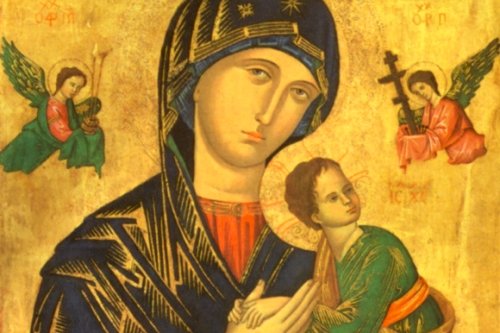
Walk into the chapel at Jasna Gora Monastery in Czestochowa, Poland, today, and you'll find a dim room, a wall of silver votive offerings, and a dark, time-worn panel behind glass that pilgrims have been kneeling before for over six hundred years. The image shows the Virgin Mary in the traditional "Hodegetria" pose used throughout Orthodox and Byzantine iconography — she gestures toward the Christ Child in her arms rather than at herself, a visual way of saying that she points the way to him rather than to herself. He, in turn, holds a book of the Gospels and raises his right hand in blessing. Both figures wear robes patterned with small golden fleur-de-lis, and both have faces darkened to a deep brown-black that gave the icon its enduring popular name: the Black Madonna.
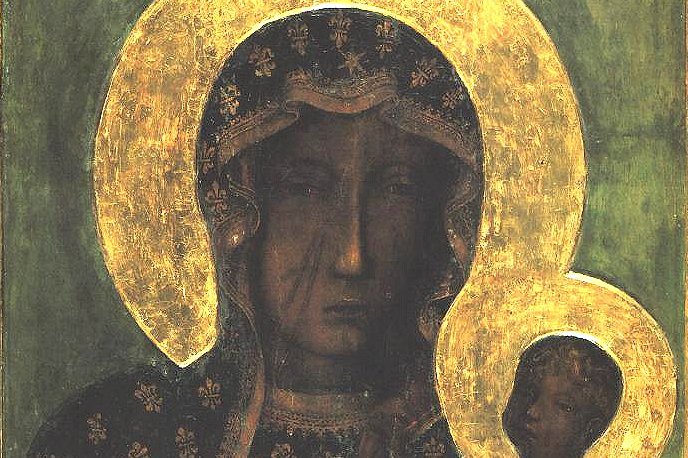
Anonymous, Czestochowska (icon of Our Lady of Czestochowa), photograph of the traditional image. Public domain, via Wikimedia Commons.
The most familiar story about this painting's origin is also the one with the least historical footing, and it's worth being upfront about that distinction. Tradition holds that the Evangelist Luke painted the image himself, using a cedar tabletop taken from the home of the Holy Family in Nazareth, and that Saint Helena — mother of the Roman emperor Constantine, famous for her own fourth-century search for relics of the True Cross — later discovered the panel in Jerusalem and carried it to Constantinople. It's a beautiful legend, and a durable one, repeated by generations of pilgrims and still printed in devotional literature today. But art historians who have physically examined the panel describe something different: a painting technique and style consistent with Byzantine icon-making of roughly the sixth to ninth century, which would place its true origin many centuries after Luke's own lifetime. The icon's defenders at Jasna Gora acknowledge this scholarly dating themselves — the Lucan story survives as pious tradition, not as a claim the Church asks anyone to accept as documented fact.
From Belz to a mountain in Poland
What can be traced with more confidence is the painting's arrival in Poland itself. The earliest Jasna Gora records describe the icon traveling west from Constantinople through Belz, a town then on the eastern edge of the Polish-Hungarian world, where it came into the hands of Władysław, Duke of Opole — a nobleman serving as an adviser to Louis of Anjou, king of both Poland and Hungary. According to the monastery's own telling, Władysław was passing near Czestochowa in August 1382 (some sources give 1384) when his horses abruptly refused to go any farther. That night, the story goes, he was told in a dream to leave the icon on the hill known as Jasna Gora, meaning "Bright Mountain." He did, and entrusted its care to the Pauline Fathers, a monastic order he had brought from Hungary — the same community of monks who still keep the shrine today.
The fleur-de-lis pattern on the Virgin's robe, incidentally, isn't just decoration. Historians connect it to the French-descended Angevin dynasty that ruled both Hungary and Poland at the time the icon made its journey west, suggesting the symbol was likely added by the Hungarian Pauline monks themselves before the painting ever reached Czestochowa.
The scars that were never erased
The event that did the most to shape how people look at this image happened less than fifty years after it arrived. On April 14, 1430, raiders — commonly identified with the Hussites, the religious-reform movement then unsettling much of Central Europe — broke into Jasna Gora and attacked the icon directly, cracking the wooden panel and slashing the painted surface, including the Virgin's face. Monastery restorers set about repairing it, but medieval chroniclers recorded an odd technical problem: the new paint applied over the damaged sections kept failing to hold, reportedly because the original image had been done in an encaustic technique (a method using pigment mixed with heated wax) that ordinary tempera paint couldn't properly bond to. The eventual solution was to repaint the entire face, which is part of why art historians can't simply date the visible image to its true original century — what viewers see today is largely a 15th-century restoration layered over a much older original.
And the two sword marks on the Virgin's right cheek were never fully hidden. Whether that was restorers' deliberate choice or simply the limits of what 15th-century techniques could accomplish, the scars became a permanent feature of the image rather than a flaw to be concealed — visible proof, to the pilgrims who have venerated this icon ever since, that the Madonna of Czestochowa had already survived violence once before anyone living had ever heard of her.
A siege, a crown, and a title: "Queen of Poland"
The icon's reputation as a national protector crystallized during the Swedish invasion of the Polish-Lithuanian Commonwealth in the 1650s, a conflict so devastating to the country that Polish historians still refer to it as "the Deluge." In the winter of 1655, a Swedish force laid siege to Jasna Gora itself. The monastery held out, and in the telling that spread afterward across Poland, that survival was credited not to fortification alone but to the protection of the Virgin whose image the monks guarded inside.
The following year, in 1656, King John Casimir traveled to Lwów Cathedral and made a formal vow consecrating the Polish-Lithuanian Commonwealth to Mary's protection, proclaiming her "Queen of Poland" under this title — a declaration that fused the icon's devotional identity permanently with Polish national identity itself. In the centuries since, through more foreign partitions, two world wars, and decades of Communist rule that actively discouraged religious practice, the Black Madonna remained the single image Poles across every political and social divide could rally around. Pope Clement XI formally recognized the depth of that devotion in 1717, issuing a decree of canonical coronation for the icon — a solemn liturgical act (distinct from simply placing a crown on an image) that the Church reserves for images of exceptional, long-established veneration.
A pope who never stopped coming back
No modern figure is more closely tied to this icon's story than Pope John Paul II, born Karol Wojtyła in Wadowice, Poland, in 1920. Having grown up under a devotion to the Black Madonna that was woven into ordinary Polish Catholic life, he carried that attachment with him through his entire papacy, returning to Jasna Gora on multiple papal visits to Poland and repeatedly invoking Mary "of Jasna Gora" in his writings and addresses. For a pope whose pontificate was shaped so visibly by his Polish origins and by the Cold War-era struggle against Communist rule in his homeland, the Black Madonna functioned as something close to a personal emblem — the same protective, battle-scarred face that had watched over his country's resistance for centuries, still watching over it in his own lifetime.
That devotion has only deepened the shrine's pull in the decades since. Jasna Gora now draws several million pilgrims a year, a flow that swells especially around the August 26 feast day and the annual walking pilgrimages that converge on Czestochowa from across Poland, placing it consistently among the most visited Marian shrines anywhere in the world — a remarkable scale of devotion for a single painted panel whose true age, true artist, and even the full history of its own repairs remain, six centuries on, only partly resolved.
If a protective, unwavering presence like Our Lady of Czestochowa speaks to how you'd like to feel watched over at home, this blog's broader Marian devotion coverage traces several other titles and images of the Virgin across different countries and centuries — each shaped, as this one was, by the specific history of the people who turned to her.
Trivia
Why is the icon called the 'Black Madonna'?
Did Saint Luke really paint the icon of Czestochowa?
How did the icon get its scars?
Why is Our Lady of Czestochowa associated with Polish national identity?
When did the icon arrive in Poland, and where is it now?
Related Reading