The Cathedral Basilica of Saint Louis

A new cathedral for a growing American city
By the late 19th century, the old riverfront cathedral that had served Catholic St. Louis since the early days of French settlement was no longer equal to the size and ambition of the city around it. Archbishop Peter Richard Kenrick had begun discussing the need for a larger cathedral as early as the 1870s, and a fundraising association was formally organized in 1871, but it was his successor, Archbishop John J. Glennon, who finally pushed the project forward. Glennon selected the St. Louis architecture firm Barnett, Haynes & Barnett, with Thomas P. Barnett leading the design, and ground was broken on May 1, 1907, on a site well west of the old downtown riverfront, in what is now the city's Central West End neighborhood.
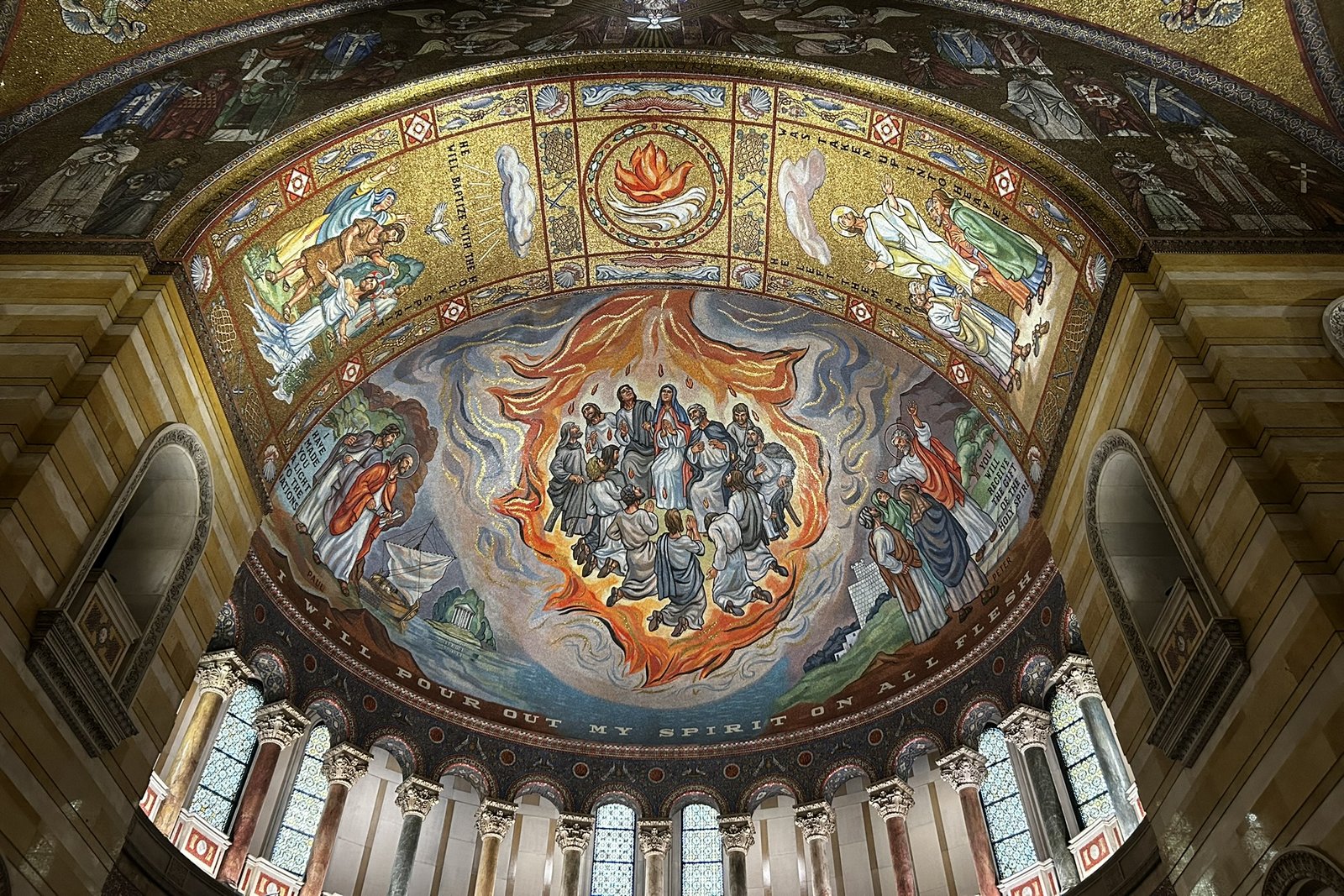
Photograph by The Real Dr. Worm, Pentecost mosaic, Cathedral Basilica of Saint Louis — CC0, Wikimedia Commons.
Construction moved quickly by the standards of a building this ambitious. The cornerstone was laid in October 1908, and by October 18, 1914, enough of the structure was finished for a formal dedication and first Mass, even though the building's full consecration would not take place until June 29, 1926. The finished cathedral measures 365 feet long and 204 feet wide, built of granite on the outside and brick, marble, and mosaic tile within — specifications that made it, from the start, one of the largest and costliest Catholic church buildings constructed in the United States up to that time, at a reported cost of roughly $3 million in 1914 dollars.
Seventy-six years of mosaic work
What makes the Cathedral Basilica of Saint Louis genuinely unusual isn't just its size — plenty of American cathedrals are large — it's what happened to the interior after the walls went up. Installation of mosaic decoration began in 1912, while construction was still underway, and continued, with long interruptions during the Great Depression and World War II, until 1988. That is a 76-year project, carried out across the working lives of multiple generations of artists, to cover nearly every interior surface — domes, vaults, walls, even floor sections — in small pieces of colored and gold-backed glass. The final tally: an estimated 41.5 million tesserae in more than 7,000 colors, spread across roughly 83,000 square feet, often described as the largest single mosaic collection in the Western Hemisphere.
No single artist is responsible for all of it, which is part of why the cathedral feels less like one unified composition than like a gallery of related but distinct visions under one roof. Tiffany Studios designed mosaics for several of the side chapels and sanctuary walls early in the project. The main cathedral areas were designed by the artist August Oetken. The St. Louis–based firm Ravenna Mosaic Company carried out a large share of the physical installation work over the decades, and the father-and-son team of Paul and Arno Heuduck reportedly spent nearly their entire careers as mosaicists working inside this one building. Later in the project, the Polish-American artist Jan Henryk de Rosen designed the mosaics of the main dome, depicting Old and New Testament scenes, while the rear dome was given over to mosaics commemorating significant events in the history of the Archdiocese of St. Louis itself.
A Byzantine building in the American Midwest
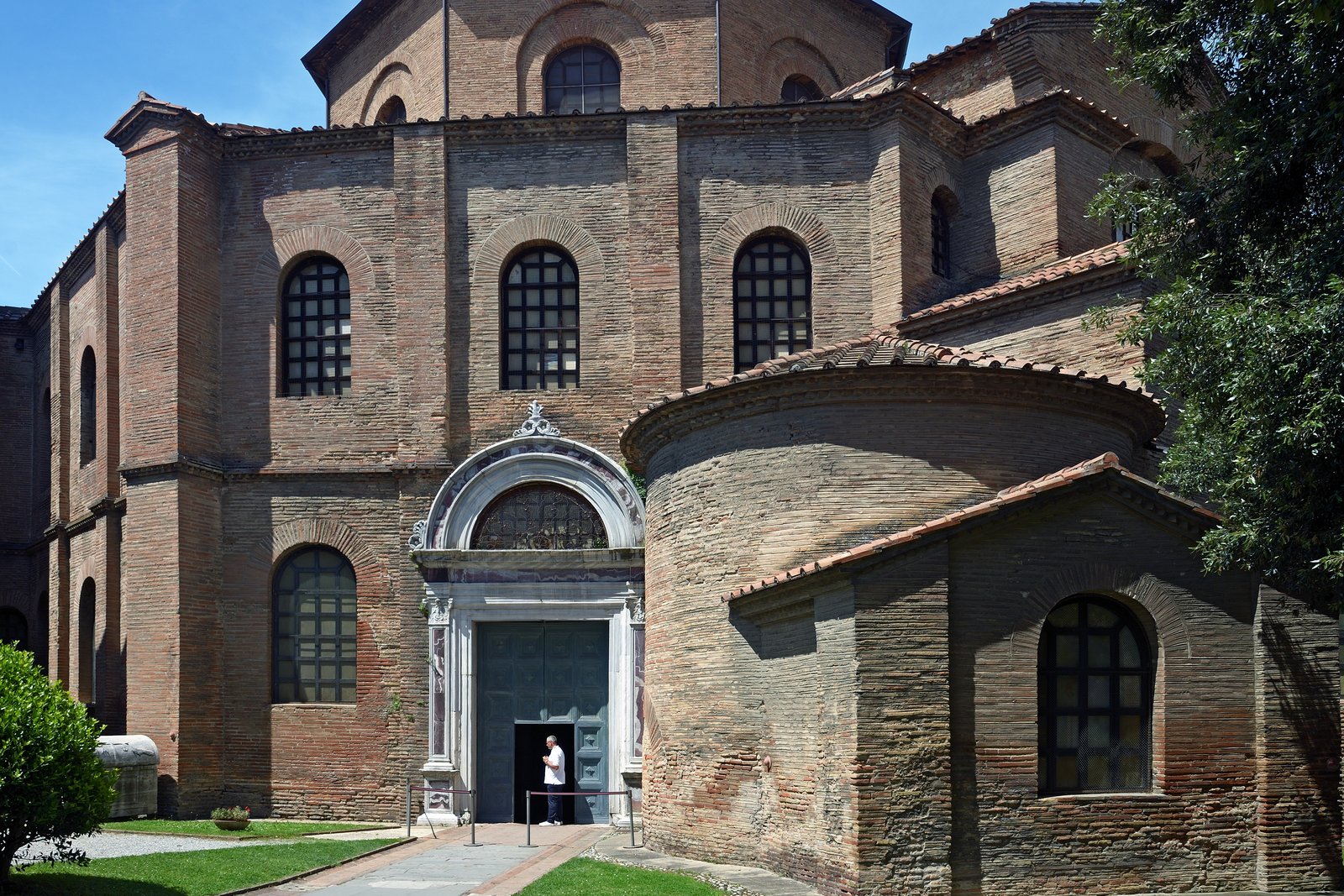
The architectural style Barnett, Haynes & Barnett chose for the cathedral — a blend architectural historians generally describe as Neo-Byzantine with Romanesque Revival elements — was a deliberate departure from the pointed-arch Gothic Revival style that dominated American cathedral-building in the same period. A centrally planned, domed Byzantine-style church lent itself naturally to the kind of large, continuous mosaic surfaces the cathedral eventually filled, much as the domed, centrally planned Basilica of San Vitale in Ravenna had done over a thousand years earlier, on the other side of the Atlantic. The resemblance isn't a coincidence of engineering convenience alone — Byzantine church architecture and Byzantine-style mosaic decoration developed together, each shaping what the other could achieve, and Barnett's design borrowed consciously from that same inherited architectural logic.
Walking the length of the nave today, a visitor moves beneath a sequence of domes and vaults, each carrying its own mosaic program, toward the sanctuary and its own dome overhead — the effect many visitors and writers have compared to churches like Ravenna's Byzantine monuments or, on a smaller scale, mosaic-covered basilicas in the eastern Mediterranean, even though the Cathedral Basilica of Saint Louis is a 20th-century American building through and through, built of modern materials and methods and finished with 20th-century workshop techniques.
Named for a crusading king
The cathedral's name, and the city's, trace back to Louis IX of France, the 13th-century king canonized by Pope Boniface VIII in 1297 — still, to this day, the only French monarch the Catholic Church has ever declared a saint. French colonists founded the city of St. Louis in 1764 and dedicated it to him, a choice made well before this particular cathedral existed; the earlier riverfront cathedral this building replaced carried the same dedication. Inside the New Cathedral, the narthex — the entrance hall just inside the main doors — carries a mosaic sequence depicting episodes from Louis IX's life, including, according to the cathedral's own mosaic program, his departure on crusade, tying the building's patron saint directly to its decorative scheme rather than leaving the dedication as a name alone.
It's worth being precise about what that patronage does and doesn't claim: Louis IX is remembered in the Church's own tradition for his personal piety, his reforms of French royal justice, and his costly, largely unsuccessful crusading campaigns in Egypt and Tunisia, not for any direct connection to the Mississippi River valley he never saw. The link between the saint and the city is a matter of 18th-century French colonial naming, carried forward into this 20th-century building nearly two centuries later.
Crypts, a museum, and a working cathedral
Beneath the main worship space, the cathedral's undercroft houses both a museum dedicated to the mosaics — explaining materials, techniques, and the decades-long installation process — and a crypt chapel where several former leaders of the Archdiocese of St. Louis are buried, including Cardinals John J. Glennon, Joseph Ritter, and John Carberry, along with Archbishop John L. May. Pope John Paul II designated the building a minor basilica in 1997, adding that honorary status to its existing role as the cathedral — the mother church — of the Archdiocese of St. Louis, and it remains, today, both a functioning parish church offering daily and Sunday Mass and one of the most visited religious landmarks in the Midwest, drawing visitors less for any single relic or event than for the sheer, accumulated scale of the artwork overhead.
For a browser of the places and sacred buildings that Christian history has left scattered across the world, the Cathedral Basilica of Saint Louis is a reminder that this kind of monumental undertaking didn't stop in the Middle Ages — it kept happening, quietly, inside an American city, through two world wars and a depression, one hand-set piece of glass at a time.
Trivia
How many mosaic tesserae are inside the Cathedral Basilica of Saint Louis?
How long did it take to complete the mosaics in the Cathedral Basilica of Saint Louis?
Why is the Cathedral Basilica of Saint Louis named for King Louis IX of France?
What architectural style is the Cathedral Basilica of Saint Louis built in?
Is the Cathedral Basilica of Saint Louis still an active church?
Related Reading