David Spares Saul's Life in the Cave

A king hunting the man he already knows will succeed him
By this point in David's story, the relationship between him and King Saul has fully collapsed. Saul, aware on some level that God's favor had already shifted toward David, pursues him relentlessly through the wilderness with a force of three thousand chosen soldiers, determined to eliminate the threat David represents to his own throne. David, meanwhile, is living as a fugitive, hiding with his own band of men in caves and strongholds throughout the region rather than confronting Saul directly or seizing power for himself despite having every apparent justification to do so.
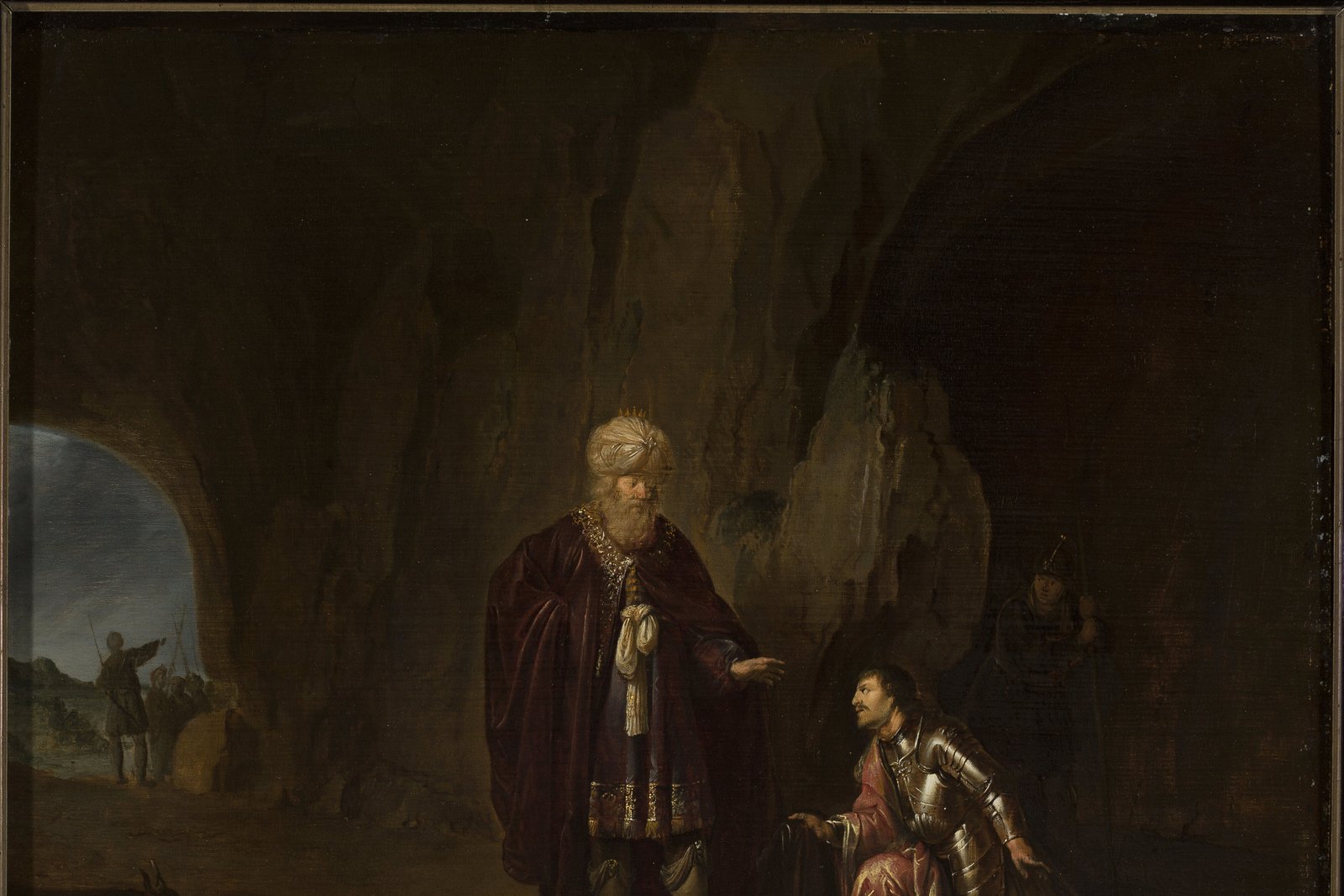
Willem de Poorter, Saul and David in the Cave of En-Gedi (17th century), public domain via Wikimedia Commons
An unplanned, total vulnerability
The scene that follows turns entirely on coincidence rather than any scheme David arranges. Saul, still searching the area, happens to enter a cave along the way "to relieve himself," with absolutely no awareness that "David and his men were occupying the inmost recesses of the cave" at that very moment (1 Samuel 24:4, NABRE). It's difficult to imagine a more complete reversal of the pursuit's usual dynamic — the hunted man is hidden in the shadows, and the hunter has walked, alone and utterly exposed, directly into striking range.
"Do with him as you see fit"
David's own men see the moment for exactly what it appears to be — an opportunity too perfect to be accidental. "This is the day about which the Lord said to you: I will deliver your enemy into your hand; do with him as you see fit" (1 Samuel 24:5, NABRE), they tell him, framing the coincidence as clear divine permission, arguably even encouragement, to finally end the years of pursuit with one decisive act. It's a reasonable reading of the circumstances by any ordinary military logic — the enemy commander, alone, unarmed against surprise, standing within arm's reach.
A cut he immediately regrets
What David actually does is far more restrained than his men expect. He moves forward and "stealthily cut off an end of Saul's robe" (1 Samuel 24:5, NABRE) — not an attack at all, just a small, symbolic act, proof that could later demonstrate how close Saul had come to death without David or Saul actually having to acknowledge it in the moment. Even this small act unsettles David immediately: "Afterward, however, David regretted that he had cut off an end of Saul's robe" (1 Samuel 24:6, NABRE). He tells his own men directly why he won't go further: "The Lord forbid that I should do such a thing to my master, the Lord's anointed, to lay a hand on him, for he is the Lord's anointed" (1 Samuel 24:7, NABRE) — a specific theological reasoning, not simple mercy or sentiment. David's restraint rests on Saul's anointing itself, treating that anointing as something that places Saul's life outside David's own authority to end, regardless of what Saul has done to deserve otherwise.
Why "the Lord's anointed" carries so much weight
David's reasoning only makes full sense against what had already happened to him years earlier. The prophet Samuel had anointed David with oil while he was still a young shepherd, tending his father's flocks, and from that moment "the spirit of the Lord rushed upon David" (1 Samuel 16:13, NABRE) — but Saul was also anointed, years before that, as Israel's first king, and that anointing had never been revoked even after Saul's own disobedience cost him God's favor. David's restraint in the cave isn't simply personal mercy toward a man who happens to be his enemy; it's a conviction that the anointing itself, once given, creates an obligation no human grievance can override. Killing Saul, in David's own reasoning, would mean treating God's choice of king as something a subject could undo by force — exactly the kind of claim to authority David refuses to make for himself, even against a king actively hunting him.
A second chance to kill Saul, and the same restraint
This isn't the only time David finds Saul entirely at his mercy. A later chapter of 1 Samuel records a strikingly similar scene: David sneaks into Saul's own camp at night while Saul and his guards lie asleep, and his companion Abishai urges him to kill Saul on the spot with his own spear. David again refuses, for the same stated reason — Saul remains the Lord's anointed — and instead takes only Saul's spear and water jug as proof of how close he'd come, exactly as he had taken only a piece of robe in the cave. Tradition has long connected En-Gedi's wilderness caves, a rugged oasis region near the Dead Sea where David hid during this period, to Psalm 57, whose own heading describes it as written "when he fled from Saul into a cave" — a prayer of fear and trust written, by that account, from inside the very kind of hiding place this story describes.
Proof offered after the fact
Once Saul leaves the cave, unaware of how close he'd come to death, David follows him out and calls to him from a distance, showing him the cut piece of robe as evidence of what had just happened. It's a striking choice — David could have simply let the moment pass unremarked, keeping his restraint private. Instead, he makes it visible, forcing Saul to reckon directly with how completely he'd been at David's mercy and how deliberately David had chosen not to use it.
Saul's tears, and a confession that doesn't last
Saul's response is immediate and, in the moment, apparently genuine. Recognizing David's voice, "Saul... wept freely," and admits plainly, "You are more in the right than I am. You have treated me graciously, while I have treated you badly... the Lord delivered me into your hand and you did not kill me" (1 Samuel 24:17-19, NABRE). It's worth noting, without letting it undercut the scene itself, that this reconciliation doesn't hold permanently — later chapters of 1 Samuel show Saul resuming his pursuit of David before long. The cave scene's power doesn't rest on it fixing the relationship for good; it rests on what it reveals about David in a single, unrepeatable moment of total opportunity: a man with every practical justification to kill his enemy, choosing instead to let a piece of cloth speak for the violence he refused to commit.
Trivia
Why was Saul hunting David in the wilderness?
How did Saul end up alone in the same cave as David?
What did David's own men urge him to do?
What did David actually do instead of killing Saul?
How did Saul react when David showed him the piece of his robe afterward?
Related Reading