The Agnus Dei Symbol in Art History

A symbol before it was a painting
The theological reasoning behind picturing Christ as a lamb is covered in depth in The Lamb of God Symbolism Explained — the title traces to John the Baptist's words at the Jordan River and the Passover sacrifice described in Exodus. This article takes a different angle: rather than the scriptural reasoning, it follows the image itself as it moved through specific, datable works of art across roughly fifteen centuries, from hidden catacomb carvings to a papal coat of arms.
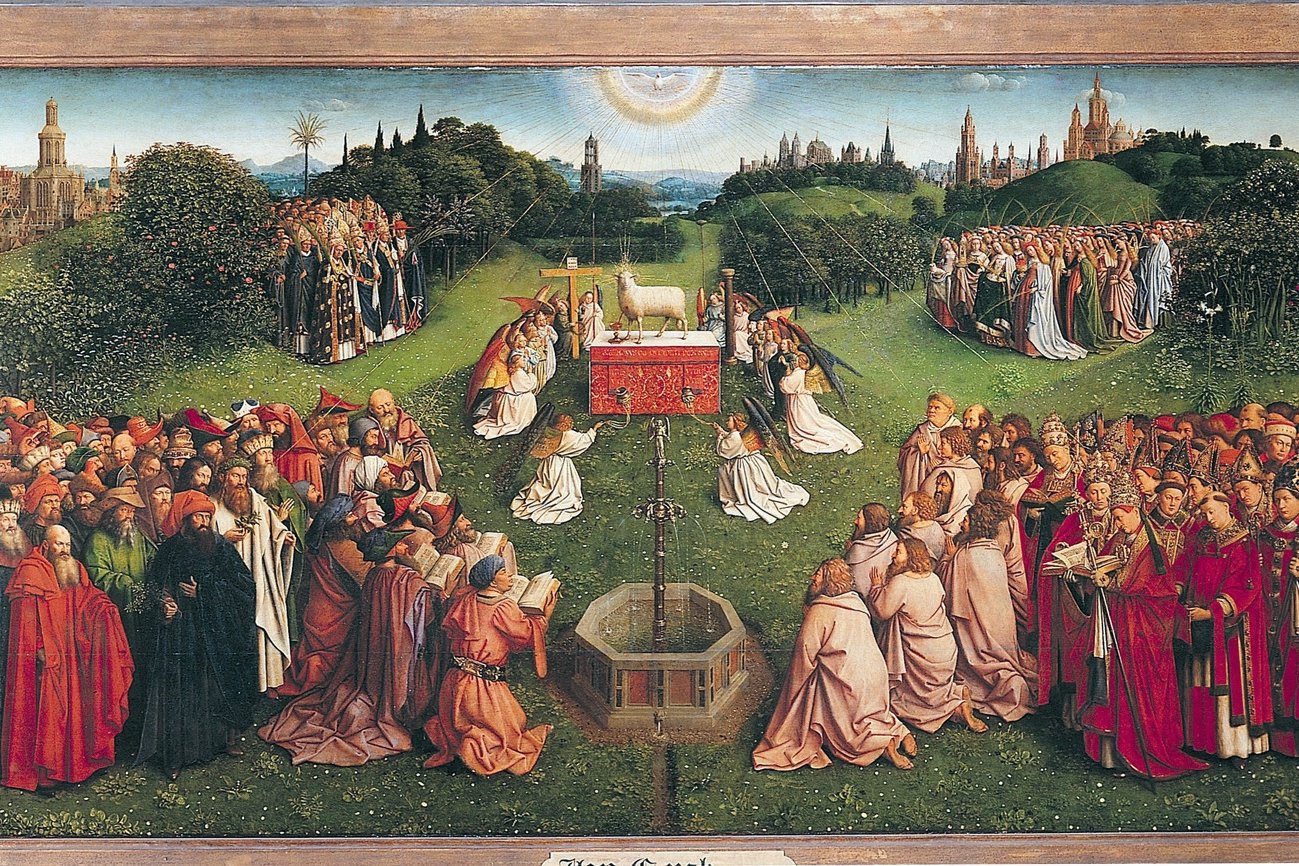
Jan van Eyck (and Hubert van Eyck), "Adoration of the Mystic Lamb" (central panel, Ghent Altarpiece), 1432, Saint Bavo Cathedral, Ghent — public domain.
Hidden in stone: the earliest lambs
Christian art's very earliest centuries left behind comparatively few explicit images of the crucified Christ, since Christianity remained a persecuted, often underground faith across much of the Roman Empire until the fourth century. In that environment, a lamb carried meaning without carrying obvious risk — a shepherd tending sheep, or a single lamb among a flock, could pass as ordinary pastoral decoration to anyone unfamiliar with its Christian reading while communicating clearly to believers who knew the reference. Surviving catacomb frescoes and carved sarcophagus panels from the third and fourth centuries preserve numerous versions of this coded imagery, some showing a lamb resting on the shoulders of a shepherd figure (echoing Christ as the Good Shepherd), others showing a solitary lamb marked with a small cross.
Once Christianity gained legal protection under Constantine in the early fourth century, the same imagery moved out of hidden burial chambers and into public church decoration. Byzantine and early medieval church mosaics frequently placed a haloed lamb at the center of elaborate apse or ceiling compositions, sometimes surrounded by twelve smaller lambs representing the apostles processing toward it — a formula that appears in several surviving Roman basilicas and set a visual template later artists would keep returning to.
The Ghent Altarpiece: a lamb worth a pilgrimage
No single artwork did more to fix the Agnus Dei in art history's collective memory than the Ghent Altarpiece, a monumental polyptych completed in 1432 by the Flemish painters Jan van Eyck and, according to an inscription on the frame, his brother Hubert. Its central lower panel, the Adoration of the Mystic Lamb, shows exactly what its name promises: a small, standing white lamb on an altar in an open, sunlit meadow, blood flowing from a wound into a chalice, while enormous converging crowds of prophets, apostles, martyrs, virgins, and clergy kneel and approach from every direction, drawn by rays of light streaming down from a dove above.
The composition draws directly on the Book of Revelation's vision of heavenly worship, where John describes "a Lamb that seemed to have been slain" standing at the center of adoration before God's throne (Revelation 5:6, NABRE). Van Eyck's technical achievement — the meticulous rendering of individual blades of grass, jewelry, and fabric texture, achieved through the still-developing technique of oil painting — made the altarpiece one of the most studied works of the early Renaissance, and it remains on view today in Saint Bavo's Cathedral in Ghent, Belgium, drawing visitors specifically to see this one panel.
Onto coins, seals, and small devotional objects
Beyond large-scale paintings, the Agnus Dei found a durable home in smaller, more portable formats. Ecclesiastical and papal seals across medieval and early modern Europe frequently incorporated the lamb image to signal Christ's sacrificial authority standing behind the pope's own pastoral role as shepherd of the Church. Separately, small wax medallions known as Agnus Dei — round discs stamped with the lamb's image and blessed by the pope — were produced and distributed to the faithful as devotional and protective objects, a practice documented since at least the early medieval period and still continued in some form today. Unlike the grand scale of an altarpiece meant to be seen from across a nave, these smaller objects carried the same symbol into private hands and homes, a devotional counterpart to public church art.
A motif that keeps its shape across centuries
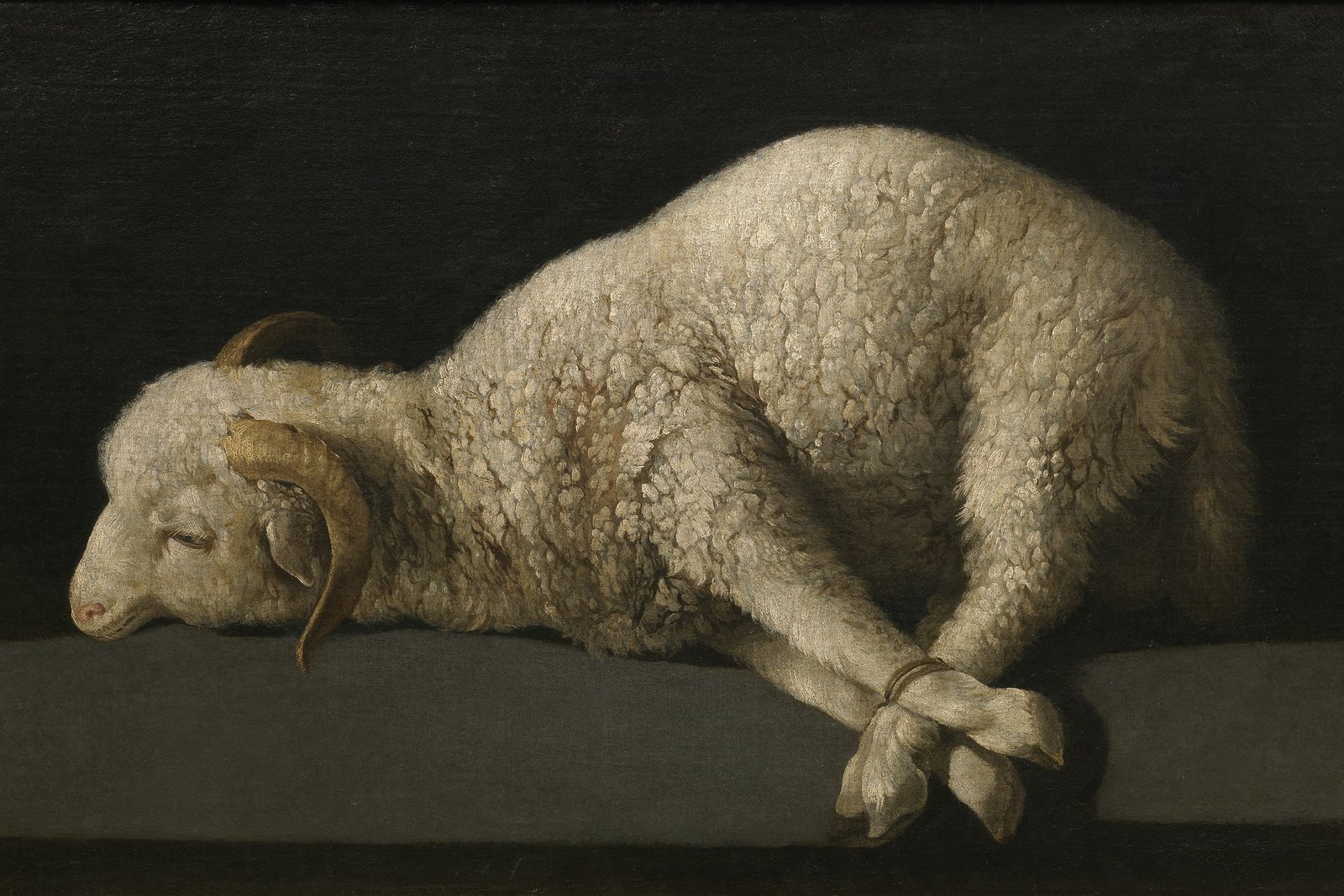
What's notable across this whole span — mosaic to altarpiece to wax medallion — is how stable the core image stays even as its scale and medium change completely. A lamb, sometimes bound and sometimes standing, sometimes bearing a banner and sometimes a wound, remains immediately legible as a reference to Christ regardless of whether it's carved into third-century stone, painted with fifteenth-century oil technique, or stamped into wax the size of a coin. Few symbols in Christian visual history have proven this durable across such different artistic periods, media, and audiences, which is part of why the Ghent Altarpiece's version still draws crowds of visitors nearly six centuries after it was painted.
Modern restoration work on the Ghent Altarpiece, completed in stages over the 2010s and 2020s, uncovered just how much later overpainting had altered the lamb's appearance over the centuries — conservators removing sixteenth-century retouching found the original lamb underneath had a far more direct, almost startled human-like gaze than the more placid face generations of visitors had grown used to. The discovery became international news specifically because it showed how even a single, celebrated image of the Agnus Dei had itself quietly changed hands and appearances across its own history, layered over by later restorers before being recovered again — a small reminder that the symbol's long life in art has never been a single unbroken line, but a chain of artists and conservators each handling the same inherited image in their own way.
Trivia
What is the earliest known artistic depiction of the Agnus Dei?
What is the most famous painted depiction of the Lamb of God?
Why does the papacy use a lamb on some of its seals and emblems?
What is a wax Agnus Dei medallion?
Is the Agnus Dei image the same in every artwork?
Related Reading