David and Bathsheba

A king who stayed home
Second Samuel 11 opens with a detail that reads almost like a stage direction, easy to skim past but pointed once you notice it: it was the season "when kings go out to battle," and the army had gone out under Joab's command — but David himself stayed behind in Jerusalem. It's the first small crack in a story built almost entirely out of small choices compounding into larger ones. One evening, restless, David walks the roof of his palace and sees a woman bathing below. "One evening David rose from his bed and strolled about on the roof of the king's house. From the roof he saw a woman bathing; she was very beautiful" (2 Samuel 11:2, NABRE).
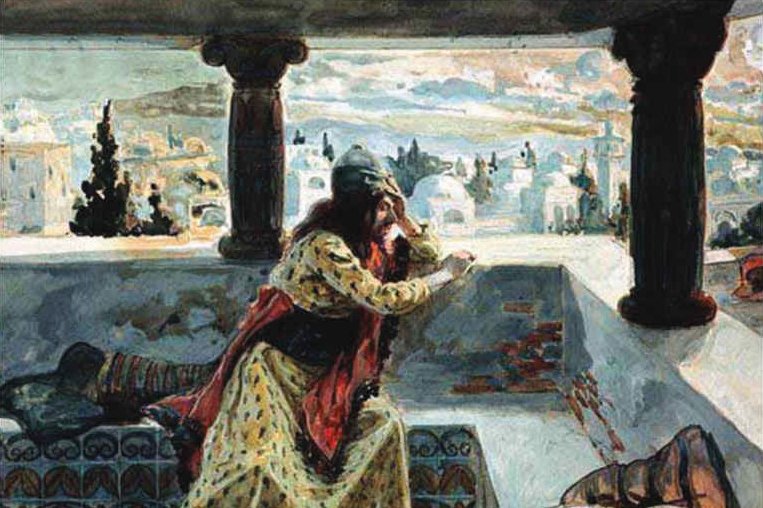
James Tissot, King David and Bathsheba Bathing (1896-1902), public domain via Wikimedia Commons
Taking what wasn't offered
David doesn't stop at looking. He sends someone to find out who the woman is, and learns she's "Bathsheba, daughter of Eliam, and wife of Uriah the Hittite" (2 Samuel 11:3, NABRE) — Uriah being, notably, one of David's own soldiers, currently away serving in the very war David had chosen to sit out. The text doesn't linger on deliberation; David simply acts: "Then David sent messengers and took her. When she came to him, he took her to bed... and she returned to her house" (2 Samuel 11:4, NABRE). The narrative's spareness here is deliberate — no internal debate is recorded, no hesitation, just a king's request answered because a king's requests generally were. What follows changes everything: "But the woman had become pregnant; she sent a message to inform David, 'I am pregnant'" (2 Samuel 11:5, NABRE).
A cover-up that escalates
David's first response to the pregnancy isn't confession — it's management. He brings Uriah home from the battlefield, hoping he'll spend the night with his own wife and the child's parentage will be quietly resolved. Uriah refuses, insisting he won't enjoy the comfort of home while his fellow soldiers remain camped in the open field — an act of loyalty that, unknowingly, blocks David's plan and forces his hand further. Rather than let the plan fail, David escalates to something far worse, writing a letter for Uriah to personally carry back to his own commander: "Place Uriah up front, where the fighting is fierce. Then pull back and leave him to be struck down dead" (2 Samuel 11:14-15, NABRE). Uriah dies exactly as arranged, unknowingly delivering the order for his own death.
A story about a stolen lamb
The prophet Nathan approaches David sometime later, but not with a direct accusation. He tells a story instead — a wealthy man with vast flocks who, rather than take from his own abundance to feed a visitor, steals the single, cherished lamb belonging to a poor neighbor, an animal the poor man had raised "like a daughter." David, hearing the story as a case brought before him for judgment, reacts with genuine fury, declaring the rich man deserves death and must repay the lamb fourfold — fully invested in the injustice of someone else's story, with no idea yet that it's his own. Nathan lets the outrage land before delivering the turn: "Then Nathan said to David: 'You are the man!'" (2 Samuel 12:7, NABRE), going on to recount everything David had been given by God and how directly he had repaid it with betrayal and murder.
"I have sinned against the Lord"
What David does next is what has kept this episode central to how his whole story is remembered. He doesn't argue, minimize, or deflect blame onto Bathsheba or circumstance. "Then David said to Nathan, 'I have sinned against the Lord.' Nathan answered David: 'For his part, the Lord has removed your sin. You shall not die'" (2 Samuel 12:13, NABRE) — a short, unqualified admission met immediately with a word of forgiveness, even though Nathan goes on to describe serious, lasting consequences that would still follow within David's own family as a result of what he'd done.
Consequences that outlast the forgiveness
Nathan's word of forgiveness isn't the end of the account. In the same breath that he tells David the Lord has removed his sin, Nathan also delivers a harder word: "since you have utterly spurned the Lord by this deed, the child born to you will surely die" (2 Samuel 12:14, NABRE). Forgiveness and consequence arrive together, not as opposites — David is not condemned for the affair and murder, but he also isn't spared from watching their aftermath play out in his own household. The child does die soon after birth, and Scripture records David's grief over the loss with the same unflinching directness it used for the sin itself. It's a detail that keeps the episode from becoming a tidy lesson about sin followed by a clean, cost-free pardon — the biblical text insists on holding both truths, mercy and real loss, in the same chapter.
A second son, and a line that continues
What follows the child's death complicates any reading of this story as simple tragedy straight through. David and Bathsheba have another son, Solomon, who eventually succeeds David as king and becomes, by tradition, the builder of the Jerusalem Temple. The Gospel of Matthew's genealogy of Jesus names this lineage directly, identifying "David became the father of Solomon, whose mother had been the wife of Uriah" (Matthew 1:6, NABRE) — a genealogy that could easily have smoothed over or omitted Bathsheba's earlier marriage, and instead names it plainly, inside the very family line Matthew traces forward to Christ. It's one of several points in that genealogy where Matthew includes complicated, even scandalous family history rather than editing it out, and it gives the Bathsheba episode a reach well beyond its own chapter — this is not a story Scripture tries to bury, but one it keeps in open view even generations later.
A king remembered for both the fall and the response
What keeps David and Bathsheba's story from being simply a scandal buried in Israel's history is the pairing of the two halves — the sin, described without euphemism or excuse, and the response to being confronted with it, equally direct. Tradition holds that Psalm 51, attributed to David and traditionally connected to this very episode, is built entirely around that same posture of unguarded confession. Whatever else David's reign is remembered for, this episode has remained central precisely because Scripture refuses to smooth it over — a king capable of real evil, and, when finally confronted with it directly, capable of admitting it without a single word of self-defense.
Trivia
How did David first see Bathsheba?
What did David do after learning Bathsheba was married?
How did David try to cover up the pregnancy?
How did the prophet Nathan confront David about what he'd done?
How did David respond once he was confronted?
Related Reading