The Original Statue of Our Lady of Fatima


A statue built from someone else's memory
No one who carved the statue of Our Lady of Fátima ever claimed to have seen what it depicts. That distinction matters, because it sets this object apart from something like a shroud or a relic bone, where the claim is that the physical thing itself touched the sacred event. The statue of Our Lady of Fátima is, instead, a careful reconstruction — a devotional commission built entirely on testimony, specifically the recollections of Lúcia dos Santos, the eldest of the three shepherd children who reported seeing a radiant woman near the village of Fátima, Portugal, six times between May and October 1917. (This blog's article on Our Lady of Fátima covers those original apparitions in full; this one is about the object that grew out of them.)
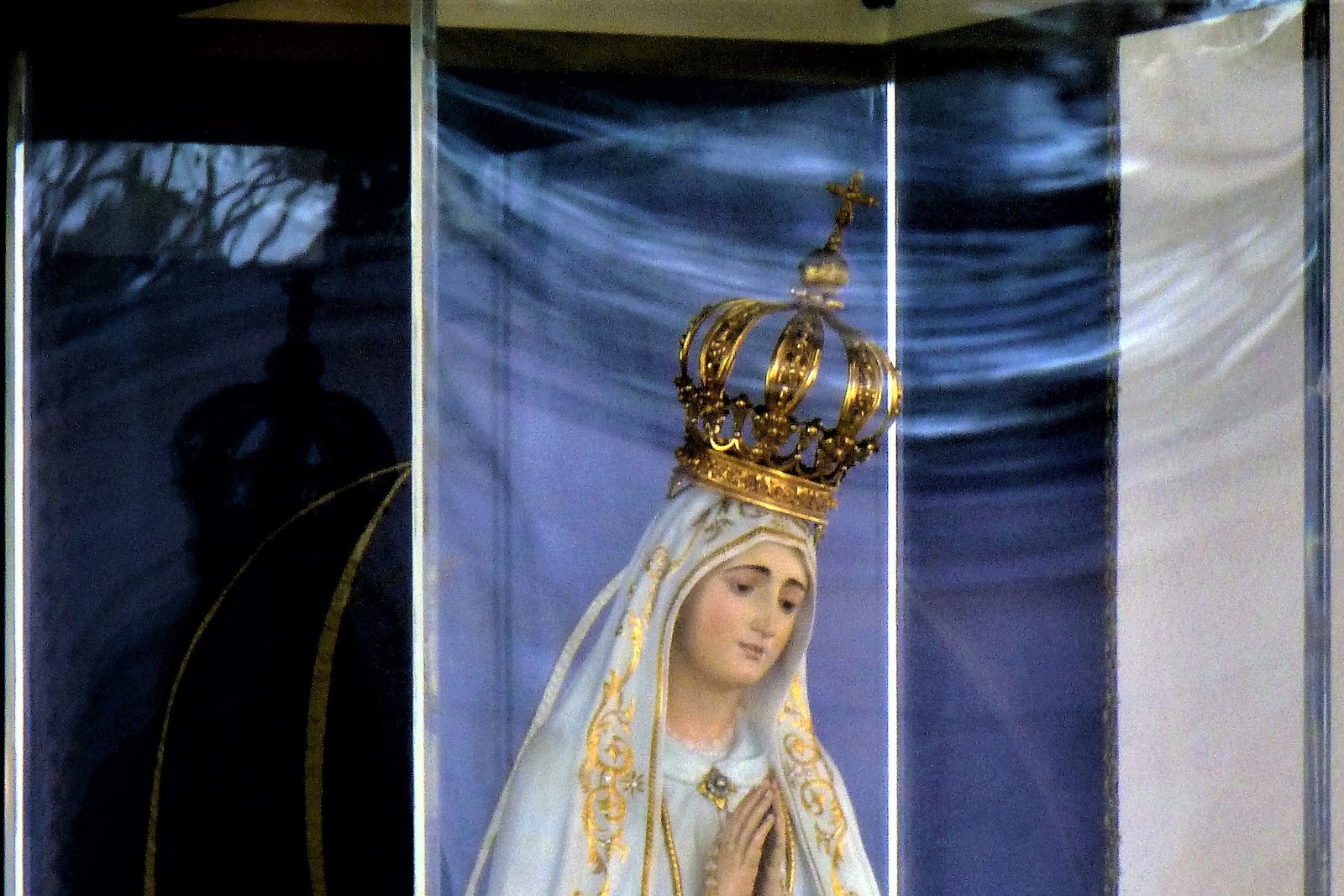
Bingar1234, First Sculpture of Our Lady of Fatima, photograph, 2014. Public domain, via Wikimedia Commons.
By 1920, devotion to what the children had reported was spreading quickly across the surrounding region, even though the Church itself had not yet investigated or ruled on the matter — that formal recognition wouldn't come until 1930. A devotee from the nearby town of Torres Novas, Gilberto Fernandes dos Santos, commissioned a sculpture to be venerated at the site. The commission went to José Ferreira Thedim, a sculptor working in one of the religious-imagery workshops that supplied churches across the Portuguese-speaking Catholic world with statuary. Thedim had no vision of his own to draw on. What he had was Lúcia's description — and, according to the sanctuary's own account of the statue's history, her approval of the finished piece before it was ever blessed for public veneration.
Cedar, paint, and a teenager's final word
The result was modest in scale: a figure just over a meter tall (about 41 inches), carved from Brazilian cedar wood rather than stone or bronze, with the polychrome painting, gilding, and flesh-toned "carnation" work on the face and hands carried out by the Casa Teixeira Fânzeres workshop in Braga. It shows a standing woman in white, robed and mantled, hands folded in prayer, her bare feet resting on what is meant to represent a small globe or cloud — details drawn directly from how the children had described what they saw.
The statue was blessed in the parish church of Fátima — the same church where Lúcia and her cousins had been baptized — on May 13, 1920, three years to the day after the first reported apparition. One month later, on June 13, 1920, it was formally enthroned in the small Chapel of the Apparitions, built on the exact spot in the Cova da Iria field where the children said the visions had occurred. From that day forward, this single carved figure became the visual reference point for a devotion that would eventually spread across the entire Catholic world — reproduced, as the shrine's own historians note, in countless copies in churches, homes, and roadside shrines on every continent, all tracing back to Thedim's original.
A queen's crown, built from gratitude rather than money
For more than two decades, the statue stood without the ornament most people now associate with it. That changed through a grassroots effort that had nothing to do with the sanctuary's clergy initiating it. In 1941, a group of Portuguese women launched a national campaign asking other women across the country to donate their own gold jewelry — not money — to fund a crown for the statue, in gratitude that Portugal, alone among so many of its European neighbors, had stayed out of the Second World War. Thousands of pieces of gold and gemstones poured in, and the Lisbon jewelers Casa Leitão & Irmão, a firm with centuries of experience crafting pieces for the Portuguese royal court and the Church, spent roughly three months and employed twelve craftsmen turning the donated gold into a closed, eight-arched royal crown topped with a cross-bearing globe — the traditional heraldic form used to signify a reign understood as held under God's own authority.
The crown was finished in 1942, but its formal use was delayed for four years. On May 13, 1946, Pope Pius XII sent his personal legate, Cardinal Benedetto Masella, to Fátima to carry out a solemn canonical coronation of the statue — a formal liturgical act distinct from simply placing a crown on an image, meant to publicly affirm the devotion Pius XII himself had already encouraged by naming Our Lady of Fátima "Queen of Peace and of the World."
The bullet that found an empty space
The detail that has done more than almost anything else to fix this particular statue in the modern imagination came decades later, and it involves a pope who nearly died. On May 13, 1981, Pope John Paul II was shot and seriously wounded in St. Peter's Square by a gunman named Mehmet Ali Ağca — on the exact calendar date of the first 1917 apparition, a coincidence the Pope himself treated as deeply significant. He later said he believed Our Lady of Fátima's intercession had spared his life that day.
One year later to the day, on May 13, 1982, John Paul II traveled to Fátima specifically to give thanks at the shrine — and he brought the bullet surgeons had removed from his body as an offering. According to the jewelers who had made the crown forty years earlier, the shrine's rector approached Casa Leitão & Irmão wondering what to do with the bullet, and the firm's craftsmen discovered that one of the eight decorative settings at the top of the crown — left empty since 1942 — matched the bullet's caliber almost exactly. They fused it into that space with a gold weld, where it remains today, a literal piece of twentieth-century political violence permanently lodged in a crown built from the donated jewelry of grieving wartime mothers.
A devotional image, not a relic
It's worth being precise about what kind of sacred object this actually is, because it's easy to blur the category. In the strict sense the Church uses, a relic is a physical remnant connected directly to a saint's body or an object that saint actually touched or used — a bone fragment, a piece of clothing, the kind of item venerated at shrines housing the remains of early martyrs. The statue of Our Lady of Fátima is something different: a devotional image, deliberately commissioned after the fact to represent a reported vision, its authority resting entirely on how faithfully it reflects Lúcia's testimony and on the broader Church's 1930 judgment that the Fátima apparitions were, in the Church's own cautious phrase, "worthy of belief." Catholic teaching is careful never to place a judgment like that on the same footing as a dogma of the faith — the faithful are free to find such private revelations spiritually helpful without being bound to accept them as articles of belief in the way they would, say, the Creed.
That theological caution hasn't dampened the intensity of devotion the statue draws in practice. Twice a year, on the anniversaries of May 13 and October 13, it is carried in procession across the vast paved esplanade of the Fátima sanctuary before crowds that can run into the hundreds of thousands, following a route pilgrims have walked — some on their knees — for a century now. The statue briefly left Portugal in October 2025, traveling to Rome for the Jubilee of Marian Spirituality, a rare departure from its home in the Chapel of the Apparitions that underscored just how far its reach now extends beyond the one small field where it has stood, crowned and quietly watching, since 1920.
Trivia
Who made the original statue of Our Lady of Fatima, and when?
What is the statue made of, and how big is it?
Why does the statue's crown contain a bullet?
Who made the statue's crown, and why?
Is the statue itself considered a holy relic?
Related Reading