Michelangelo's Creation of Adam Explained

One panel among nine
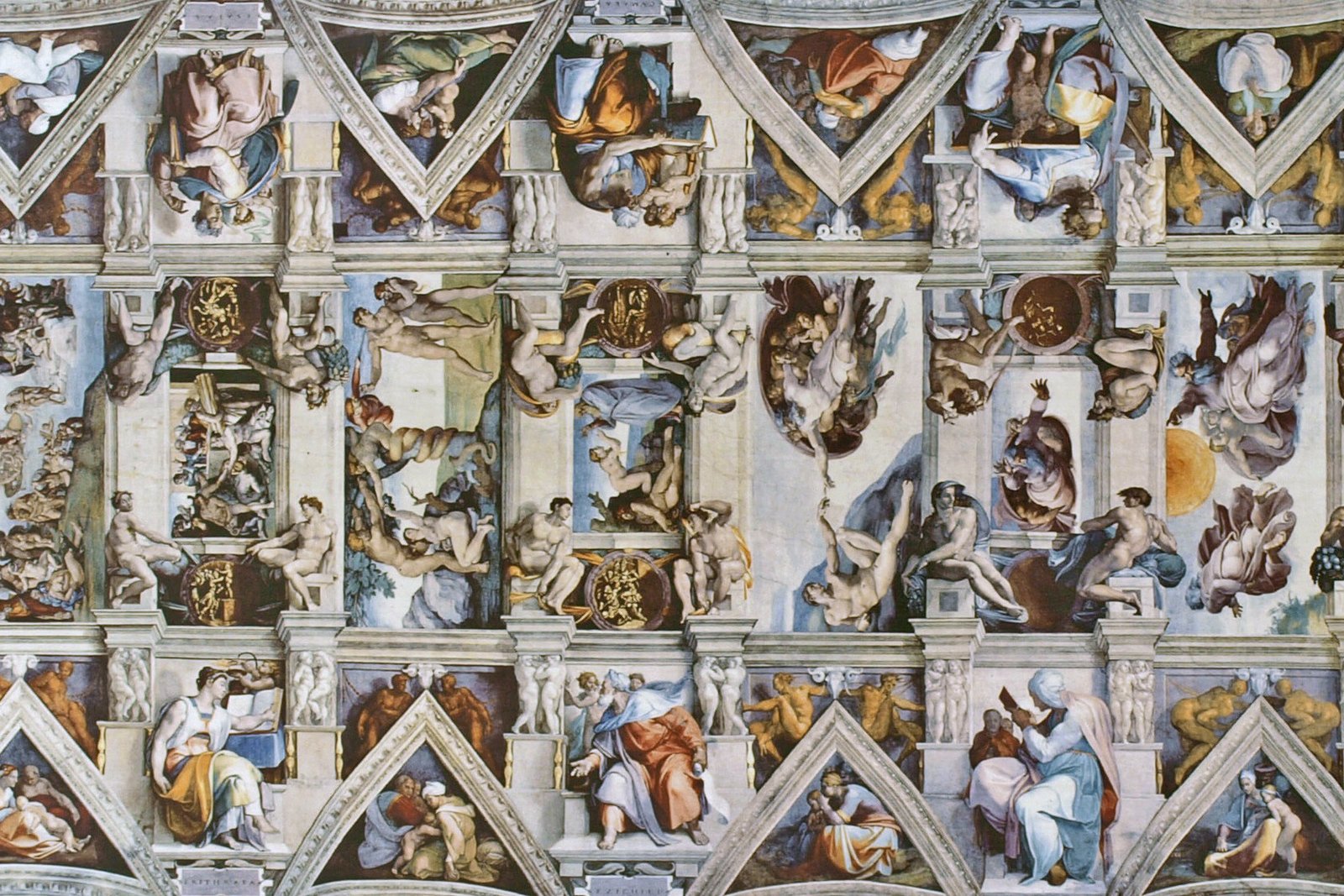
The Creation of Adam is the fourth of nine central Genesis scenes Michelangelo painted on the Sistine Chapel ceiling between 1508 and 1512, and it's worth separating from that larger ceiling program, since it has become so famous on its own that many people picture only this scene when they think of the Sistine Chapel at all. The other eight panels — the separation of light from darkness, the creation of the sun and moon, the flood, Noah's drunkenness among them — rarely appear on mugs, posters, or parody images the way this one does. Understanding why requires looking closely at what Michelangelo actually painted, since the composition takes real liberties with its brief scriptural source.
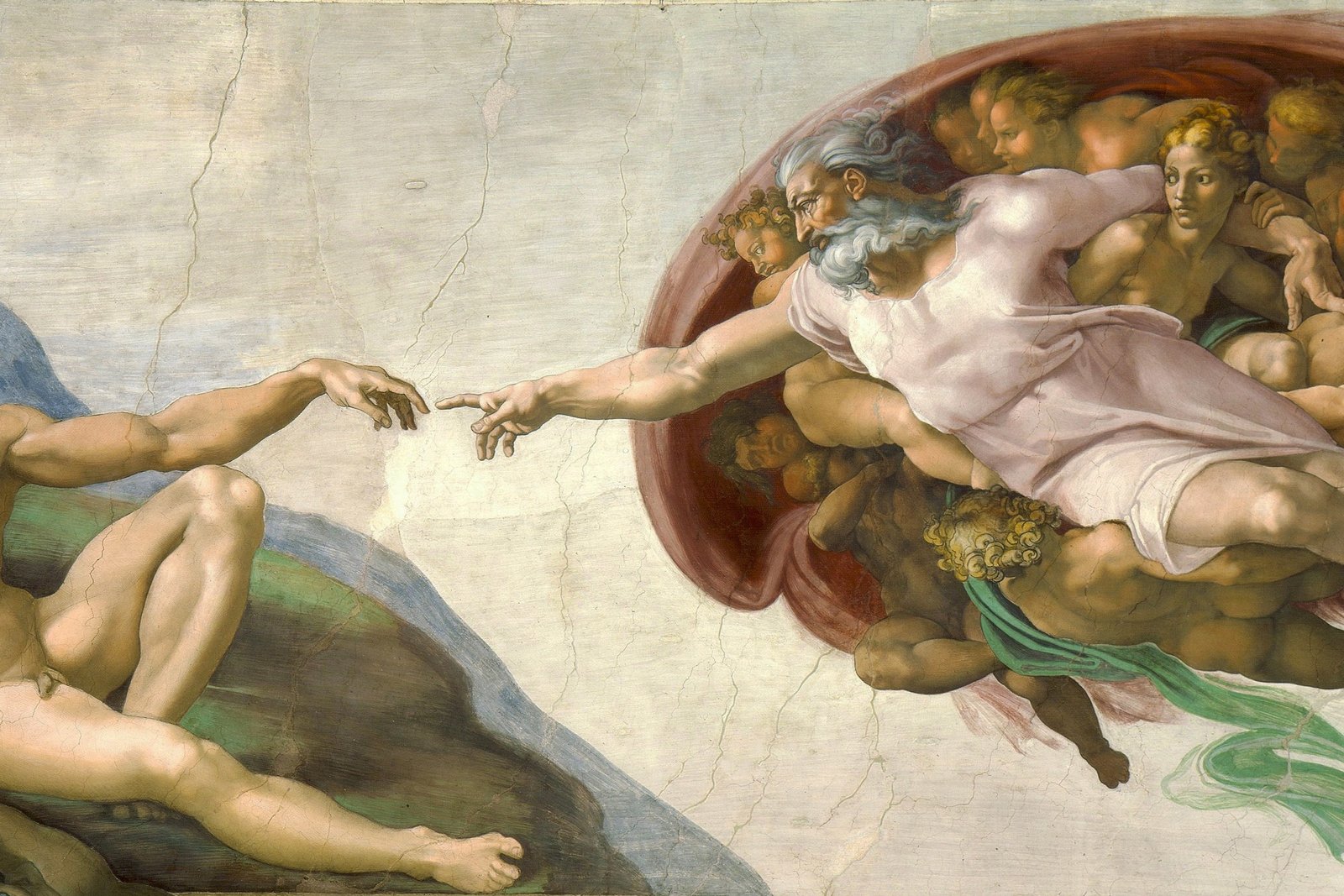
Michelangelo, "The Creation of Adam," c. 1511, Sistine Chapel ceiling, Vatican City — public domain.
The Genesis text behind the scene is spare: "then the Lord God formed the man out of the dust of the ground and blew into his nostrils the breath of life, and the man became a living being" (Genesis 2:7, NABRE). There is no reaching hand in that verse, no cloud of angels, no companion figure. Michelangelo invented the entire visual vocabulary of the scene from a single sentence, much as Caravaggio would later build The Calling of Saint Matthew from an equally brief Gospel line.
The composition
Adam reclines on a barren, grey-green hillside at the painting's left, his body still faintly slack, as if only partly animated. His left arm and hand rest along his raised knee, extended loosely toward God but without urgency or effort — Adam isn't straining toward life. God, by contrast, arrives from the right in a burst of motion: his cloak billows behind him, carried by a cloud crowded with attendant figures, and his right arm shoots forward at full extension, index finger pointed and taut. The two figures mirror each other in pose — both reclining on a diagonal, both extending an arm — which visually links them as counterparts even before the viewer registers the gap between their hands.
That gap is the panel's most quoted detail, and its effect depends entirely on withholding contact. Had Michelangelo painted the fingers touching, the moment would read as completed, static, already over. Leaving a sliver of blank space instead turns the scene into something suspended mid-action — life about to be given rather than already received. Several centuries of viewers have read that unfilled space as one of art history's most efficient devices for representing an unrepresentable transfer: divine power passing into inert matter, caught in the instant just before it happens.
The unnamed woman
Tucked beneath God's left arm, inside the same swirling red drapery, sits a young woman gazing out at Adam, along with a cluster of childlike figures. Genesis 2:7 gives no such companion any role in the moment of man's creation, so her presence is entirely Michelangelo's addition, and her identity has never been settled. The most common reading identifies her as Eve, not yet formed from Adam's rib but somehow already present in God's company, watching the man who will become her partner. Others have proposed Sophia, the personification of divine Wisdom described in some biblical wisdom literature, or simply an anonymous soul awaiting its own creation. The Vatican itself has never issued an official identification, and the ambiguity is very likely intentional — Michelangelo painted plenty of clearly labeled, unambiguous figures elsewhere on the ceiling when he wanted certainty.
The brain in the cloud
A newer and more contested reading concerns the shape of the drapery and attendant bodies surrounding God himself. In 1990, physician Frank Lynn Meshberger published an article in the Journal of the American Medical Association arguing that the red cloak, its folds, and the arrangement of the figures within it trace, with striking anatomical precision, a cross-section of the human brain — down to details resembling the frontal lobe, brain stem, and pituitary gland. Under this reading, the scene wouldn't only depict the breath of physical life described in Genesis, but also, hidden within the composition, the gift of intellect or reason.
The theory has attracted real attention precisely because Michelangelo had documented anatomical training, including dissections he reportedly performed as a young artist in Florence, which makes the claim at least plausible rather than far-fetched. But it remains a modern interpretation rather than a documented intention — no letter, contract, or contemporary account from Michelangelo's own era describes any such hidden anatomical diagram, and other art historians argue the resemblance is closer to a billowing cloak seen in profile than a genuine anatomical study. Readers should treat the brain theory as an intriguing, unproven scholarly hypothesis, not an established fact about what Michelangelo intended.
Why this panel, and not the others, became iconic
Part of the Creation of Adam's outsized fame likely comes from simple visual clarity. Many of the ceiling's other panels are crowded with multiple figures and layered action — the Great Flood alone packs in dozens of desperate bodies scrambling for high ground. The Creation of Adam, by contrast, distills its meaning into two bodies and one gap, a composition simple enough to reproduce at postage-stamp size and still read clearly. That same clarity has made the reaching hands one of the most parodied and referenced images in modern visual culture, appearing everywhere from advertising to film, often stripped of any religious content at all — an odd afterlife for a scene originally painted, four stories above a papal chapel floor, to depict the single moment human life began.
Trivia
Where is the Creation of Adam located?
Why don't God and Adam's fingers actually touch?
Who is the young woman under God's arm in the Creation of Adam?
What is the theory about the brain-shaped cloud around God?
Is the Creation of Adam based on an exact Bible verse?
Related Reading