The Angel at the Pool of Bethesda

A pool with a reputation
John's Gospel places the scene precisely: a feast has brought Jesus to Jerusalem, and near the city's Sheep Gate stands a pool "called in Hebrew Bethesda, with five porticoes" (John 5:2, NABRE). Under those covered walkways lies "a large number of ill, blind, lame, and crippled" people (John 5:3, NABRE) — not a handful of individuals but a standing community of the desperate, gathered around water that was believed, at least at times, to carry a rare and unpredictable power to heal.
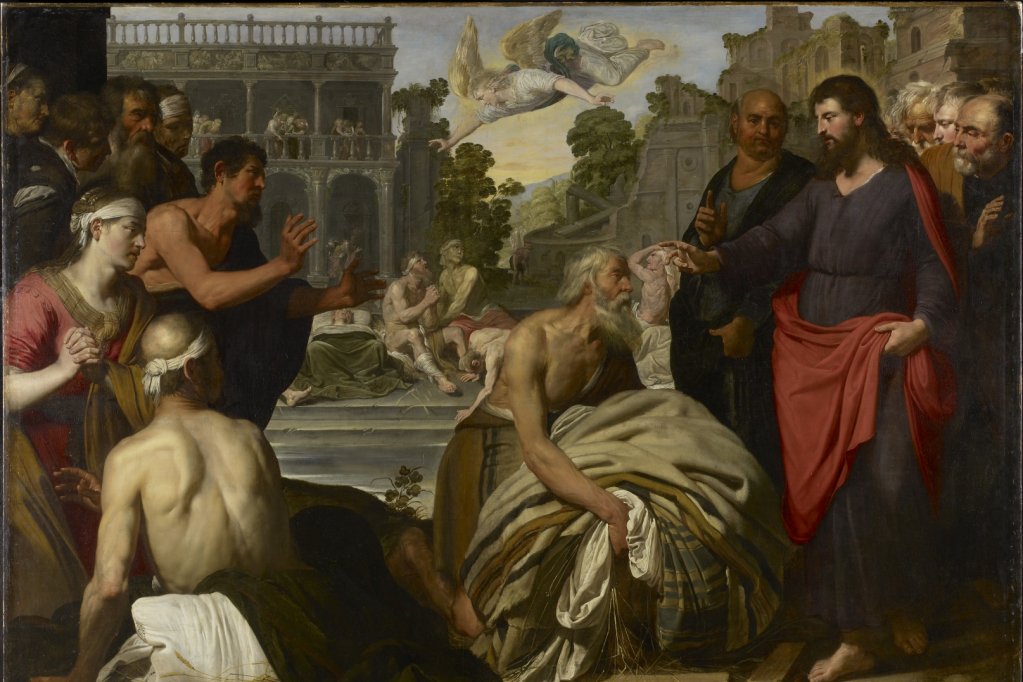
Artus Wolffort, Christ at the Pool of Bethesda (17th century), public domain via Wikimedia Commons
Thirty-eight years of almost
Among them is one man John singles out, "ill for thirty-eight years" (John 5:5, NABRE) — long enough that his condition had likely defined most of his adult life. When Jesus asks him directly, "Do you want to be well?" the man's answer isn't a simple yes. He explains the problem instead: "I have no one to put me into the pool when the water is stirred up; while I am on my way, someone else gets down there before me" (John 5:7, NABRE). It's a small, exhausted sentence that says everything about what nearly four decades of disappointment does to a person — he doesn't even ask for healing outright anymore, only explains why it has never worked out.
The line most Bibles put in brackets
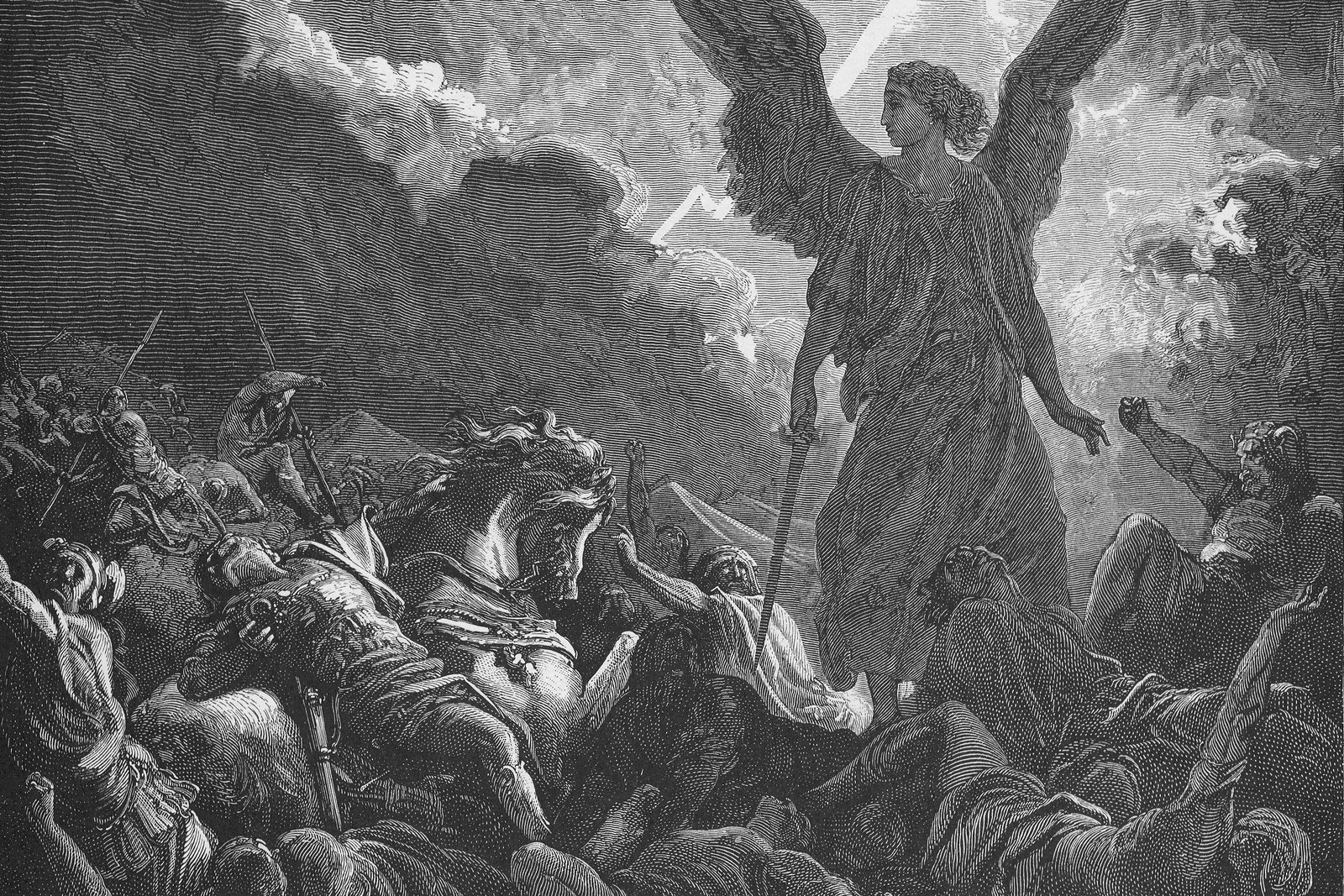
Popular retellings of this story often describe an angel physically descending to stir the pool's water, giving healing power to whoever reaches it first. That detail comes from a verse many English Bibles number John 5:4 — but it's worth being precise about its textual status. The earliest and most reliable Greek manuscripts of John's Gospel don't contain that verse at all; it appears to have entered the text later, as either a marginal note or a later scribe's attempt to explain the belief the sick man voices in verse 7. Most modern Catholic translations, including the NABRE quoted throughout this article, either omit the verse or set it apart with a bracket and footnote rather than presenting it as part of the original Gospel narration. What's certain from the undisputed text is that the crowd at Bethesda believed something — whether angelic or otherwise understood — made the water periodically healing, and that belief is what kept a man returning to the same spot for thirty-eight years.
Healed without ever touching the water
Whatever the crowd believed about the pool, Jesus doesn't rely on it. There's no stirring of the water in this account, no race to be first — he tells the man plainly, "Rise, take up your mat, and walk," and John records that "immediately the man became well, took up his mat, and walked" (John 5:8-9, NABRE). The healing arrives outside the very system the man had spent decades waiting on, which is part of the point: whatever power the pool was thought to hold, it wasn't the source of what actually restored him.
A Sabbath complication
John adds one detail that changes the whole tone of the story: "that day was a sabbath" (John 5:9, NABRE). Healing itself wasn't the controversial part — it was healing, and instructing a man to carry his mat, on the one day set aside for rest under Jewish law. The chapter goes on to describe the confrontation this provokes with Jerusalem's religious authorities, a conflict that becomes one of the recurring threads of John's Gospel. The miracle at Bethesda isn't presented as an isolated act of mercy so much as the opening move in a much larger dispute about who Jesus claimed to be and what authority he claimed to have.
A real place, not a parable
For a long time, scholars treated the "five porticoes" detail as probably symbolic — a nod to the five books of the Torah, perhaps, rather than an architectural description of an actual place, since no five-sided pool was known from antiquity. That changed with excavations near Jerusalem's St. Anne's Church, which uncovered a rectangular pool divided by a central wall, with colonnaded walkways along all four outer sides and the dividing wall itself — effectively five covered porticoes around a pool split in two. Pottery and other finds at the site suggest the pools date back to around the second century BC, likely built first as part of Jerusalem's water system and later used, at least in part, as a ritual bathing site. The discovery gave the Gospel account a concrete, physical setting rather than a symbolic one — a detail that had puzzled readers for centuries turned out to describe a real place with real dimensions.
What the story keeps returning to
Strip away the debate about verse 4, and what's left at Bethesda is still striking: a man who has waited nearly four decades for a chance he never gets, healed instead by someone who simply tells him to stand up. The angel — real, later addition, or simply the crowd's own explanation for something they didn't fully understand — belongs to the world the sick man lived in, a world where healing seemed to depend on timing and luck. What Jesus offers him instead doesn't depend on any of that. It's one of several angel-adjacent stories in the Gospels where the presence or absence of angelic action isn't really the center of the account — the center is what God does regardless of the mechanism anyone expected.
Trivia
What does the Bible actually say happened at the Pool of Bethesda?
Is the detail about an angel stirring the water actually in every Bible?
How did Jesus heal the man if the water never moved?
Has archaeology confirmed the Pool of Bethesda actually existed?
Why did this healing get Jesus in trouble?
Related Reading