Is All Saints Day a Holy Day of Obligation in the US?

The short answer, and this year's answer
Yes — All Saints Day carries a Mass obligation in the United States, the same obligation attached to an ordinary Sunday. It's one of six holy days the USCCB (United States Conference of Catholic Bishops) has kept on the American liturgical calendar, out of ten possible holy days recognized in universal Church law. But the obligation for All Saints Day specifically has a built-in exception tied to the calendar, which makes "is it obligatory this year" a genuinely different question from "is it obligatory in general."
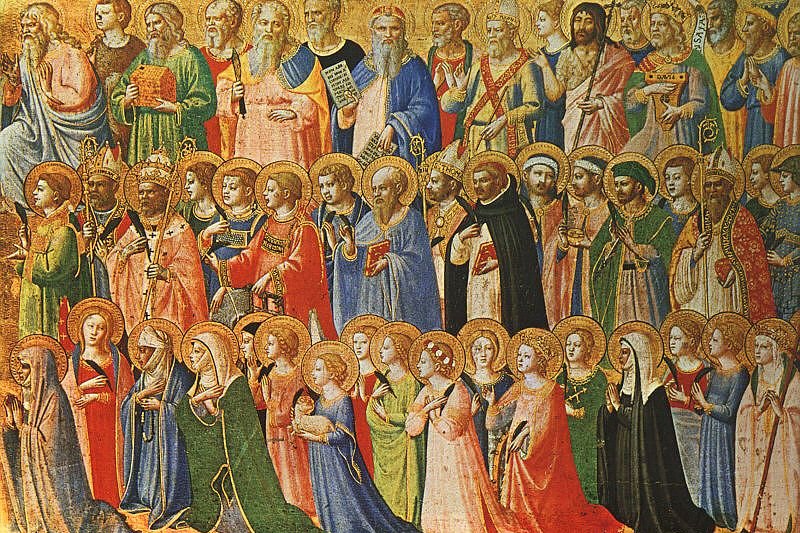
Fra Angelico, The Forerunners of Christ with Saints and Martyrs, c. 1420s, National Gallery, London — public domain.
For 2026, the answer is simple either way: November 1st falls on a Sunday. There's no separate weekday Mass to find room for — attending the Mass you'd already be at that Sunday satisfies both the Sunday obligation and All Saints Day at once. For the full US list and how each of the other five holy days is handled, see our complete guide to holy days of obligation.
Why the day of the week matters at all
Here's the wrinkle that trips people up. US bishops have decreed that whenever November 1st falls on a Saturday or a Monday, the obligation to attend Mass specifically for All Saints Day is lifted for that year — abrogated, in canonical language. The same exception applies to two other dates on the US list: Mary, Mother of God (January 1) and the Assumption of Mary (August 15). The reasoning is practical rather than theological: a Saturday or Monday observance would otherwise sit immediately next to the regular Sunday obligation, in effect asking Catholics to attend Mass on back-to-back days purely because of where a date falls on the calendar.
Christmas and the Immaculate Conception don't get this exception. Those two remain obligatory every single year regardless of the day of the week, because the Church treats them as unconditional.
So the practical checklist for any given November 1st looks like this:
- Sunday — no separate issue; it folds into the Sunday obligation you already have, exactly as in 2026.
- Saturday or Monday — the obligation for that year is lifted entirely; attending isn't required, though it remains a beautiful day to go anyway.
- Tuesday through Friday — the obligation stands as normal, a standalone weekday Mass separate from the following Sunday.
Worth noting: this abrogation is specific to how the US bishops' conference has applied the rule. Universal Church law sets the baseline list of ten possible holy days, but national bishops' conferences, with Vatican approval, can adjust how the list is actually observed locally — which is also why a Catholic who's only ever attended Mass in the US can be surprised to find a different country's calendar treats the same date differently.
What the obligation actually means
"Holy day of obligation" isn't church jargon for "a nice day to go to Mass if it's convenient." The Catechism states the underlying precept plainly: "You shall attend Mass on Sundays and on holy days of obligation and rest from servile labor" (CCC 2042). That obligation is satisfied by attending Mass anywhere it's validly celebrated in a Catholic rite, either on the holy day itself or at an evening Mass the preceding day (CCC 2180) — which is why many parishes schedule a Halloween-evening Vigil Mass for All Saints when the date falls on a weekday.
The Church is direct about what's at stake in disregarding it without good reason: deliberately skipping Mass on a Sunday or holy day of obligation is treated as grave matter (CCC 2181), the same weight given to missing Sunday itself. At the same time, the Church has always recognized real limits on a person's control — illness, caring for a sick family member, dangerous travel conditions, or a genuine impossibility of attending excuse someone from the obligation without any sin attached. The rule targets deliberate neglect, not circumstances beyond someone's control.
What All Saints Day is actually celebrating
It's easy to assume "All Saints" just means a general day to think about holiness, but the feast has a specific scope: it honors every soul believed to have reached heaven, not only the relatively small number the Church has formally canonized and given an individual feast day on the calendar. The Catechism describes the saints in heaven as those "more closely united to Christ" who "do not cease to intercede with the Father for us" (CCC 956–957) — language that covers the vast, largely unnamed multitude the Church believes share in that glory, alongside the saints whose names and stories are well known.
That's worth separating clearly from the day immediately after it. All Souls Day, November 2nd, commemorates something different: the faithful departed generally, understood as souls still undergoing purification in purgatory before entering heaven's full glory. All Saints honors those already believed to have arrived; All Souls prays for those the Church believes are still on the way. The two feasts sit back-to-back on the calendar precisely because they're meant to be held together — but they aren't the same observance, and only All Saints Day carries a Mass obligation. (For more on the history and customs behind November 1st itself, see our full look at All Saints Day traditions.)
A date worth keeping track of each year
Because the obligation status genuinely changes depending on which day of the week November 1st falls on, it's reasonable — not excessive — to check each autumn rather than assume last year's answer still applies. For 2026, the calendar makes it easy: November 1st lands on a Sunday, so the only thing to plan for is showing up to the Mass you'd already be attending that weekend, to mark a feast the Church has kept at the center of its calendar since the early Middle Ages — a day set aside for every saint in heaven, known and unknown, on equal footing with Sunday itself.
Trivia
Is All Saints Day a Holy Day of Obligation in the United States?
Is All Saints Day 2026 a day of obligation?
Why does the obligation for All Saints Day sometimes get lifted?
What happens if a Catholic misses Mass on All Saints Day without a serious reason?
What is the difference between All Saints Day and All Souls Day?
Related Reading