Our Lady of Perpetual Help: The Icon's Lost-and-Found Story

A painting with no agreed-upon birth certificate
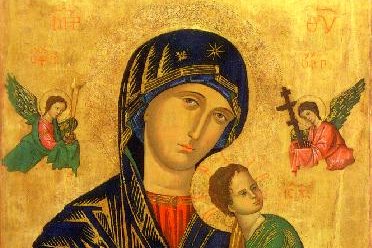
Start with what the icon's own custodians, the Redemptorists, will actually commit to in writing, because the popular versions of this story tend to run ahead of the evidence. The panel itself — gold-ground, walnut wood, just under two feet tall — underwent a thorough technical restoration in 1990, carried out in partnership with the Vatican Museums' own technical department. X-ray, infrared scanning, and a carbon-14 test on the wood placed its creation somewhere between 1325 and 1480, a Byzantine-style work almost certainly produced in Crete, which was for centuries a major export center for devotional icons sent into Catholic Europe.
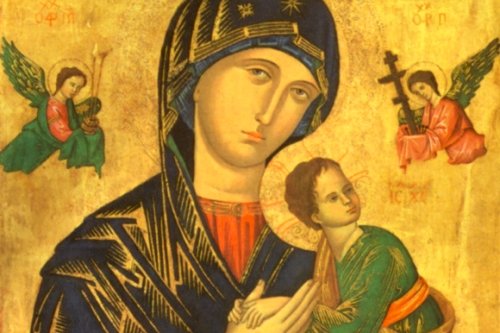
Icon of Our Mother of Perpetual Help, Cretan school, 15th century, Church of Sant'Alfonso di Liguori all'Esquilino, Rome. Public domain, via Wikimedia Commons.
Who painted it is genuinely unsettled. Some art historians have pointed to Andreas Rizo de Candia, a leading painter of the Cretan school whose surviving works share a strong family resemblance with the icon — but this is scholarly speculation, not a signed attribution, and the Redemptorists' own historical account of the image doesn't name an artist at all. What is agreed on all sides is the type of image it represents: a Hodegetria, meaning Mary is shown pointing toward her Son rather than simply holding him, combined with the specific subtype scholars call Theotokos of the Passion — Mary and the Child flanked by angels bearing instruments of Christ's eventual suffering, the Child reacting to them with visible alarm, one sandal slipping from his foot in the commotion.
From a private house to a public shrine — then gone
The icon's own traditional origin story, as the Redemptorists tell it, involves a Roman merchant who brought the image back from Crete in the late fifteenth century and kept it in his family's home. According to that tradition, the merchant's six-year-old daughter received a vision of the Blessed Virgin instructing her to tell her mother and grandmother that the image should be placed instead in the church of San Matteo (Saint Matthew the Apostle), situated between the great basilicas of St. Mary Major and St. John Lateran. It's worth being honest about what kind of claim this is: it survives only as pious tradition passed down through the religious order that now cares for the icon, not as something independently documented at the time, and should be read that way rather than as settled history.
What is documented is the transfer itself. On March 27, 1499, the icon was installed in San Matteo in Via Merulana, a church run by the Augustinian friars, where it remained publicly venerated for almost exactly three hundred years and became known locally as the "Madonna di San Matteo." That long, stable chapter ended abruptly in 1798, when French Revolutionary troops occupying Rome under Napoleon's forces demolished the church along with several others in the area, part of the broader upheaval that saw Pope Pius VI himself taken prisoner. Augustinian friars managed to rescue the icon before the building came down, moving it first to the nearby Church of St. Eusebius and eventually to a side altar at Santa Maria in Posterula, across the Tiber. There it sat — not destroyed, not hidden exactly, but effectively forgotten by the wider public — for the better part of sixty years.
A young missionary, an old complaint, and a coincidence of geography
The icon's return to public devotion came through the Redemptorists, officially the Congregation of the Most Holy Redeemer, a missionary order founded in the eighteenth century by St. Alphonsus Liguori. The man usually credited with reviving interest in the image was Fr. Michael Marchi, a young Redemptorist who, as a boy, had attended Mass near San Matteo before its destruction and still remembered the icon from childhood. At Santa Maria in Posterula, an Augustinian friar named Agostino Orsetti had long complained that the image received little attention there, overshadowed on the main altar by a different, more prominently placed Marian painting. Marchi saw an opportunity: the Redemptorists were already planning a new church of their own on the Esquiline Hill, and he brought the matter to his order's superior general, Fr. Nicholas Mauron, who in turn petitioned Pope Pius IX for custody of the icon.
Pius IX agreed. On December 11, 1865, he sent formal instructions ordering the Augustinians to surrender the original image to the Redemptorists — on the condition that the Redemptorists supply the Augustinians with a suitable replacement painting in exchange, a detail of practical fairness easy to overlook amid the story's more dramatic turns. In January 1866, Fathers Marchi and Ernest Bresciani went to Santa Maria in Posterula and formally received the icon. What neither they nor, apparently, anyone else involved had fully registered until that point was a striking piece of geography: the Redemptorists had purchased their property on Via Merulana back in 1855, years before the custody question ever arose, with no particular knowledge of what had once stood there. It turned out to be the very ground once occupied by the old church of San Matteo. The icon that tradition said Mary herself had asked to be placed "between St. Mary Major and St. John Lateran" was, without any deliberate planning by the people arranging its return, coming home to the same patch of the Esquiline Hill it had occupied three centuries earlier. The Redemptorists built their new church, Sant'Alfonso di Liguori all'Esquilino, on that site and installed the icon above its main altar, where it remains today.
Pope Pius IX moved quickly to formalize the devotion. He commissioned the restoration of the damaged, worn painting (carried out by the Polish painter Leopold Nowotny in 1866) and, on May 5 of that year, issued a pontifical decree giving the image its official Latin title, Nostra Mater de Perpetuo Succursu — Our Mother of Perpetual Succor, more familiarly Our Lady of Perpetual Help. A formal canonical coronation followed on June 23, 1867, performed by Cardinal Ruggero Luigi Emidio Antici Mattei. Tradition within the Redemptorist order holds that Pius IX charged the congregation directly to "make her known" to the wider Church — whatever the precise wording, the order clearly took the charge seriously.
A global devotion built on careful copies
The Redemptorists' missionaries did, in fact, make the image known on a scale few devotional icons ever achieve. Because the order is explicitly missionary — founded to serve ordinary parishes rather than stay cloistered in one place — Redemptorist priests carried copies of the icon to the parishes and mission territories they served across the globe, and a weekly novena built around the image became a fixture of Redemptorist parish life. The devotion found unusually fertile ground in the Philippines, where Irish Redemptorist missionaries introduced the Wednesday novena in the early twentieth century; today a copy is enshrined at the National Shrine of Our Mother of Perpetual Help in Baclaran, Parañaque, and reproductions of the image are common enough in Filipino homes, shops, and even jeepneys that the image functions almost as a piece of everyday visual culture, not just church decoration. Similar Redemptorist-led devotions took hold in Haiti, in parts of Latin America, in Ukraine (where it is venerated under the Eastern title Virgin of the Passion), and in numerous English and Irish dioceses that still carry the title in their patronage.
The feast day itself, June 27, was fixed by Pius IX in 1876. It was eventually removed from the Church's universal calendar during the post-Vatican II liturgical reforms, but several national bishops' conferences — including those of Mexico, Haiti, Peru, Puerto Rico, Costa Rica, and Russia — restored it to their own local calendars, and the Redemptorist order itself continues to celebrate it with its own full set of liturgical texts. Nearly five hundred years after it first slipped into near-total obscurity in a side chapel across the Tiber, the image Mary is said to have asked be placed "between two basilicas" still gazes out at devotees from that same stretch of Roman ground, its two attendant angels still holding out, with evident foreboding, the instruments of a suffering not yet arrived.
Trivia
Where is the original icon of Our Lady of Perpetual Help kept today?
How old is the icon, and who painted it?
Why was the icon lost for so long?
What are the angels in the icon holding?
Why is the devotion so strong in the Philippines?
Related Reading