Notre-Dame de Paris

Almost two centuries to build
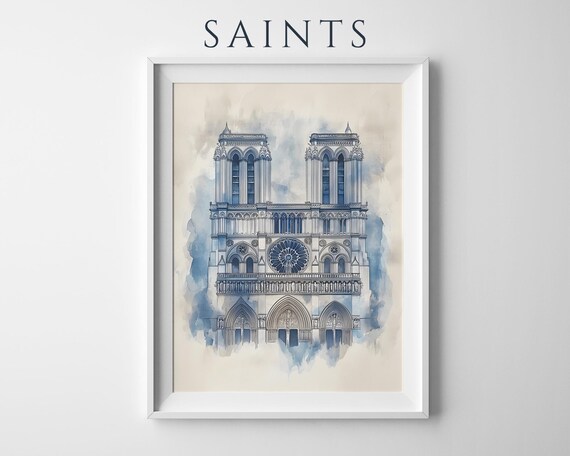
Notre-Dame's foundation stone was laid in 1163, during the reign of Louis VII, under the direction of Bishop Maurice de Sully — but the cathedral he started was not finished in his lifetime, or his successor's, or the one after that. The nave was substantially complete by around 1250, the towers by 1260, and work on side chapels and other refinements continued into the 14th century. Entire careers, and in some cases entire lives, were spent working on a building whose completion its earliest stonemasons would never see. What rose from that patience was one of the defining works of French Gothic architecture: flying buttresses supporting soaring stone walls, enormous rose windows filling the interior with colored light, and a west facade whose twin towers became the silhouette most people picture when they hear the word "cathedral."
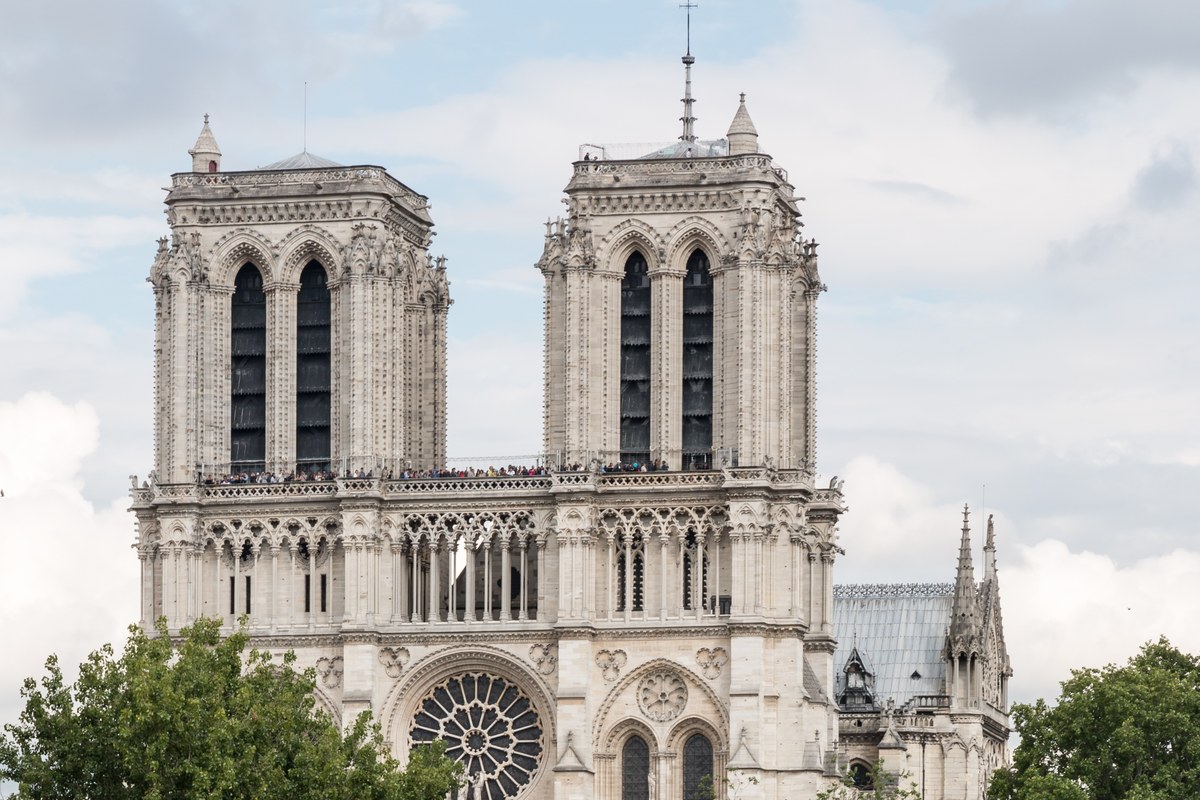
Photo by Dietmar Rabich, "Paris, Notre-Dame -- 2014," cropped, CC BY-SA 4.0, via Wikimedia Commons.
Notre-Dame was built on the Île de la Cité, a small island in the Seine that had already served as a religious site for centuries before Bishop de Sully broke ground — earlier churches, and possibly a Gallo-Roman temple before them, had occupied roughly the same spot. Its Gothic style was, in the 1160s, still a genuinely new architectural language, pioneered only a couple of decades earlier at the royal abbey of Saint-Denis just outside Paris. Notre-Dame helped popularize it on a grand civic scale: the flying buttress, in particular, was an engineering breakthrough that let builders push walls higher and fill them with more glass than earlier Romanesque churches could safely support, since the buttresses carried the outward thrust of the stone roof away from the walls rather than letting the walls bear it alone. The result was an interior that felt, by the standards of its day, almost weightless — vast stone volumes lit by colored glass rather than enclosed by heavy, windowless masonry.
The cathedral's three great rose windows, particularly the north transept rose, are still largely filled with 13th-century glass, remarkable survivals given the building's long and often turbulent history. Its statuary and carved portals told biblical stories to a population that, in the medieval period, mostly could not read — the west facade's tympanums depict the Last Judgment and scenes from the life of the Virgin Mary in stone relief meant to be understood at a glance by anyone standing in the square below.
A revolution, a novel, and a near-collapse
By the late 1700s, Notre-Dame had fallen into serious disrepair, and the French Revolution made things considerably worse: revolutionaries damaged or destroyed many of its statues, and the building was repurposed away from Catholic worship entirely for a time. During the most radical phase of the Revolution, it was rededicated to a "Cult of Reason," its treasures were looted or melted down, and the row of statues on the west facade depicting the biblical kings of Judah was mistaken for a gallery of French monarchs and beheaded by a revolutionary mob — several of the actual heads, recovered by archaeologists in a Paris basement in the 1970s, are now on display in the Musée de Cluny. By the early 19th century, there were genuine proposals to demolish it. What helped save it was, in part, a novel — Victor Hugo's "The Hunchback of Notre-Dame," published in 1831, rekindled public affection for the cathedral and helped drive the major restoration that architect Eugène Viollet-le-Duc carried out from the 1840s onward, including the addition of the spire and many of the gargoyles most visitors now assume are medieval.
Viollet-le-Duc's restoration was, in its own way, controversial even at the time — he didn't merely repair what had existed before but made creative additions of his own, including the very spire that would later collapse in the 2019 fire and a self-portrait carved among the apostle statues that once ringed its base. Whatever the debates over his methods, the restoration gave Notre-Dame the silhouette most of the world came to recognize, and it remained largely unchanged for well over a century afterward.
The fire, and what came after
On April 15, 2019, a fire broke out in the cathedral's attic and quickly spread, collapsing the 19th-century spire and destroying most of the wooden roof structure — a loss watched, in real time, by a stunned crowd along the Seine and a global audience beyond it. The roof's timber framework, nicknamed "the forest" because of the sheer number of ancient oak beams it contained, many dating to the original medieval construction, was almost entirely lost. The stone towers, the facade, and the great rose windows survived, along with most of the cathedral's relics and artwork, thanks to firefighters and a chain of volunteers who worked to carry treasures out of the burning building.
What followed was a five-year restoration that brought together roughly two thousand craftspeople, architects, and specialists working to rebuild the roof and spire using historically accurate techniques and materials, including traditional hand tools and timber framing methods essentially unchanged since the Middle Ages. French forests supplied the oak for a new "forest" of roof beams, and stonemasons trained in centuries-old techniques repaired the vaulted stone ceiling beneath it. Notre-Dame reopened to the public on December 7, 2024 — not as a museum piece frozen in time, but as a working cathedral once again, having survived a revolution, centuries of weather, and a fire that came close to taking the whole structure with it.
Why it still matters
Notre-Dame was never simply a tourist landmark that happened to have a church inside it. It is dedicated, as its name says plainly, to Mary — Notre Dame, Our Lady — and it was built, stone by stone across two centuries, by people who would never see it finished, for a purpose that had nothing to do with their own recognition. That's part of why its near-loss in 2019 hit so many people who had never set foot in Paris: buildings built on that kind of patience are rare, and losing one, even partially, felt like losing something that couldn't simply be replaced. Its return in 2024 said the opposite — that patience like that can still be found today.
It remains, above all, a functioning cathedral rather than a monument kept behind glass: Mass is celebrated there daily, pilgrims still come to venerate its relics, including a relic venerated as a fragment of the Crown of Thorns, and its bells — several of which survived the fire — still ring out over the Seine. Visitors curious about other landmarks shaped by centuries of Catholic devotion may also want to read about Our Lady of Perpetual Help, one of the most widely reproduced Marian images in the world, a reminder that devotion to Mary has taken very different physical forms across the Church's history — from a single icon small enough to hold, to a cathedral that took two centuries and thousands of hands to raise.
Trivia
What does the name Notre-Dame mean?
How long did Notre-Dame take to build?
What happened to Notre-Dame in 2019?
Has Notre-Dame reopened since the fire?
Related Reading