The Wedding at Cana

A wedding, not a crisis of life or death
John places this scene early and deliberately, "on the third day" (John 2:1, RSV-CE) after the events that open his Gospel — a detail scholars have long connected to the careful week-by-week structure John uses in his opening chapters, building toward this first sign as a kind of culmination of Jesus's earliest days of public ministry. Cana itself was a modest village in Galilee, not far from Nazareth, and nothing about the setting suggests any special significance before the wine runs out — it's an entirely local, small-scale family wedding, the kind of event that would otherwise have left no trace in history at all.
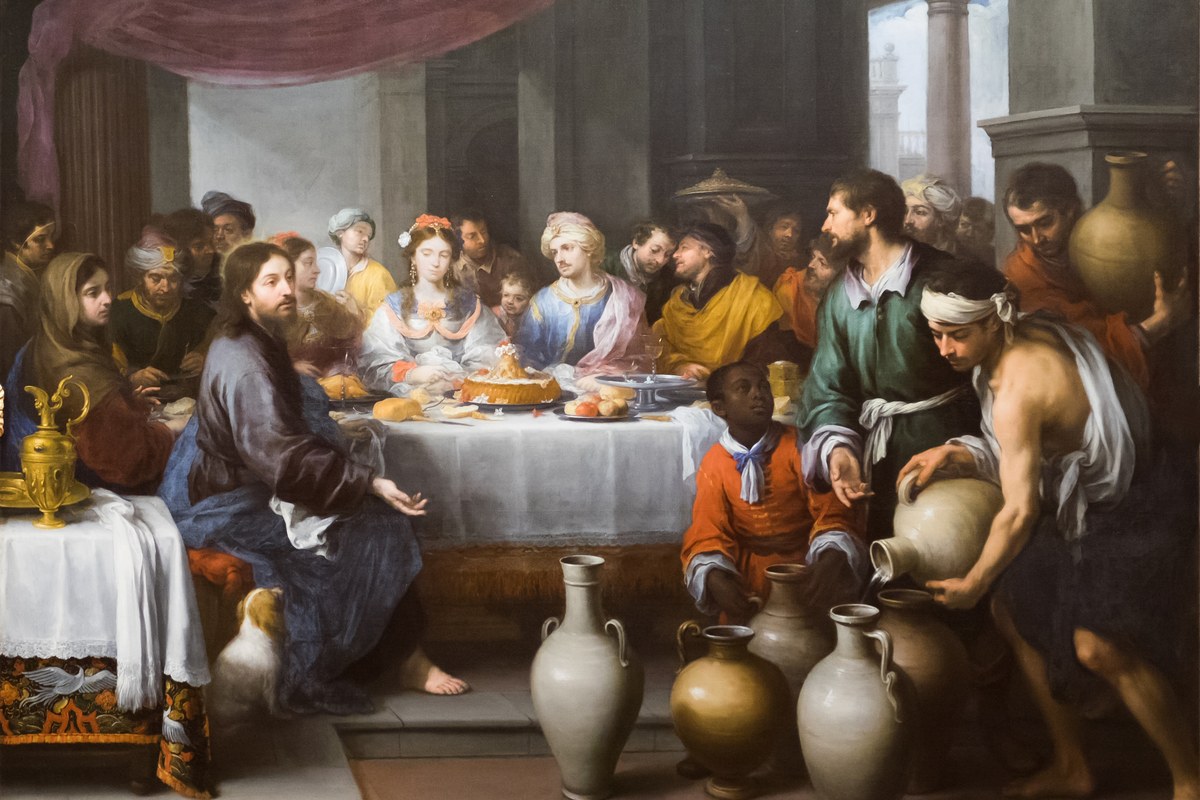
Bartolomé Esteban Murillo, "The Marriage Feast at Cana," 17th century — public domain.
Compared to the miracles that follow it in the Gospels — healing the blind, calming storms, raising the dead — the wedding at Cana starts with a strikingly small-scale problem: the wine has run out. John records the scene plainly: "the wine gave out," and Jesus's mother brings the problem to him directly, telling him, "They have no wine" (John 2:3, RSV-CE). Nothing about the situation is dangerous. It is, at most, a social embarrassment for a newly married couple and their families — which makes it a deliberately unusual place for the Gospel of John to locate the very first sign of who Jesus is.
"Do whatever he tells you"
Jesus's own response is notably reluctant: "Woman, how does your concern affect me? My hour has not yet come." (John 2:4, RSV-CE) — language that suggests he does not consider this the moment to begin revealing himself. His mother doesn't argue the point. She simply turns to the servants and says, "Do whatever he tells you" (John 2:5, RSV-CE), a instruction that assumes he will act regardless of what he has just said. It's one of the few moments in the Gospels where another person's confidence in Jesus visibly outpaces his own stated timeline — and the story sides with her.
A setting soaked in older meaning
Weddings and wine both carried heavy symbolic weight in the world John was writing for. Old Testament prophets regularly pictured Israel's covenant with God as a marriage, and abundant wine as a sign of the blessing that would accompany the promised age of restoration — Amos and Joel both describe a future in which the "mountains shall drip sweet wine" as part of Israel's renewal. Placing the beginning of Jesus's public signs at a wedding feast running short on wine, then quietly filling that shortage to overflowing, lines up with imagery readers steeped in Scripture would have recognized immediately: a bridegroom's abundance arriving in the middle of an ordinary celebration.
Ordinary water, extraordinary quantity
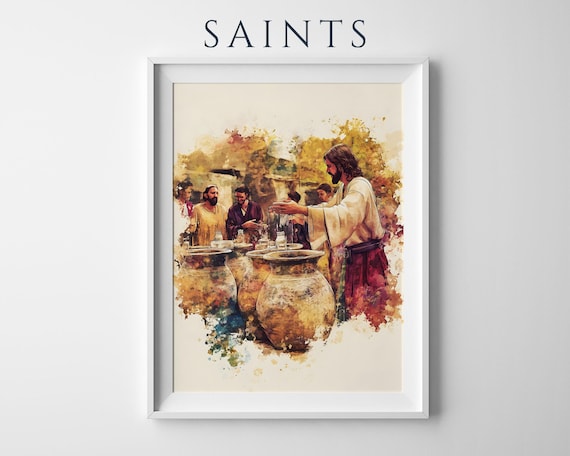
What happens next is described with careful, almost mundane detail: six stone jars used for ceremonial washing, each holding twenty or thirty gallons, filled with plain water at Jesus's instruction (John 2:6-7, RSV-CE). When it's drawn out and tasted, the master of the banquet is startled — not because it's become wine, but because it's better than what was served first: "you have kept the good wine until now" (John 2:10, RSV-CE). The sheer volume involved, well over a hundred gallons by any estimate, is often read less as a fix for one evening's shortage and more as a signal of the scale of abundance Jesus's presence brings — far more than the immediate need required.
Why John calls it the first "sign"
John closes the account with a line that reframes everything before it: "Jesus did this as the beginning of his signs in Cana in Galilee and so revealed his glory, and his disciples began to believe in him." (John 2:11, RSV-CE). John's Gospel consistently uses "signs" rather than "miracles" for these events, treating each one as a pointer toward Jesus's identity rather than simply a demonstration of power. That a wedding's wine shortage was where this pattern began — quiet, domestic, prompted by his mother rather than a crowd's desperation — has made Cana a lasting reminder that his first public act was one of generosity in an entirely ordinary setting.
Mary's role, and how the Church has read it
Catholic tradition has paid close attention to Mary's part in this scene. She doesn't perform the miracle, doesn't command it outright, and receives what sounds like a mild rebuff from her son — yet her simple confidence that he will act, expressed in her instruction to the servants, is enough to set the whole episode in motion. Catholic teaching has long pointed to this moment as an example of Mary's intercessory role: bringing others' needs to Jesus and trusting him to respond in his own way and his own time, a pattern many Catholics look to as a model for their own prayers asking for her intercession.
The connection between wine transformed and the Eucharist, where wine is again central and again understood to become something more than it appears, was not lost on early Christian readers either. Read alongside the Feeding of the Five Thousand, another meal in John's Gospel that points toward the Eucharist, Cana marks the first note in a theme John returns to throughout his account: ordinary food and drink, in Jesus's hands, becoming the occasion for something far larger than a single meal.
Trivia
What actually happens at the wedding at Cana?
Why does Jesus initially seem reluctant to help?
Why does John call this event a 'sign' rather than a miracle?
Is there significance to the amount of wine produced?
Related Reading