Our Lady of Perpetual Help

An icon older than its Roman home
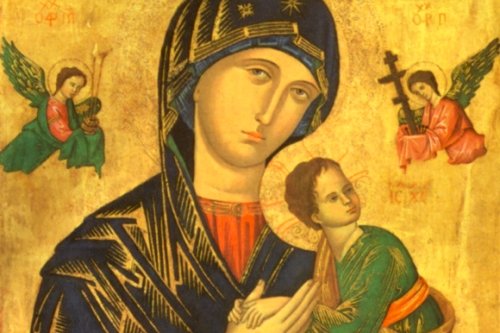
The image known as Our Lady of Perpetual Help is a Byzantine-style icon, believed by tradition to have originated on the island of Crete, likely painted sometime in the late medieval period. It depicts Mary holding the child Jesus close, her expression solemn rather than serene — and the child himself is shown looking not at his mother but toward an angel bearing instruments of the Passion, the cross and nails. That detail is central to how the image has always been read theologically: even as an infant, Jesus is depicted as aware of the suffering ahead of him, and Mary's expression reflects that same foreknowledge rather than simple maternal tenderness.
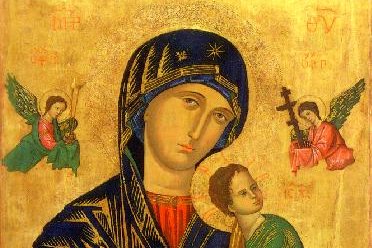
"Our Mother of Perpetual Help," 15th century, unknown author. Public domain (Wikimedia Commons).
The icon follows a recognizable Byzantine type, sometimes called the "Strastnaya" or "Passion" icon in Eastern iconographic tradition, in which two archangels — usually identified as Michael and Gabriel — flank the Virgin and Child bearing the instruments of the Passion between them. A small, easily overlooked detail often noted by those who study the icon closely is that one of the child Jesus's sandals has come loose and dangles from his foot, as though he had turned so suddenly toward the vision of the cross that his sandal slipped — a tiny human touch inside an otherwise formal, symbolic composition. Icons of this general type were painted and venerated across the Byzantine and post-Byzantine world for centuries; what makes this particular one distinct is simply the specific, documented history of the physical object itself, and the devotion that grew up around that one panel rather than the type in general.
Stolen, and gone from public view for decades
At some point after arriving in Rome, the icon was placed in a church there and became an object of local devotion — until it was stolen by a merchant, according to the traditional account surrounding its history, and effectively vanished from public veneration for roughly forty years. Exactly how and where it was kept during that period isn't part of the well-documented tradition; what the story focuses on instead is how it eventually resurfaced.
Tradition holds that the merchant, on his deathbed, confessed to the theft and asked that the icon be placed somewhere it would once again receive public veneration, a request his family reportedly did not carry out with any urgency, which is part of why the image stayed out of public view for as long as it did. That gap of roughly four decades meant that, by the time the icon resurfaced, an entire generation of Roman Catholics had grown up without ever having seen it — a genuine disappearance, not simply a quiet relocation.
A child's dream and a pope's directive
Tradition holds that the icon's location came to light through the account of a dying child, who reported that Mary had appeared to him and told him where the image could be found. Whatever the precise details of that account — which, like much of the icon's early history, rests on tradition rather than documented record — it led to the icon's rediscovery, and in 1866 Pope Pius IX personally intervened, directing that it be placed in the church of Sant'Alfonso di Via Merulana, on a site that, notably, had itself once stood near the older church associated with the icon's earlier home. Pius IX is widely quoted as instructing the Redemptorist order, who were given custody of the icon, to "make her known" — a charge they took literally and ran with for the century and a half that followed.
A devotion that spread through a religious order
The Redemptorists — the same missionary congregation Saint John Neumann had joined decades earlier in America — became the primary force behind spreading devotion to Our Lady of Perpetual Help internationally. Reproductions of the icon spread to parishes across the world, often accompanied by the Perpetual Novena, a set of prayers traditionally offered on Wednesdays that became one of the most widely practiced Marian devotions of the 20th century in many countries, including the Philippines, where devotion to this title remains especially strong.
Part of what made the devotion travel so effectively was how portable it was compared to other major Marian shrines: rather than requiring a pilgrimage to a single fixed location, the Perpetual Novena could be prayed anywhere a parish had a reproduction of the icon and a copy of the printed prayers, which the Redemptorists distributed widely. Churches from Baltimore to Manila to Lagos adopted Wednesday devotions built around the image, and in many of those places, "Perpetual Help" parishes became common enough that the title functions almost like a patron saint's name in its own right, independent of the specific icon in Rome that originated it.
The icon today
The original icon remains enshrined at Sant'Alfonso in Rome, largely undisturbed since Pius IX's 1866 directive placed it there. The Church celebrates the feast of Our Lady of Perpetual Help on June 27 each year. What makes the image unusual among Marian devotions is how directly traceable it is to one specific, physical object — most churches and homes displaying "Our Lady of Perpetual Help" today are displaying a reproduction of this same Cretan icon, rather than a generic or symbolic representation of Mary.
The icon was formally crowned in 1867 by the Vatican chapter of St. Peter's Basilica, a traditional papal honor reserved for images considered especially significant to Catholic devotion, cementing its status well beyond that of an ordinary parish icon. Its story sits alongside a wider tradition of Marian images with their own distinct histories of loss, rediscovery, or miraculous origin — a reminder that Marian devotion across the Catholic world is often anchored not in an abstract idea of Mary, but in specific images, places, and stories that communities have carried forward, sometimes for centuries, sometimes through genuine interruption, as this one was.
Trivia
What kind of image is Our Lady of Perpetual Help?
How did the icon disappear, and how was it eventually recovered?
What role did Pope Pius IX play in the icon's history?
Why are the Redemptorists specifically associated with this devotion?
When is the feast of Our Lady of Perpetual Help celebrated?
You May Also Like
Related Reading