Saint Catherine of Siena

A vision at seven years old
Catherine's spiritual life began remarkably early. At just seven, she reported seeing a vision of Christ enthroned in pontifical robes, accompanied by the apostles Peter, John, and Paul — an experience vivid enough that she responded by taking a private vow of virginity and committing herself to prayer and penance, long before most children are old enough to make such decisions with any lasting weight. The vision would remain, by her own account, permanently imprinted on her soul.
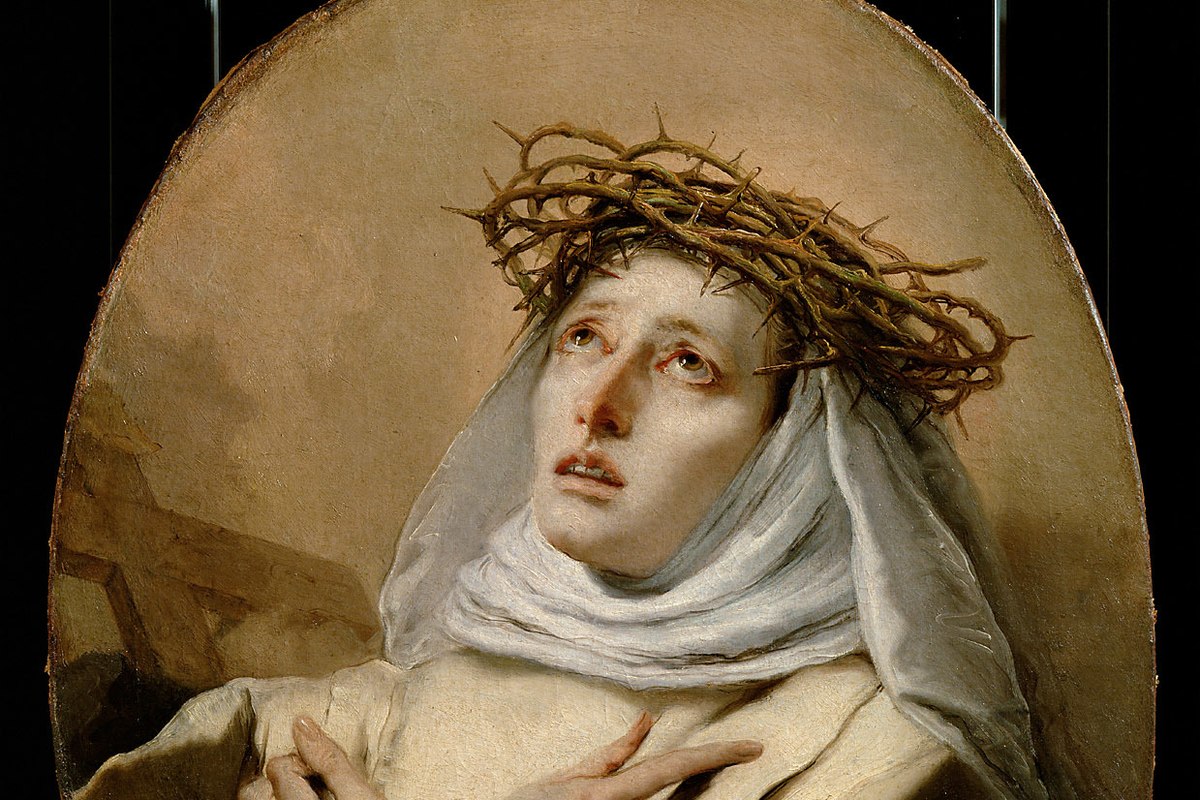
Giovanni Battista Tiepolo, "Saint Catherine of Siena," 18th century — public domain.
Catherine was born in 1347 in Siena, the twenty-third of twenty-five children born to a wool dyer and his wife — a large, ordinary household in a prosperous Tuscan city, not the kind of setting that typically produced a future Doctor of the Church. Her family expected her to marry, as was customary for a girl of her age and station, and by her teenage years she faced considerable pressure to accept a suitor. She refused. According to tradition, she cut off her hair to make herself less attractive to prospective husbands, a small act of defiance that her family met with anger, assigning her the household's most menial chores in an attempt to break her resolve. She treated the punishment as its own kind of discipline, later saying she imagined the family home as a monastery and her chores as acts of service to Christ.
At sixteen, Catherine joined the Mantellate, a lay association of Dominican women — most of them widows — who lived at home rather than in a convent, wore a modified habit, and devoted themselves to prayer and service to the poor and sick. It was an unusual path for someone so young and unmarried, and the older women initially resisted admitting her. She spent the years that followed largely in seclusion, praying and fasting in a small room in her family's house, before emerging around age twenty to begin the public ministry of nursing, almsgiving, and letter-writing that would define the rest of her life. Catherine belonged to the same Dominican family as Saint Dominic de Guzman, the order's Spanish founder, though she lived a century and a half after him and never joined a cloistered community herself.
Nursing the sick and feeding the hungry
Long before her letters reached the papal court, Catherine's reputation in Siena rested on far humbler work. She nursed victims of leprosy and of the recurring outbreaks of plague that swept through Tuscany in the 1370s, tending to sufferers whom others in the city were too frightened to approach. She organized care for the poor during a severe famine in 1374, begging for food and distributing it herself, and she visited prisoners condemned to execution, sitting with them in their final hours and, by her own account, praying them into a peaceful death. This combination — mystic given to ecstatic visions on one hand, tireless caregiver to the sick and condemned on the other — is part of what distinguishes Catherine from many contemplatives of her era. Her holiness was never confined to prayer alone.
It was also during this period that Catherine, though largely unschooled in formal letters, learned to dictate correspondence with remarkable fluency, drawing a circle of followers — priests, nobles, and fellow laypeople — who called themselves her bella brigata, her "lovely company." They served as her scribes and travel companions as her reputation, and her ambitions for reforming a fractured Church, grew well beyond Siena.
Moving a pope without holding any office
What makes Catherine's later influence so unusual is that she achieved it with no formal standing in the Church whatsoever — no ordination, no official role, nothing beyond her reputation for holiness and an extraordinary gift for direct, persuasive writing. She traveled to Avignon as an unofficial mediator during a period when the papacy had been based in France for decades, and through sustained correspondence and personal appeals, she is widely credited with a pivotal role in convincing Pope Gregory XI to return the papal seat to Rome in 1377 — ending nearly seventy years of what became known as the Avignon papacy.
Her letters to Gregory XI were remarkably direct for someone with no ecclesiastical rank addressing the head of the Church. She wrote of her distress at seeing "the Bride of Christ" — a traditional image for the Church — governed from a foreign court, and pressed the pope to return "not with fear, but with the fervent desire and love of a father" for his people in Rome. When Gregory finally made the journey back to Rome in January 1377, Catherine's supporters credited her persistence as much as any political calculation. Even after his return, the peace proved short-lived: within a year of Gregory's death, a disputed election produced two rival claimants to the papacy, the beginning of what historians call the Western Schism. Catherine spent her final years writing forcefully in support of Gregory's successor, Urban VI, working to hold together a Church that was once again fracturing even after her first great victory.
Wounds no one else could see
Catherine's mystical experiences continued alongside her public influence. In 1375, while praying in Pisa, she reported receiving the stigmata — the wounds of Christ — though at her own request, the marks remained invisible to everyone but herself for the remainder of her life. It was a private suffering laid quietly alongside a very public ministry, kept deliberately out of view even as her letters reached popes and princes.
A short life, a lasting theological voice
Catherine died in Rome at just 33, having dictated her most significant theological work, The Dialogue, in the final years of her life — recorded conversations between herself and God that became a defining text of medieval Christian mysticism. In 1970, Pope Paul VI declared her a Doctor of the Church, only days after granting the same title to Teresa of Ávila — making Catherine one of the very first women in the Church's history to receive its highest recognition for theological writing, achieved without ever holding any formal position within the institution she helped reshape. She remains one of only four women, alongside Saint Teresa of Ávila, Thérèse of Lisieux, and Hildegard of Bingen, to hold the title.
Iconography and the mystical marriage
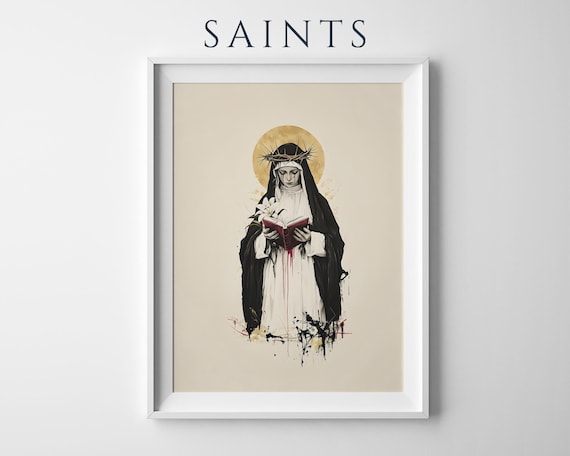
Painters through the centuries have returned again and again to a handful of scenes from Catherine's life. She is most often shown in the black-and-white habit of the Dominican tertiaries, a lily in one hand as a sign of her purity, and frequently with a crown of thorns — a reference to a vision in which she reported being offered a choice between a crown of gold and a crown of thorns, and choosing the thorns as a share in Christ's suffering. Some depictions show her receiving a ring from Christ himself, commemorating what her earliest biographer, her confessor Raymond of Capua, described as a "mystical marriage" — a private vision of espousal to Christ that Catherine treated as the seal on her vow of virginity. Artists including Giovanni Battista Tiepolo, whose portrait of Catherine appears above, and earlier Sienese painters returned to these same motifs, giving later generations a consistent visual vocabulary for a woman who left behind no other image of herself.
Patroness of Siena, Italy, and Europe
Catherine's own city claims her as one of its own: she is honored as a patron of Siena alongside the Virgin Mary, and her preserved head is kept as a relic in the Basilica of San Domenico there, while the rest of her body remains in Rome's Basilica of Santa Maria sopra Minerva. Beyond Siena, her influence in holding the papacy together during one of its most turbulent centuries eventually earned her recognition on a much larger scale, joining her in spirit to other Doctors of the Church whose writings shaped Catholic theology — a group profiled more fully on the Doctors of the Church directory. Her feast day, April 29, falls just a week before that of her fellow Sienese Dominican Saint Agnes of Montepulciano, a pairing that reflects how closely the city's religious identity became bound up with its Dominican community in the fourteenth century.
Trivia
How old was Catherine when she experienced her first major vision?
What role did Catherine play in the Avignon papacy?
Did Catherine really receive the stigmata?
Why was Catherine declared a Doctor of the Church?
What is Saint Catherine of Siena the patron saint of, and when is her feast day?
Related Reading