Saint Bede the Venerable


A life spent almost entirely within one monastery
Bede's world was, by any modern standard, remarkably small. Sent to the monastery of Monkwearmouth at just seven years old, he later joined its companion house at Jarrow, in the Anglo-Saxon Kingdom of Northumbria, and remained within that same monastic community for essentially the whole of his life, from 672/673 until his death in 735. He wasn't a widely traveled figure or a court advisor moving between centers of power — he was, for over sixty years, simply a monk immersed in study, inside one relatively remote corner of England.
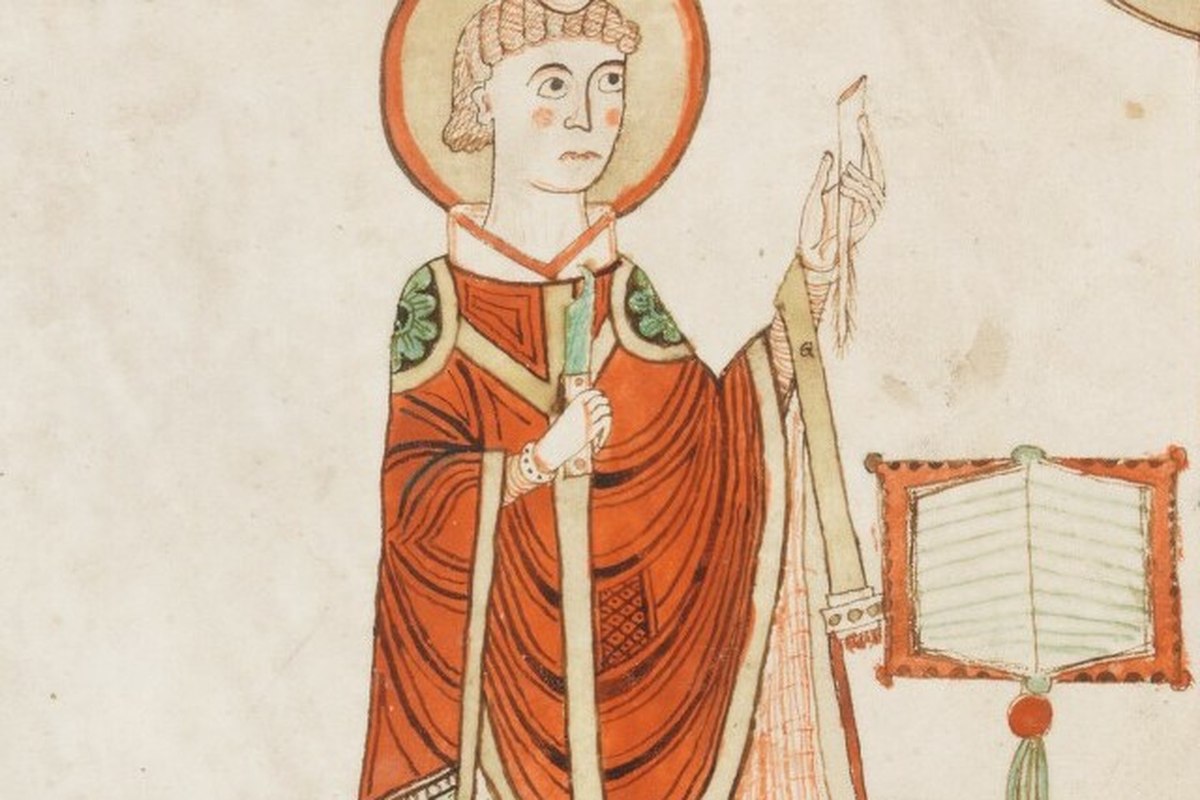
Illumination of the Venerable Bede, 12th-century manuscript, e-codices — public domain.
Being sent away to a monastery so young wasn't unusual for the period; wealthier Anglo-Saxon families sometimes offered young sons to religious houses as a form of education and dedication, called oblation, and Bede seems to have thrived immediately in that setting. The twin monasteries of Monkwearmouth-Jarrow were unusually well resourced for their era, having been founded by the nobleman-turned-abbot Benedict Biscop, who made repeated journeys to Rome specifically to bring back books, relics, and skilled craftsmen — building, in effect, one of the best libraries in early medieval Britain in a corner of the country most of Europe would have considered a remote frontier. That library gave Bede access to an unusually broad range of classical and patristic texts for a scholar of his time and place, a resource base that made his own prolific later writing possible in the first place.
A history built from within that same narrow world
It was from inside that quiet, contained setting that Bede produced his most consequential work: the Ecclesiastical History of the English People, completed in 731. The book traces the conversion of the British people to Christianity from its earliest beginnings up through Bede's own era, and it remains, to this day, one of the primary sources historians rely on for understanding early Anglo-Saxon England. The achievement earned him a title still used today: "the Father of English History."
What sets Bede apart from many earlier chroniclers is his relatively careful, source-conscious method — he explicitly names his informants, distinguishes between eyewitness testimony and secondhand report, and draws on written correspondence he requested directly from other monasteries and church officials across England to verify details outside his own firsthand knowledge. It's an approach recognizably closer to modern historical method than much of what passed for history writing in the early medieval period, which often blended legend and fact with little concern for distinguishing between them. The Ecclesiastical History also preserves, almost incidentally, some of the only surviving evidence for events and figures — such as the poet Cædmon, remembered as the earliest named English poet — that would otherwise have been lost entirely, making Bede's book not just a historical narrative but one of the foundational surviving sources for the entire span of early English culture.
A translator who opened up the Church Fathers
Bede was also a skilled linguist, and his translation work made the Greek and Latin writings of the early Church Fathers considerably more accessible to his fellow Anglo-Saxons — a contribution that helped shape the development of English Christianity well beyond his own historical writing. Scholarship, for Bede, wasn't a single specialty; it extended across history, theology, and language all at once.
By later tradition, Bede spent his very last days dictating an Old English translation of the Gospel of John to a young scribe, working even as his health failed, reportedly completing the final sentence only shortly before he died — a detail recorded by one of his own students, Cuthbert, in a letter describing Bede's death that remains one of the more moving firsthand accounts of a scholar's final days to survive from the entire medieval period. Bede's other writings ranged across biblical commentary, works on grammar and rhetoric intended for teaching, treatises on natural science and the calculation of the liturgical calendar, and hagiography, including a life of Saint Cuthbert of Lindisfarne, one of the most venerated English saints of Bede's own era.
A dating system still used today
One of Bede's quieter but more far-reaching contributions was helping popularize anno Domini (AD) dating — counting years forward from the traditional date of Christ's birth — a convention that spread widely in part through the influence of his own historical writing and remains the standard dating system used across most of the world today. The system itself had been devised roughly two centuries earlier by the monk Dionysius Exiguus, but it was Bede's consistent, careful use of it throughout the Ecclesiastical History, together with his separate technical writings on chronology and the calculation of Easter, that did the most to spread the convention across Western Christendom in the centuries following his death.
In 1899, the Vatican formally recognized Bede's scholarship by declaring him a Doctor of the Church, a title he held as the only Englishman ever given it until John Henry Newman joined him in 2025 — a rare honor for a man who spent almost his entire life without leaving one small Northumbrian monastery. His epithet, "the Venerable," was already being used within a generation or two of his death, and by the time of the Council of Aachen in 836, official Church documents were referring to him by that title as though it were already an established fact — an unusually early and durable mark of respect for a scholar whose greatest influence came not from power, travel, or public office, but from the patient, careful accumulation of knowledge inside the walls of a single monastery on the edge of the known Christian world.
Trivia
Where did Bede spend most of his life?
What is Bede's most famous work?
What dating system is Bede credited with popularizing?
When was Bede named a Doctor of the Church?
What is Saint Bede the Venerable the patron saint of, and when is his feast day?
Related Reading