The Shroud of Turin: History, Science, and What the Church Actually Says

A cloth that refuses to settle the argument
In a side chapel of Turin Cathedral, locked behind bulletproof glass and climate control, lies a fourteen-foot strip of linen that has generated more scientific papers, papal statements, and heated dinner-table arguments than almost any other object in Christendom. Faintly visible on its surface is the front and back image of a man — bearded, roughly six feet tall, marked with wounds that match, in disturbing detail, the Gospel accounts of scourging, a crown of thorns, and crucifixion. Is it the actual burial cloth of Jesus of Nazareth? After more than a century of investigation, the honest answer is still: nobody knows for certain, and the Church itself declines to say.
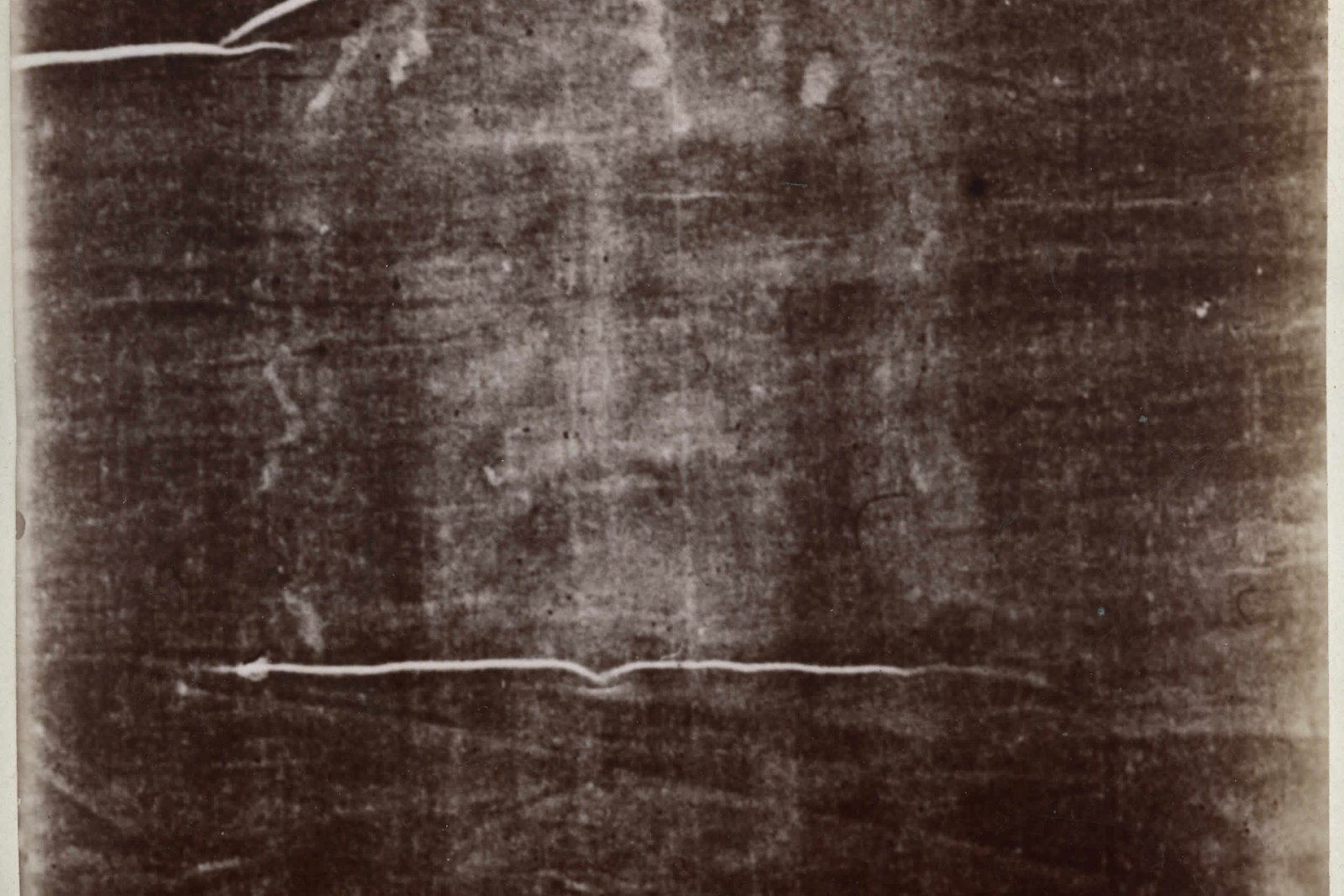
Secondo Pia, photographic negative of the Shroud of Turin (1898). Public domain, via Wikimedia Commons.
Where the Shroud comes from
The Shroud's documented history becomes solid in the mid-14th century, when it surfaced in the possession of a French knight, Geoffroi de Charny, in Lirey, France, around 1354. From there its ownership passed through the House of Savoy, and in 1578 it was moved to Turin, where it has remained ever since, eventually becoming the property of the Holy See itself in 1983.
What happens before 1354 is contested. Some historians and researchers have proposed continuity with earlier relics, such as the Image of Edessa, a cloth bearing an image of Christ's face that was venerated in the Byzantine world for centuries before vanishing from the historical record after the Fourth Crusade sacked Constantinople in 1204. Whether that earlier cloth and the Shroud of Turin are the same object is a matter of historical argument, not settled fact, and the gap in the documentary trail between antiquity and the 14th century remains one of the central obstacles to establishing authenticity through history alone.
The Gospel of John describes Jesus's burial in a way that at least fits the general shape of a shrouded burial: "They took the body of Jesus and bound it with burial cloths along with the spices, according to the Jewish burial custom" (NABRE, John 19:40). The same Gospel later records that when Peter and John reached the empty tomb, they found "the burial cloths there, and the cloth that had covered his head, not with the burial cloths but rolled up in a separate place" (NABRE, John 20:6-7) — a detail some Shroud researchers connect to the separate facial cloth known as the Sudarium of Oviedo, though that connection, too, remains debated among scholars.
The image itself
What makes the Shroud scientifically strange isn't just its age question — it's the image itself. The markings are extremely faint, visible mainly as a light-and-dark contrast on the linen fibers, and behave like a photographic negative: when photographed and the tonal values reversed, a startlingly clear human face and body emerge, a property first noticed in 1898 when an amateur photographer, Secondo Pia, developed his glass-plate negatives of the cloth. No conclusive explanation for how the image was produced — by natural, artistic, or other means — has achieved consensus, which is precisely why the object has attracted sustained scientific attention rather than being dismissed outright.
The 1988 carbon dating and its critics
In 1988, with Vatican permission, small samples of the Shroud were cut and sent to three independent laboratories — at Oxford, Zurich, and the University of Arizona — for radiocarbon dating. All three returned strikingly consistent results: a date range of roughly 1260 to 1390 AD, squarely within the medieval period when the Shroud's documented history begins. The finding was announced in 1988 and widely reported as conclusive evidence that the cloth was a medieval creation rather than a first-century burial cloth.
The story did not end there. In the years since, researchers have raised substantive questions about the 1988 test. Critics have argued that the single sample used came from a corner of the cloth long known to have been repeatedly handled, touched, and possibly rewoven or repaired during centuries of display and reliquary storage — a location poorly suited to represent the cloth as a whole. More significantly, after a 2017 freedom-of-information request unlocked the original raw laboratory data (rather than just the published averaged results), a 2019 statistical reanalysis by researchers including Tristan Casabianca found inconsistencies between the individual measurements taken at the three labs that were larger than their own reported margins of error — a red flag, statistically, for treating the averaged 1260-1390 result as reliable.
It is important to be fair to both sides here: these critiques have not produced a new scientific consensus establishing the Shroud's first-century origin, and no subsequent radiocarbon test has been permitted to confirm or overturn the 1988 result. What the critiques have done is reopen a question that was, for a time, treated in public discourse as definitively closed. The honest scientific status of the Shroud's age, as of today, is genuinely unresolved rather than settled in either direction.
What the Church actually teaches
This is where the Shroud's story often gets misrepresented. The Catholic Church has never dogmatically pronounced on the Shroud's authenticity, in either direction. No pope has declared it must be believed to be the actual burial cloth of Christ, and no pope has declared it a forgery either. The Church's official custodianship treats the Shroud as an object worthy of devotion and reflection on Christ's Passion, independent of the unresolved scientific question of its material age.
Pope Benedict XVI, venerating the Shroud in 2010, called it an "icon written in blood" and spoke of it as a summons to contemplate Christ's suffering, while carefully avoiding any claim about its scientific authenticity. Pope John Paul II, in a similar 1998 address, described the Shroud as posing a "challenge to our intelligence" and encouraged continued scientific study rather than settling the matter by decree. This restraint is consistent with how the Church generally treats non-defined matters of piety: belief in the Shroud's authenticity is permitted, not required, and Catholics in good standing hold a range of views on the question.
Why the devotion persists either way
For many pilgrims who travel to Turin during the Shroud's rare public expositions, the scientific debate is almost beside the point. The image, however it was produced, has functioned for centuries as a devotional aid — a visual meditation on the physical brutality of the Passion that written Gospel accounts convey in words but that the Shroud, true relic or not, renders disturbingly vivid.
That is, in the end, the same posture the Church takes toward the object: an invitation to contemplation that does not hinge on certainty. Whether or not laboratory science ever settles the age of the linen, the Shroud has already done what devotional images are meant to do — draw the eye, and through the eye, the heart, toward the suffering it depicts.
Trivia
What is the Shroud of Turin?
What did the 1988 carbon dating test find?
Has the 1988 test been questioned since?
Does the Catholic Church require Catholics to believe the Shroud is authentic?
Why does the Church allow veneration of an unproven relic?
Related Reading
You May Also Like