The Miraculous Medal: Origin and Meaning of a Marian Devotion

A voice in the dark
On the night of July 18, 1830, a novice named Catherine Labouré was woken in her dormitory at the motherhouse of the Daughters of Charity on Rue du Bac in Paris by what she described as the voice of a child, urging her to come to the chapel. She followed, found the chapel unexpectedly lit, and there, she reported, the Virgin Mary appeared and sat with her for hours, speaking of hardships coming to France and entrusting her with a mission. It was an extraordinary night for an otherwise unremarkable twenty-four-year-old novice who, by her own account, had asked for nothing more than to see her.
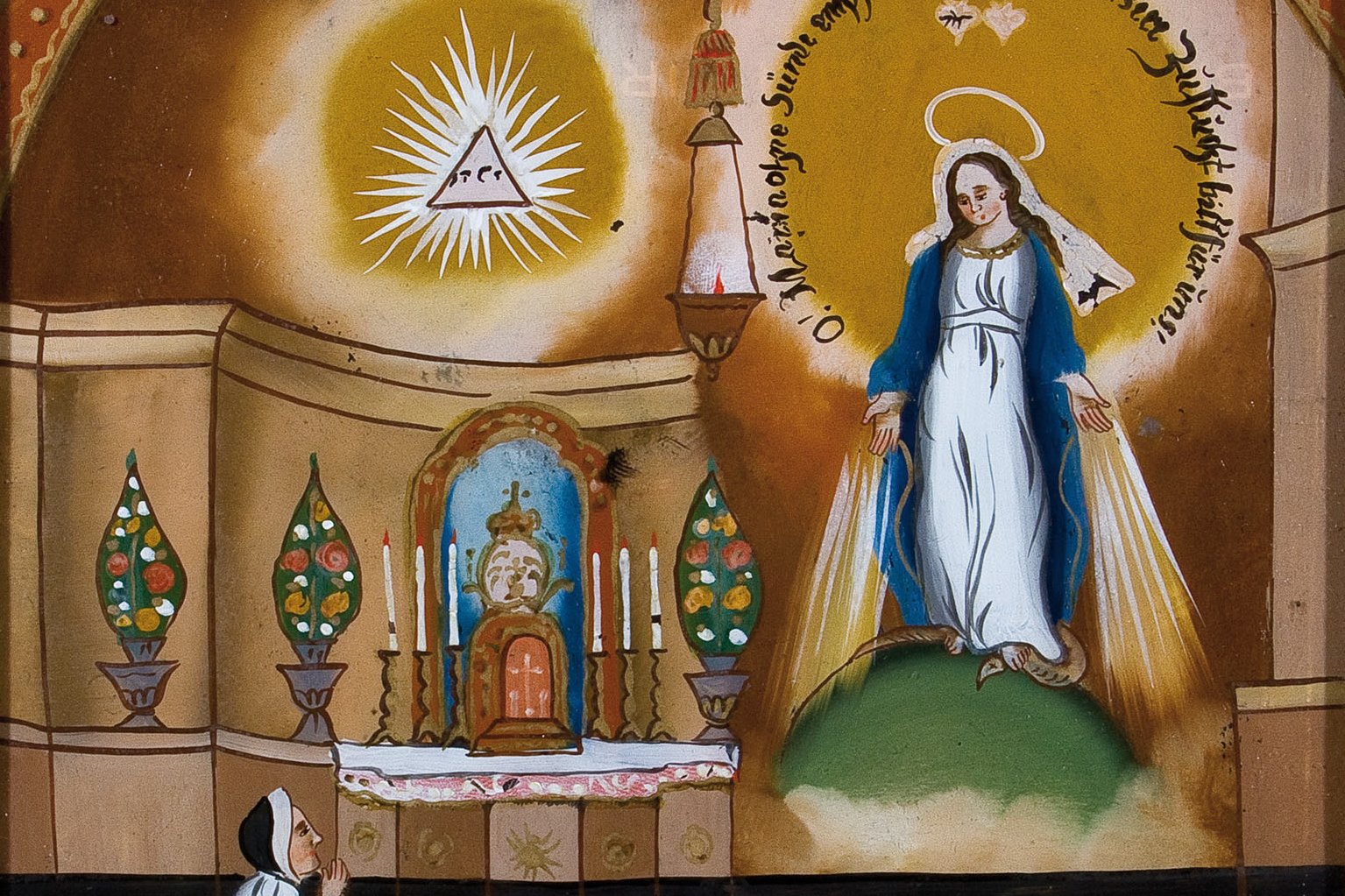
Alois Gege, Apparition of the Blessed Virgin in Paris, 1830, 19th-century Hinterglasbild — public domain
The apparition that would give the world the Miraculous Medal, however, came a few months later, on November 27, 1830. Catherine reported seeing Mary standing on a globe, her feet crushing a serpent, with rays of light streaming from rings on her fingers toward the earth below. Around the image, in an oval frame, ran the words: O Marie, conçue sans péché, priez pour nous qui avons recours à vous — "O Mary, conceived without sin, pray for us who have recourse to thee." Then the image seemed to turn, revealing on its reverse a large letter M surmounted by a cross, with a bar beneath it, above two hearts — one crowned with thorns, the other pierced by a sword — surrounded by twelve stars. According to Catherine, a voice told her: "Have a medal struck upon this model. All who wear it will receive great graces."
From vision to medal
Catherine relayed the request to her spiritual director, a priest named Jean-Marie Aladel, who was, understandably, cautious. It took nearly two years of persistence on Catherine's part before Father Aladel brought the matter to the Archbishop of Paris, who authorized the medal's production. The first batch of 1,500 medals was struck in June 1832; within a few years, millions had been produced and distributed across France and beyond.
What happened next is what earned the medal its popular name. Almost immediately, Catholics began attributing healings, conversions, and protections to the medal's use — not through any claim that the medal itself held magical power, but as a sacramental, an object that, worn or carried in faith, was believed to draw the wearer closer to the graces Mary was understood to be offering through her intercession. Paris began calling it la Médaille Miraculeuse, and the name stuck permanently, eventually eclipsing its more formal title, the Medal of the Immaculate Conception.
Reading the symbols
The medal's imagery rewards a slower look. Mary stands on a globe, a visual echo of the woman described in the Book of Revelation, crushing the serpent beneath her feet — an image tied to Genesis's promise that the offspring of the woman would strike at the serpent's head. The rays streaming from her open hands, according to the account, represent the graces she obtains for those who ask; notably, some of the rings on her fingers in the vision emitted no light at all, which Catherine was told signified graces not granted because they had not been asked for — a detail often cited as an encouragement to pray boldly and specifically rather than vaguely.
The reverse side's twelve stars evoke the "woman clothed with the sun... and on her head a crown of twelve stars" from Revelation 12:1, while the twin hearts beneath the cross-topped M represent the Sacred Heart of Jesus and the Immaculate Heart of Mary, bound together in the medal's design just as Catholic devotion has long held their two hearts together in spiritual union.
An approved, ordinary miracle
Six years after the apparitions, in 1836, the Archbishop of Paris formally examined Catherine's reported visions and gave ecclesiastical approval to the devotion that had, by then, already spread across the world with or without an official ruling. Catherine herself remained almost entirely anonymous throughout this process, having asked her superiors to keep her identity secret; she lived out the rest of her life as an ordinary Sister of Charity, caring for the elderly and infirm at a hospice in Paris, and only revealed her role in the apparitions to her Superior a few months before her death in 1876. She was canonized by Pope Pius XII in 1947.
The Rue du Bac apparitions sit alongside a handful of other Marian apparitions the Church has formally recognized over the centuries; for a broader survey of those events and how the Church evaluates them, see Marian Apparitions Recognized by the Church.
Why a small piece of metal still matters
It would be easy to see the Miraculous Medal as a curiosity of nineteenth-century French piety, a devotional trend that happened to outlast its moment. But its persistence — worn today by Catholics across every continent, often without a second thought about its origin — says something about what devotional objects are actually for. The medal was never meant to be venerated in itself. It was struck, at Mary's own request as Catherine understood it, as a small, portable reminder: that grace is asked for, that intercession is available, and that even an obscure novice's midnight encounter in a Parisian convent chapel could ripple outward for nearly two centuries and counting.
Trivia
What is the Miraculous Medal?
Who was Saint Catherine Laboure?
Why is it called 'miraculous'?
What do the symbols on the medal mean?
Did the Church approve the apparitions and the medal?
You May Also Like

Related Reading