King David

The son no one thought to call
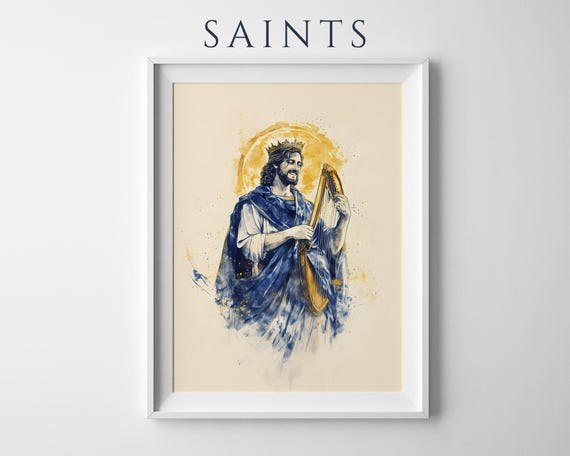
David's introduction to Israel's story is almost a footnote at first — the youngest of Jesse's sons, working the fields near Bethlehem, so far from consideration as a future king that when the prophet Samuel came looking for God's chosen successor, David wasn't even summoned to stand with his brothers. He would go on to found a royal dynasty and unite the tribes of Israel and Judah under a single crown around 1000 BC — an ascent that began with a shepherd fetched almost as an afterthought.
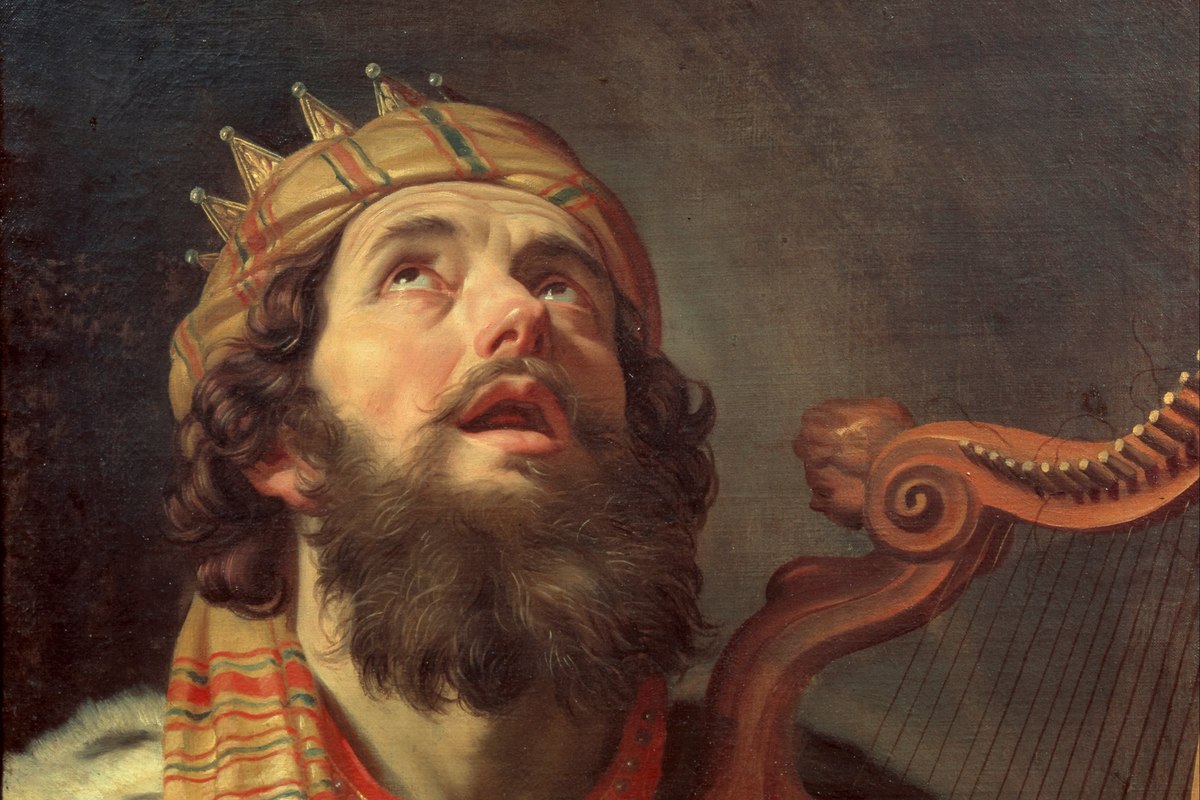
Gerard van Honthorst, "King David Playing the Harp," 1622 — public domain.
Before he was ever a king, David was known first as a giant-killer. Facing the Philistine champion Goliath with nothing but a sling and a handful of stones, while Israel's own soldiers, including the men who should have been his superiors, stood frozen with fear, David walked onto the battlefield insisting that the same God who had protected him against lions and bears while tending his father's sheep would protect him now. The full story is told in David and Goliath, and it set the pattern for how David would be remembered ever after: unlikely, undersized, and utterly confident that God's favor mattered more than anyone's armor.
A friendship, and a fugitive decade
David's rise wasn't smooth even after Goliath. King Saul, Israel's first king, grew increasingly jealous of David's popularity and made repeated attempts on his life, forcing David into years spent as a fugitive, hiding in caves and wilderness strongholds with a band of followers. Through it all, David kept a close friendship with Saul's own son, Jonathan, who chose loyalty to David over loyalty to his father's throne — one of the most enduring examples of friendship in the Hebrew Bible. David also had more than one opportunity to kill Saul outright during this period and refused each time, unwilling to raise his hand against a king he still regarded as God's anointed, whatever Saul's own conduct toward him.
A reputation built partly on the Psalms
Much of David's enduring reputation rests on his association with the Psalms — nearly half of which carry the heading "A Psalm of David," reflecting his long-standing image as a gifted poet, harpist, and hymnist, the very image captured in the painting above. It's worth being precise about what that association actually means historically: those headings were added to the text later, and no single psalm can be confidently attributed to David with full certainty. What survives instead is a tradition, not a signature — but a tradition detailed and persistent enough to have shaped how David is remembered for three thousand years.
That reputation isn't purely literary, either. David is remembered as the king who brought the Ark of the Covenant into Jerusalem, dancing before it in the street with such unrestrained joy that his own wife, Michal, watching from a window, despised him for it — a scene told in full in David dancing before the ark. It's a telling episode: a king willing to look undignified in public worship, more concerned with honoring God openly than with preserving royal composure. David also established Jerusalem itself as Israel's political and religious capital, a decision whose consequences still shape the region three thousand years later.
A king's gravest failure
David's story resists easy hagiography, and nowhere more than in his affair with Bathsheba. Having seen her and learned she was already married to Uriah, one of his own soldiers, David arranged for Uriah to be placed on the front lines of battle and abandoned there — ensuring his death so that David could marry Bathsheba himself. It stands as one of the most serious moral failures attributed to any figure in the Hebrew Bible, and the text doesn't soften it or excuse it. Their first child together did not survive; their second was Solomon, who would go on to inherit David's throne.
What follows the affair matters as much as the affair itself. The prophet Nathan confronts David directly, telling him a parable about a rich man who stole a poor man's only lamb — a story David condemns in righteous anger before Nathan tells him plainly that he himself is the guilty man in the story. Rather than deny the charge or punish the prophet for speaking against a king, David admits his guilt outright. Tradition credits Psalm 51, one of the most quoted penitential prayers in Scripture, to this exact moment of confession — turning David's worst failure into the source of some of the Bible's most enduring language about repentance and mercy.
The line the Gospels chose to trace
That same complicated history is precisely what makes the Gospels' treatment of David so notable. Both Matthew and Luke trace Jesus's genealogy directly back through David's line, and Matthew's version goes further still, naming Bathsheba explicitly — not by name, but as "the wife of Uriah" — among the women listed in Jesus's ancestry. It's a detail the Gospel writer could easily have omitted. Instead, the harder, messier parts of David's story were kept fully intact, folded directly into the ancestry of the very figure Christian tradition would come to call the Son of David.
That title — "Son of David" — echoes throughout the Gospels every time someone appeals to Jesus for mercy or healing, a direct invocation of David's royal line and of the ancient promise, given to David through the prophet Nathan, that his throne would endure forever. Jewish and Christian tradition alike have long treated David as the model against which every later king of Israel was measured, for better or worse, and Christian tradition specifically reads the promise of an everlasting Davidic throne as finding its ultimate fulfillment not in a political dynasty but in Christ himself. Few figures in the Bible combine such extraordinary favor with such plainly recorded failure — which may be exactly why, three thousand years later, David's story still reads as strikingly, uncomfortably human.
Trivia
Who was King David?
Did David really write the Psalms?
What happened between David and Bathsheba?
How is David connected to Jesus?
Related Reading