The Queen of Sheba Visits Solomon


A reputation that traveled far enough to be tested
By the time the events of 1 Kings 10 take place, Solomon's reign had already produced the kind of reputation that spreads across trade routes and borders — a king renowned not primarily for military conquest but for wisdom, wealth, and the enormous building projects that included the Temple in Jerusalem. Word of this had reached "the queen of Sheba," and rather than simply admire the reports from a distance, "she came to test him with subtle questions" (1 Kings 10:1). The text frames her visit from the start as a deliberate examination, not a courtesy call — she wanted proof, not rumor.
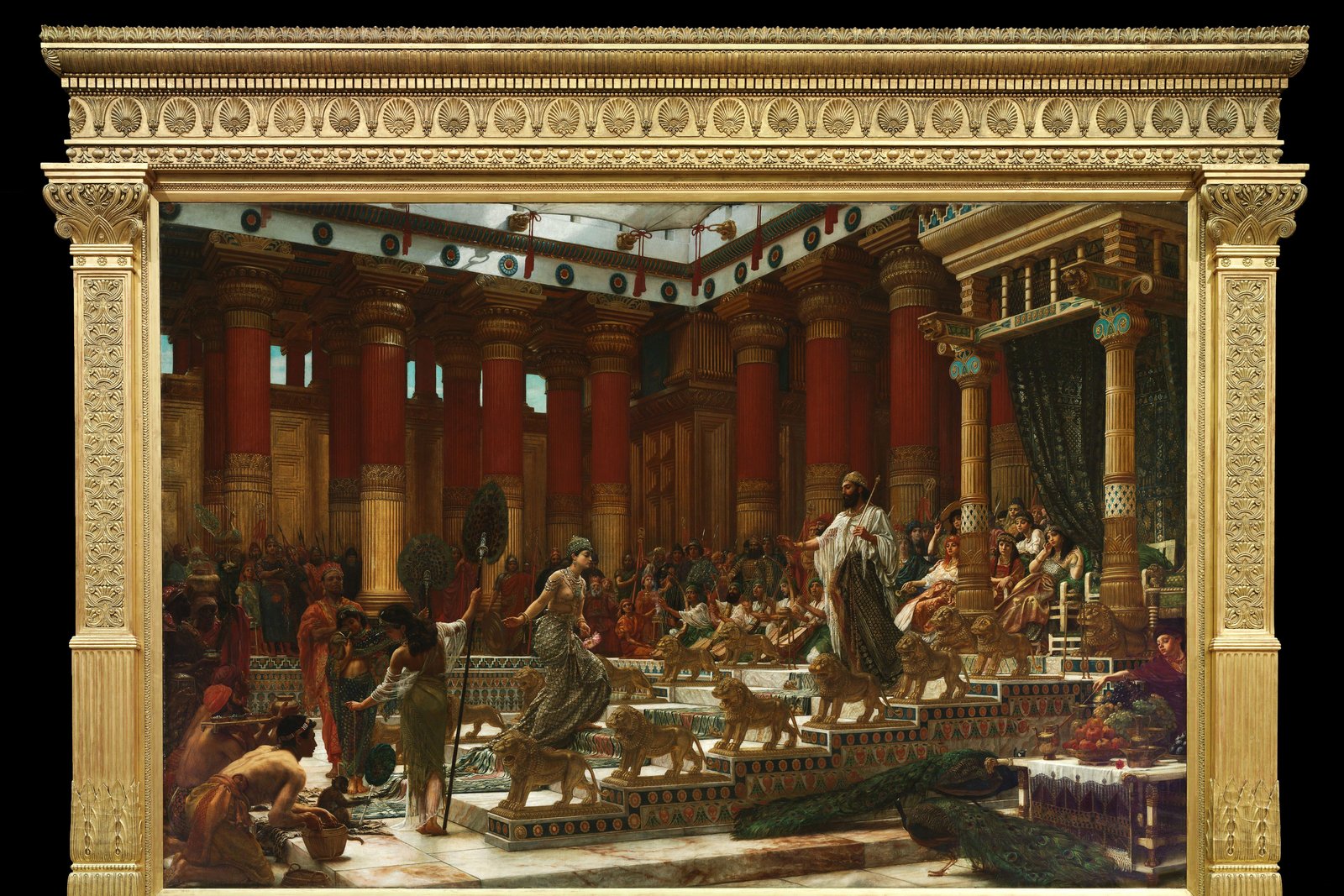
Sir Edward John Poynter, "The Visit of the Queen of Sheba to King Solomon," 1890, Art Gallery of New South Wales. Public domain.
Sheba, a kingdom far to the south
Scripture never gives this queen a personal name, identifying her only by her kingdom, Sheba — most commonly associated by scholars with the ancient South Arabian kingdom of Saba, in what is now Yemen, a region that controlled lucrative incense and spice trade routes in antiquity. A separate and enduring tradition, especially strong in Ethiopian Christianity, places her origins instead in the Horn of Africa and credits her visit to Solomon with founding a royal dynastic line — the Kebra Nagast, Ethiopia's national origin epic, builds an entire royal genealogy around this encounter. The biblical text itself stays deliberately spare on these details, leaving her origin and later legend for others to fill in.
An arrival built to impress
When she reaches Jerusalem, the queen doesn't travel light: "She arrived in Jerusalem with a very numerous retinue, and with camels bearing spices, a large amount of gold, and precious stones" (1 Kings 10:2). It's an entrance calibrated to signal her own wealth and status even before the testing begins — she comes not as a supplicant but as a fellow monarch, capable of offering as much as she's come to evaluate. "She came to Solomon and spoke to him about everything that she had on her mind" (1 Kings 10:2), and the text records the result plainly: "King Solomon explained everything she asked about, and there was nothing so obscure that the king could not explain it to her" (1 Kings 10:3) — every question she brought, answered.
Overwhelmed by what she finds
What follows in the text isn't just the queen's questions being answered — it's her reaction to the whole scale of Solomon's court, described in detail: his household, the arrangement of his officials, "the attendance of his ministers and their vesture, his cupbearers, and the burnt offerings he offered in the house of the LORD" (1 Kings 10:5). Her response is unguarded: "there was no more spirit left in her" (1 Kings 10:5) — a phrase suggesting genuine astonishment, someone momentarily out of words. When she recovers them, she's direct about how far short the rumors had fallen: "The report I heard in my country about your deeds and your wisdom is true... I did not believe the report until I came and saw with my own eyes that not even the half had been told me. Your wisdom and prosperity surpass the report I heard" (1 Kings 10:6-7).
A theological reading, not just a compliment
The queen's admiration doesn't stay purely secular. She goes on: "Happy are your servants, happy these ministers of yours, who stand before you always and listen to your wisdom. Blessed be the LORD, your God, who has been pleased to place you on the throne of Israel. In his enduring love for Israel, the LORD has made you king to carry out judgment and justice" (1 Kings 10:8-9). Coming from a foreign monarch with no obligation to acknowledge Israel's God at all, this is a striking moment — a queen from outside the covenant explicitly crediting the Lord, not merely Solomon's personal talent, for the wisdom and prosperity she has just witnessed firsthand.
An exchange of extraordinary gifts
The visit closes with a formal exchange of wealth that the text takes care to quantify: "she gave the king one hundred and twenty gold talents, a very large quantity of spices, and precious stones. Never again did anyone bring such an abundance of spices as the queen of Sheba gave to King Solomon" (1 Kings 10:10) — a striking superlative embedded directly in the historical record. Solomon reciprocates in kind: "King Solomon gave the queen of Sheba everything she desired and asked for, besides what King Solomon gave her from Solomon's royal bounty. Then she returned with her servants to her own country" (1 Kings 10:13). No further detail is given about what became of her afterward — the biblical account closes the episode as cleanly as it opened it.
Wisdom as Solomon's defining trait
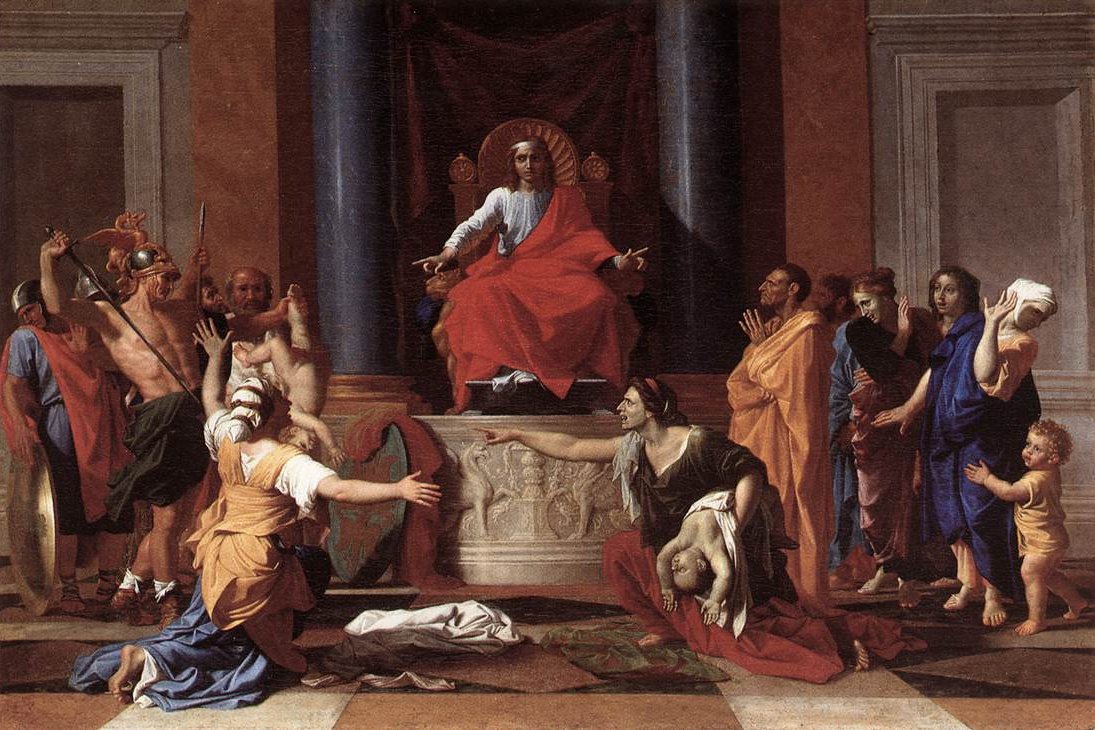
This story sits within a broader biblical portrait of Solomon built almost entirely around wisdom rather than conquest — from his famous request to God for "an understanding heart to judge your people and to distinguish right from wrong" (1 Kings 3:9) at the start of his reign, through his celebrated judgment between two women both claiming the same child (see our article on Solomon's judgment), to this culminating scene of a foreign monarch traveling a great distance just to verify that the reports were true. Jesus himself later invokes this exact episode, telling a crowd that "At the judgment the queen of the south will arise with this generation and condemn it, because she came from the ends of the earth to hear the wisdom of Solomon; and there is something greater than Solomon here." (Matthew 12:42) — using her journey and her willingness to seek out wisdom as a standard by which he measures his own contemporaries' response to him.
Edward Poynter's Victorian vision of the scene
The painting illustrating this article, completed by the British artist Edward Poynter in 1890, reflects a particular late-19th-century fascination with reconstructing the material splendor of the ancient Near East in exhaustive, almost archaeological detail — the marble, the processions of attendants, the exoticism of gold and incense being carried into a court built to overwhelm. Poynter was known for this kind of meticulously researched historical grandeur, and this canvas, one of his most celebrated works, imagines the moment of the queen's arrival at the height of its ceremonial display, capturing the theatrical scale that the biblical text itself only briefly gestures toward with its list of camels, gold, and spices.
Trivia
Who was the Queen of Sheba and where did she come from?
Why did the Queen of Sheba travel to see Solomon?
What did the Queen of Sheba bring as gifts?
What did the Queen of Sheba say after meeting Solomon?
Did Solomon give the Queen of Sheba anything in return?
Related Reading