King Solomon: The Wisdom, the Wealth, and the Fall

From David's Son to Israel's King
Solomon inherited a kingdom his father David had spent a lifetime fighting to secure, but he did not inherit it cleanly. His succession followed a tense palace intrigue — his half-brother Adonijah tried to seize the throne while David lay old and failing, and it was the prophet Nathan and Bathsheba, Solomon's mother, who moved quickly to have Solomon anointed king before Adonijah's coup could harden into fact (1 Kings 1). It is a reminder that even the most celebrated reign in Israel's history began with a scramble for survival.
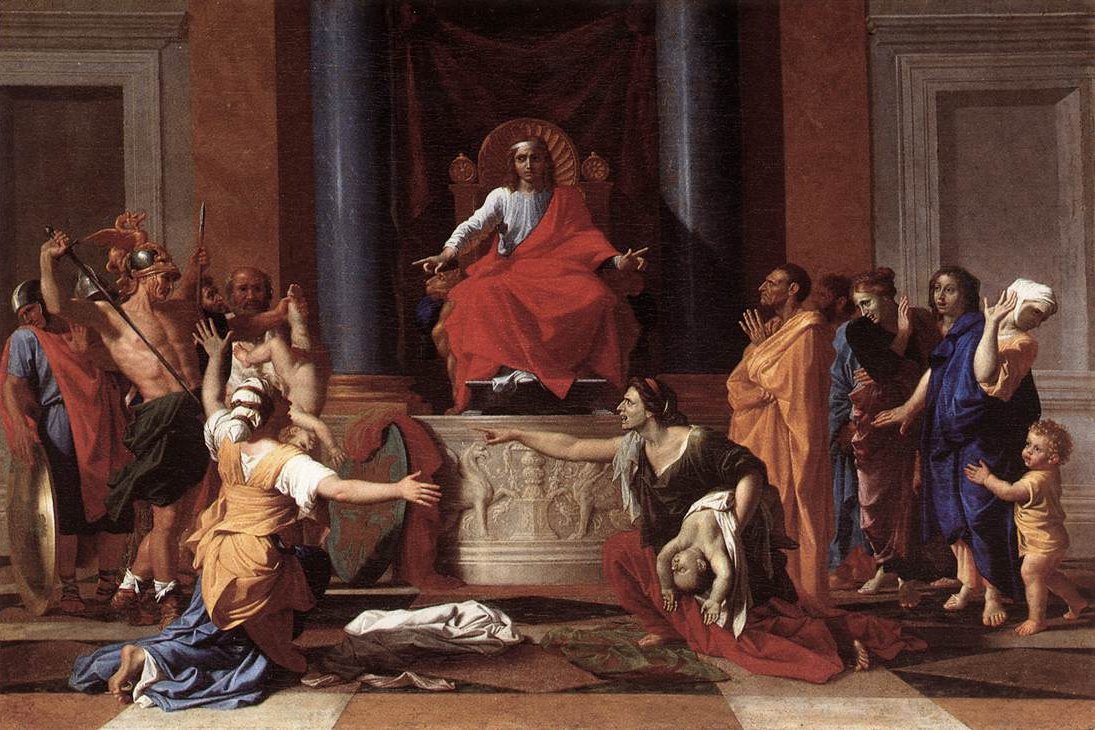
Nicolas Poussin, "The Judgment of Solomon," 1649, Louvre — public domain.
Once secure on the throne, Solomon went to Gibeon, "the great high place," to offer sacrifice. There, in a dream, God made him an open-ended offer: "Whatever you ask I shall give you" (NABRE, 1 Kings 3:5). Solomon did not ask for a long life, riches, or the death of his enemies. Instead he asked, "Give your servant, therefore, a listening heart to judge your people and to distinguish between good and evil" (NABRE, 1 Kings 3:9). God was pleased, and answered: "I give you a heart so wise and discerning that there has never been anyone like you until now, nor after you will there be anyone to equal you" (NABRE, 1 Kings 3:12).
The Judgment That Made Him Famous
The story that cemented Solomon's reputation came almost immediately. Two women living in the same house each claimed the same living infant as her own, while insisting the dead child belonged to the other. With no witnesses and no way to prove either claim, Solomon ordered a sword brought before him: "Cut the living child in two, and give half to one woman and half to the other" (NABRE, 1 Kings 3:25). One woman accepted the terms outright. The other begged, "Please, my lord, give her the living baby—do not kill it!" (NABRE, 1 Kings 3:26). Her compassion exposed her as the true mother, and Solomon awarded her the child. "All Israel heard the judgment the king had given, they were in awe of him, because they saw that the king had in him the wisdom of God for giving right judgment" (NABRE, 1 Kings 3:28).
It is a story built for oral memory — simple, shocking, and morally clear — and it has functioned that way for three thousand years, still invoked whenever someone describes a judgment that cuts through deception to find the truth.
Building the House of the Lord
David had wanted to build a temple for the Ark of the Covenant but was told the task would fall to his son instead. Solomon carried it out on a scale meant to announce Israel's God to the world: cedar from Lebanon, gold overlay throughout the inner sanctuary, a workforce drawn from across the kingdom, and seven years of construction (1 Kings 5-6). When it was finished, the Ark was carried into the Temple and, according to 1 Kings 8, a cloud filled the house — a visible sign, in the biblical account, of the Lord's presence taking up residence among his people. For readers of the Bible ever since, Solomon's Temple has stood as the central image of Jerusalem's sanctity, the place whose eventual destruction would echo through the rest of Scripture and whose memory Jesus himself invoked when he called his own body a temple.
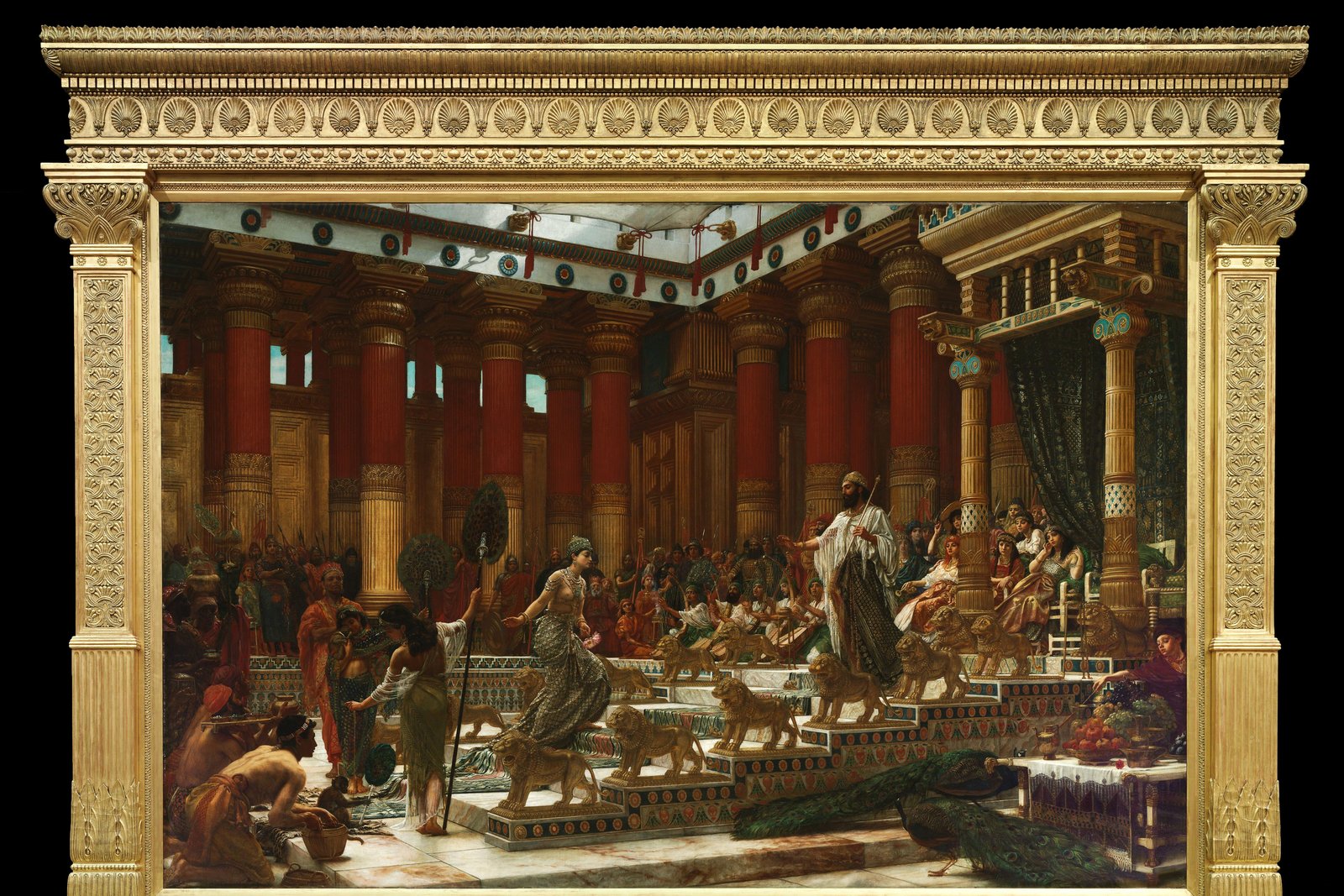
Solomon's fame did not stay local. The Queen of Sheba's visit, drawn by reports of his wisdom, and the descriptions of gold, ivory, and imported goods flowing into Jerusalem paint a court that had become a genuine international power, its wealth matched by very few kingdoms of its era.
The Slow Turn Away
The Bible does not let Solomon's story end on that high note, and it does not soften what comes next. "King Solomon loved many foreign women besides the daughter of Pharaoh... He had as wives seven hundred princesses and three hundred concubines, and they turned his heart" (NABRE, 1 Kings 11:1,3). Many of these marriages were political alliances, common practice for ancient monarchs — but Scripture treats the religious consequence as the real danger. "When Solomon was old his wives had turned his heart to follow other gods, and his heart was not entirely with the Lord, his God" (NABRE, 1 Kings 11:4). He built shrines to Chemosh and Molech, gods worshiped with practices Israel's own law explicitly forbade.
The text is blunt about the cost: God tells Solomon that the kingdom will be torn from his line after his death, sparing only one tribe for David's sake (1 Kings 11:11-13). The united monarchy that Solomon inherited and expanded would fracture into two kingdoms under his son Rehoboam — a split the Bible traces directly back to this failure of fidelity.
Solomon's arc — extraordinary wisdom given, extraordinary works accomplished, and then an ordinary human failure to keep faith — is precisely why later biblical and Jewish tradition would treat him with such mixed feelings, crediting him with Proverbs and Ecclesiastes while never pretending his ending was triumphant. Wisdom, the story insists, is not the same thing as fidelity, and having one without the other is not enough.
Trivia
What was King Solomon known for?
What was the judgment of Solomon?
Did Solomon build the Temple in Jerusalem?
Why did Solomon fall out of favor with God?
Is Solomon considered a saint?
You May Also Like
Related Reading