What Is Canon Law?

A legal system older than most governments
It surprises a lot of people to learn the Catholic Church has its own formal, codified legal system, complete with courts, trained judges, and centuries of accumulated precedent. Canon law is exactly that — an internal body of law governing how the Church organizes itself, administers the sacraments, disciplines its clergy, manages its property, and resolves internal disputes. The word "canon" comes from the Greek kanon, a measuring rod or straightedge, the same image behind the phrase "biblical canon" — a fixed standard against which things are measured.
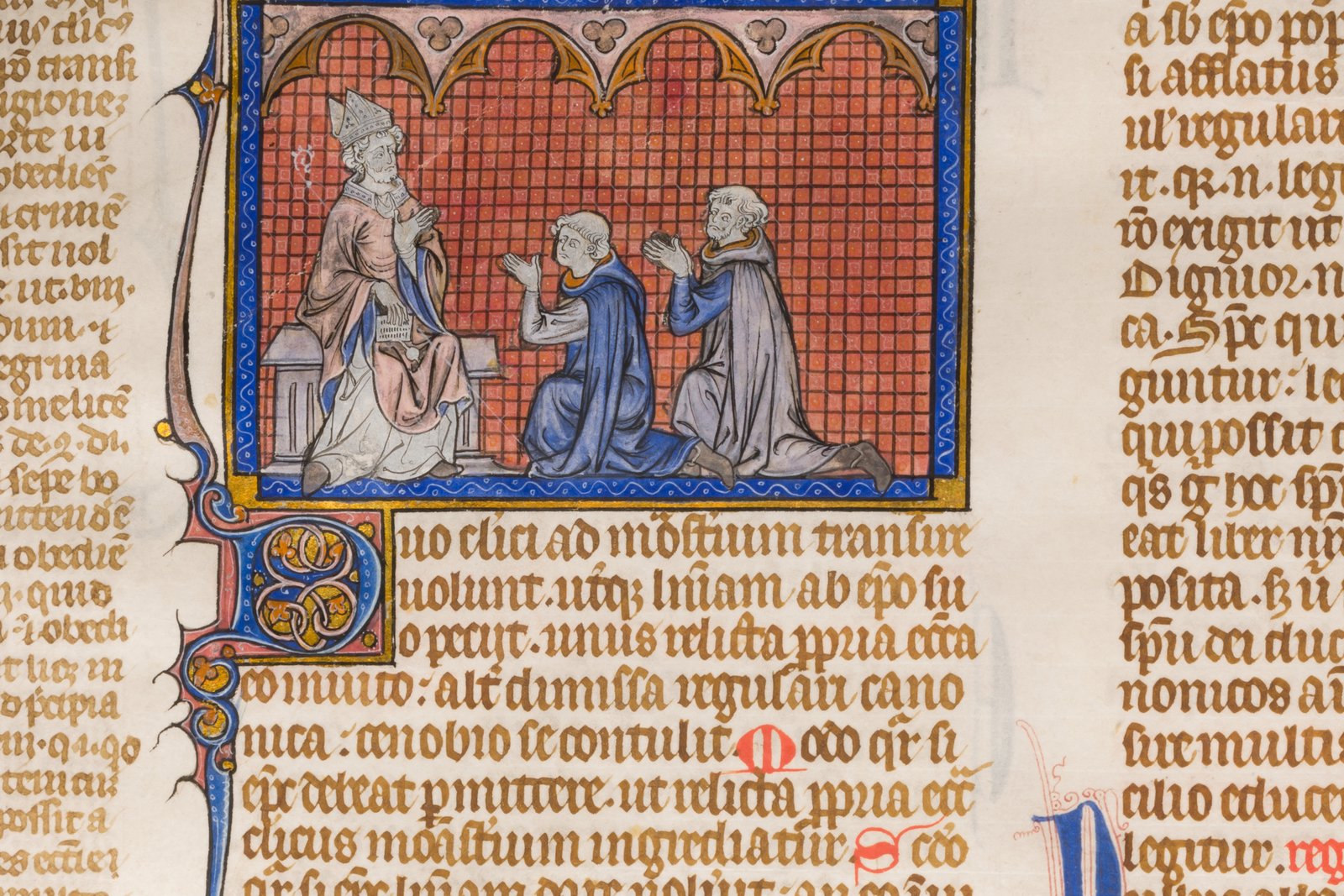
Master Honoré, leaf from Gratian's Decretum, c. 1290, The Metropolitan Museum of Art — public domain (CC0).
Unlike civil law, canon law doesn't claim jurisdiction over criminal matters in the way a national court system does, and it operates alongside, not above, the civil laws of whatever country a diocese happens to sit in. Its scope is specifically ecclesial: the internal governance and discipline of a worldwide religious institution with well over a billion members.
Centuries in the making
Canon law didn't arrive as a single finished document. It grew organically over nearly two thousand years, accumulating through the decisions of early Church councils, papal decrees, and the rulings of individual bishops responding to local disputes. For much of that early period, this body of law existed as a scattered, sometimes contradictory patchwork rather than an organized code.
The turning point came in the 12th century, when a monk named Gratian, working in Bologna, undertook the enormous task of gathering, organizing, and reconciling centuries of this scattered material into a single coherent work now known as the Decretum Gratiani. Gratian's achievement is widely regarded by historians as the founding text of Western legal science more broadly, not just of canon law specifically — the methods of legal reasoning he systematized went on to influence the development of civil law faculties across medieval Europe.
The Church's law continued developing after Gratian, through further compilations and additions, until Pope Benedict XV promulgated the first fully unified, modern Code of Canon Law in 1917. That code was substantially revised following the Second Vatican Council, resulting in the current 1983 Code of Canon Law, promulgated by Pope John Paul II — 1,752 individual canons organized into seven books.
What canon law actually covers
The 1983 Code's seven books give a good sense of its real scope. It opens with general legal norms (how canon law itself is to be interpreted and applied), then moves through the "People of God" (the structure of the Church's hierarchy, from parishes and dioceses up to the papacy, along with the rights and obligations of the laity and religious orders), the Church's teaching office, its sanctifying office (governing the sacraments, including detailed norms for who may validly and licitly celebrate them), Church property and finances, sanctions for canonical offenses, and finally the procedures used in canonical trials.
That last category is where canon law becomes most visible to ordinary Catholics, particularly through the marriage annulment process — a canonical determination, made through a Church tribunal, that a particular marriage lacked something essential for validity from the very beginning. It's worth being precise here: an annulment is not, as it's sometimes casually described, "Catholic divorce." Canon law treats it as a finding about whether a valid marriage bond ever actually came into existence in the first place, a legal and theological question distinct from a civil divorce, which simply dissolves a legally recognized marriage going forward.
Not the same as moral teaching
It's worth distinguishing canon law clearly from Catholic moral teaching, since the two are often conflated. Canon law is fundamentally administrative and juridical — it governs structure, procedure, and discipline. Catholic moral teaching, laid out primarily through the Catechism and the broader tradition of moral theology, addresses questions of right and wrong conduct. The two intersect at points (canon law does address penalties for certain serious moral offenses, for instance), but they aren't the same body of material, and a canon lawyer trained in Church legal procedure isn't necessarily the same figure a Catholic would consult on a question of moral theology.
Who actually applies it
Canon law functions through an actual court system, staffed by canonists — lawyers trained specifically in this body of law, often holding a doctorate in canon law from a pontifical university. Diocesan tribunals handle most cases at the local level, with more complex matters, or appeals, sometimes reaching the Roman Rota, one of the principal tribunals of the Holy See, which functions in some respects like a Church-wide appellate court, particularly for marriage cases referred from dioceses around the world.
Far from a forgotten relic, canon law remains a living, actively applied system — proof that an institution with roots in the apostolic age can still run, in a very literal sense, on its own law.
A parallel code for the Eastern Churches
One further wrinkle worth knowing: the 1983 Code of Canon Law governs only the Latin Church, the largest of the Catholic Church's constituent churches. The Eastern Catholic Churches — communities like the Ukrainian Greek Catholic Church or the Maronite Church, fully Catholic and in communion with the pope but rooted in ancient Eastern liturgical traditions — follow their own parallel legal framework, the 1990 Code of Canons of the Eastern Churches. The two codes share the same underlying theological foundations and much of the same legal structure, but each is adapted to the distinct history, discipline, and customs of the church it governs, a reminder that even the Church's law reflects its wider unity in diversity rather than a single uniform mold.
Trivia
What is canon law in simple terms?
Is canon law the same as the Ten Commandments or Catholic moral teaching?
What is the current official Code of Canon Law?
Who enforces or interprets canon law?
Where did canon law originally come from?
Related Reading