Hagia Sophia

A church built to end all comparison
Hagia Sophia was not Justinian's first attempt at a great church on this site in Constantinople. Two earlier basilicas had stood here and burned, the second one destroyed in the Nika riots of 532 — a week of civil unrest so violent it nearly cost Justinian his throne. Rather than rebuild modestly, the emperor used the crisis as an opening. He commissioned something that had never quite been attempted before: a church whose central space would be crowned not by a long roof or a row of domes, but by a single vast dome that seemed to hover, weightless, over the congregation below.
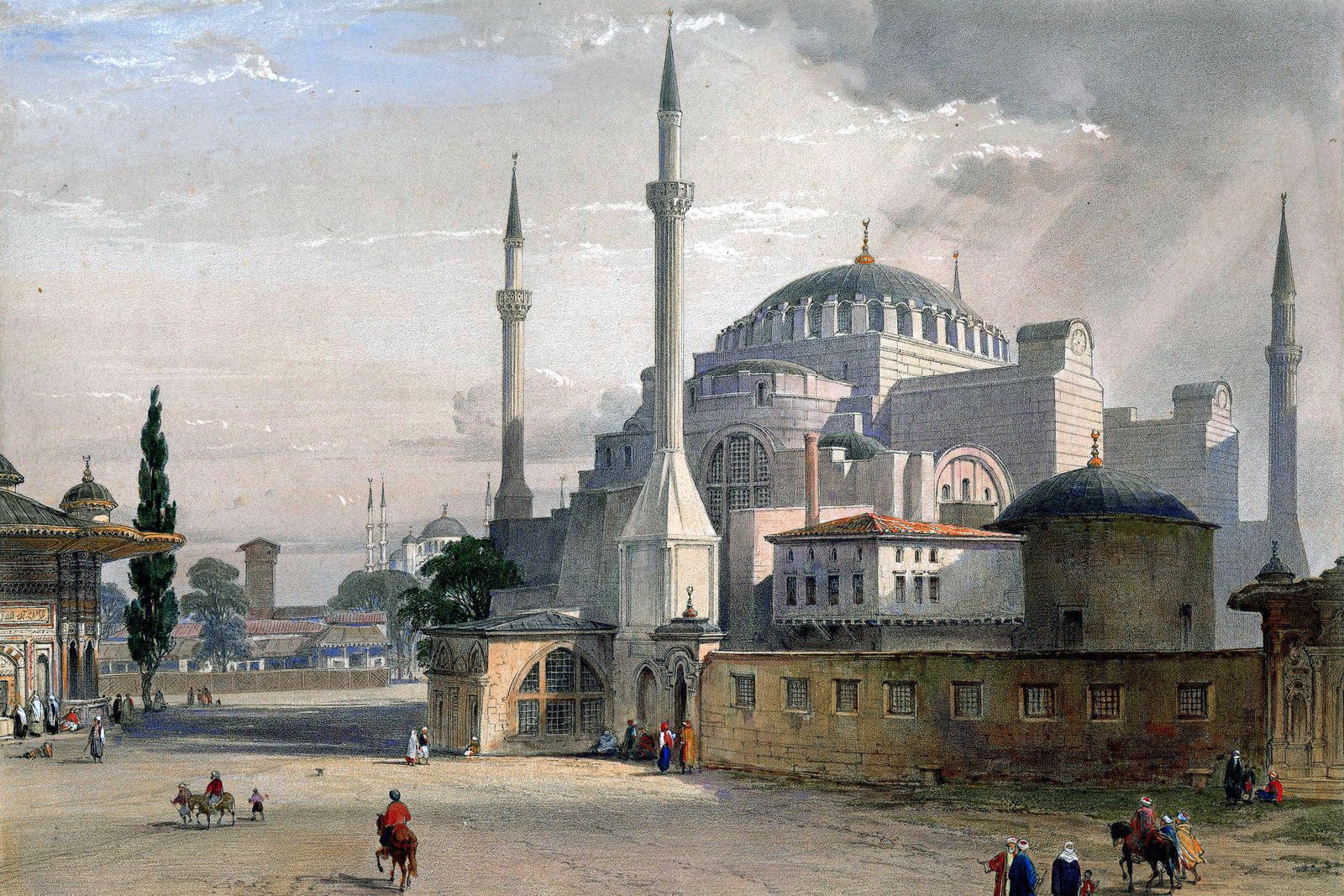
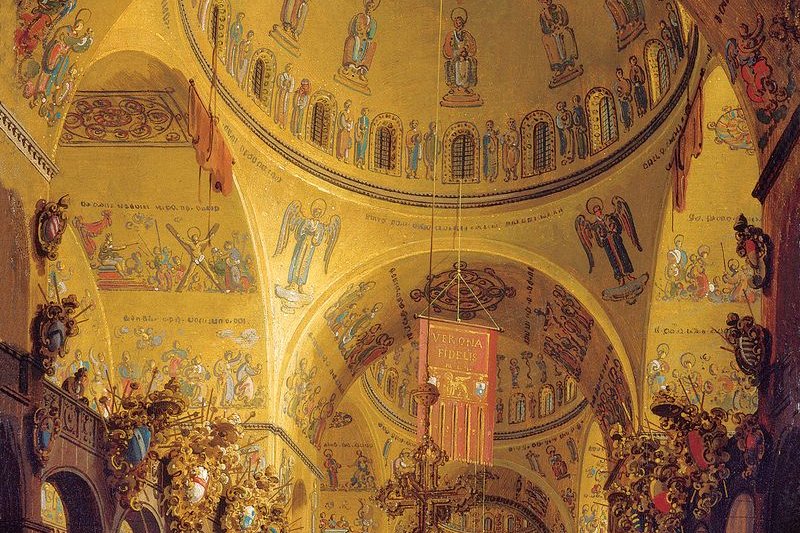
Louis Haghe, Interior view of Hagia Sophia, Constantinople, 1852 — public domain.
He handed the project to two men who were not master builders in the traditional sense but mechanikoi — mathematicians and engineers, Anthemius of Tralles and Isidore of Miletus. Their solution was the pendentive: a curved triangular surface that lets a circular dome rest on a square base, funneling its enormous weight down through four piers instead of a continuous circular wall. It let them ring the base of the dome with forty windows, so that direct sunlight seems to dissolve the boundary between the dome and the sky above it. Contemporaries wrote that it looked less like something built than something suspended by a golden chain from heaven.
The whole structure — nave, dome, galleries, and an interior sheathed in colored marble quarried from across the empire — went up in under six years, an almost unbelievable pace for pre-modern construction. It was consecrated in 537, and for the better part of a millennium it stood as the largest cathedral on earth, a title it would not surrender until Seville Cathedral was completed in the 16th century.
From cathedral to mosque to museum to mosque
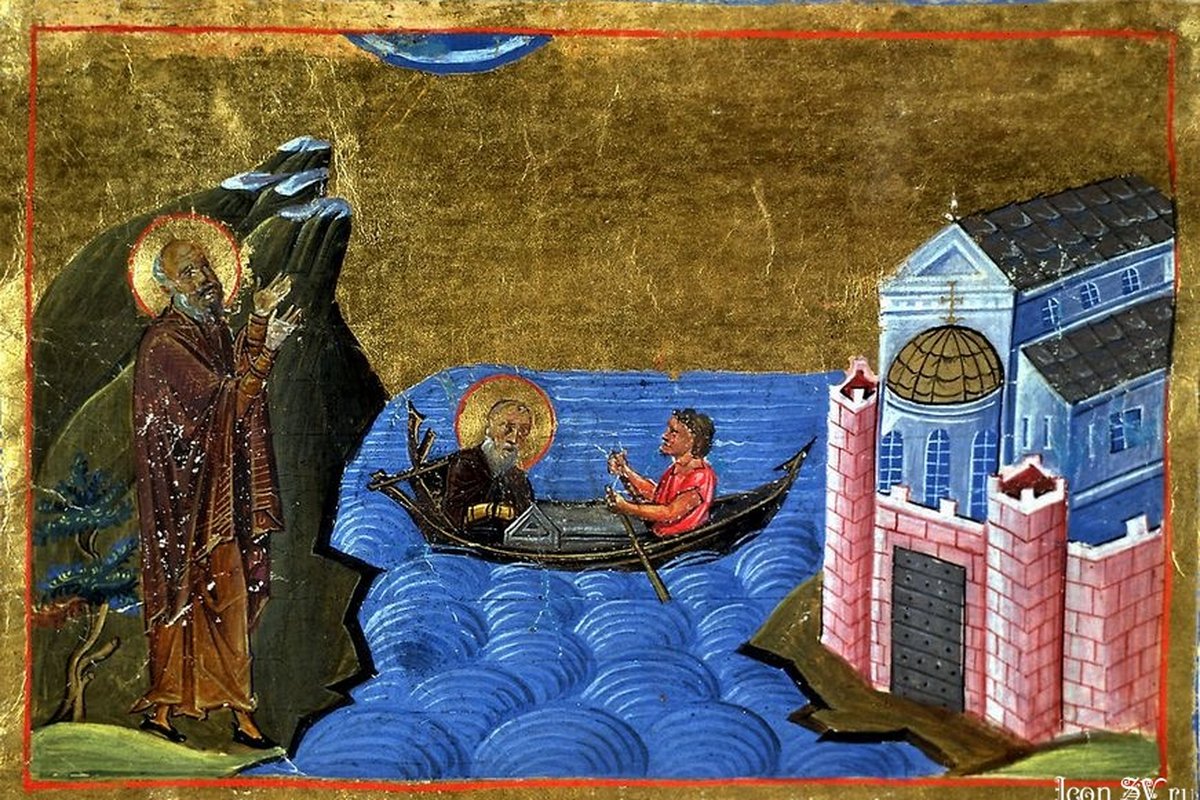
Hagia Sophia served as the principal church of the Byzantine Empire and the seat of the Ecumenical Patriarch for roughly 900 years, hosting imperial coronations and, at least in later tradition, some of the most consequential moments in the long, slow split between Eastern and Western Christianity. When Constantinople fell to the Ottoman forces of Sultan Mehmed II in 1453, the sultan reportedly rode straight to Hagia Sophia and ordered it converted into a mosque within days.
That conversion changed the building's furniture more than its bones. Minarets were added at the corners, a mihrab indicating the direction of Mecca was set into what had been the apse, and large calligraphic roundels bearing the names of Allah, Muhammad, and the early caliphs were hung around the interior — they remain today, some of the largest examples of Islamic calligraphy in the world. Crucially, most of the building's Byzantine Christian mosaics were plastered over rather than smashed, since figural religious imagery is generally avoided in mosques. That plaster, unintentionally, acted as a preservative.
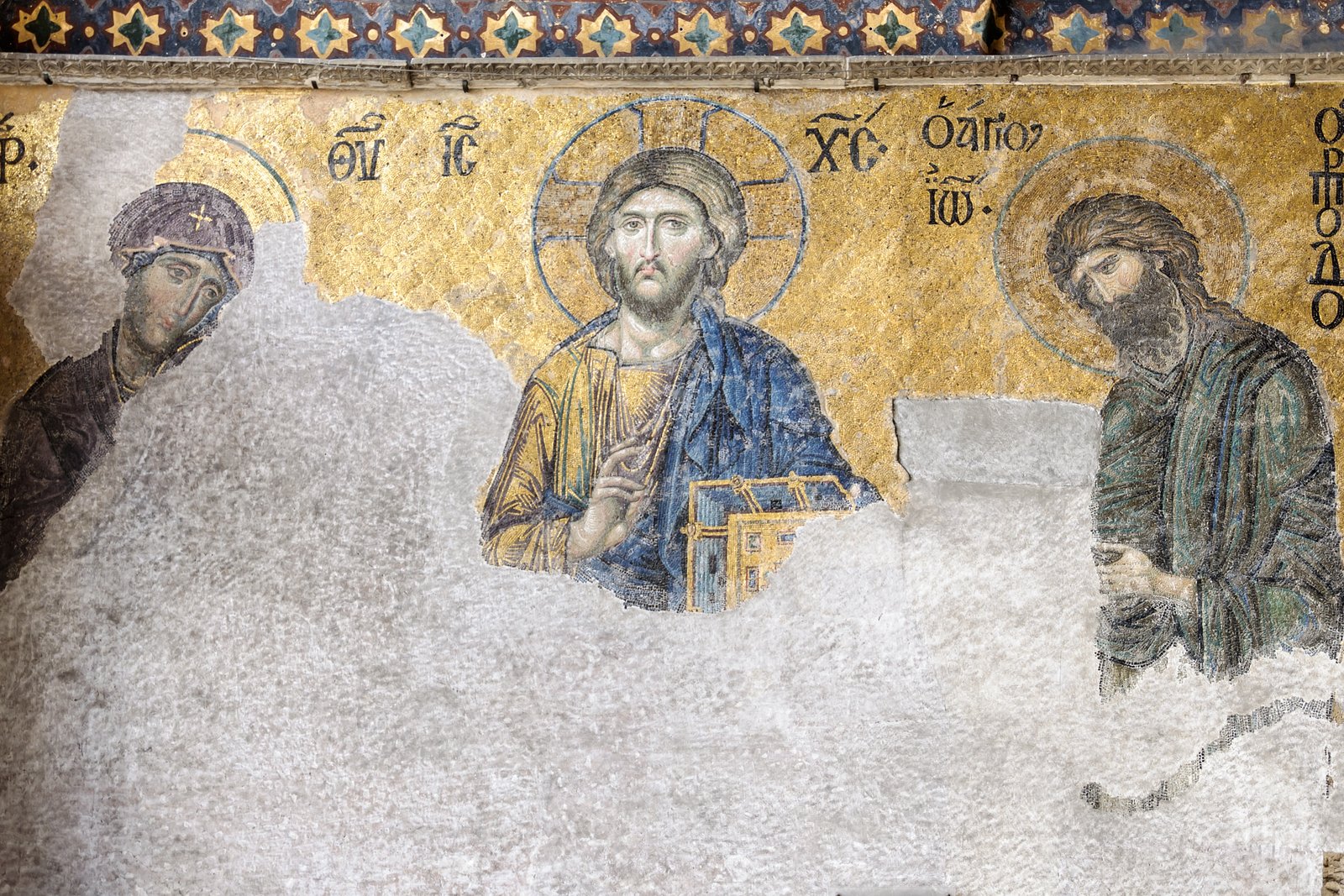
In 1934, the secular Turkish Republic under Kemal Atatürk converted Hagia Sophia into a museum, and restoration teams spent decades carefully uncovering mosaics that had been hidden for nearly 500 years — a monumental Christ Pantocrator, a Deesis panel showing Christ flanked by Mary and John the Baptist, and imperial portraits of Byzantine emperors and empresses. In July 2020, a Turkish court annulled the 1934 museum decree and Hagia Sophia reopened as an active mosque, with the most prominent Christian mosaics now covered by curtains or panels during the five daily prayers and visible again at other times — an uneasy but functioning compromise between the building's two long identities.
Why it still matters to Christian history
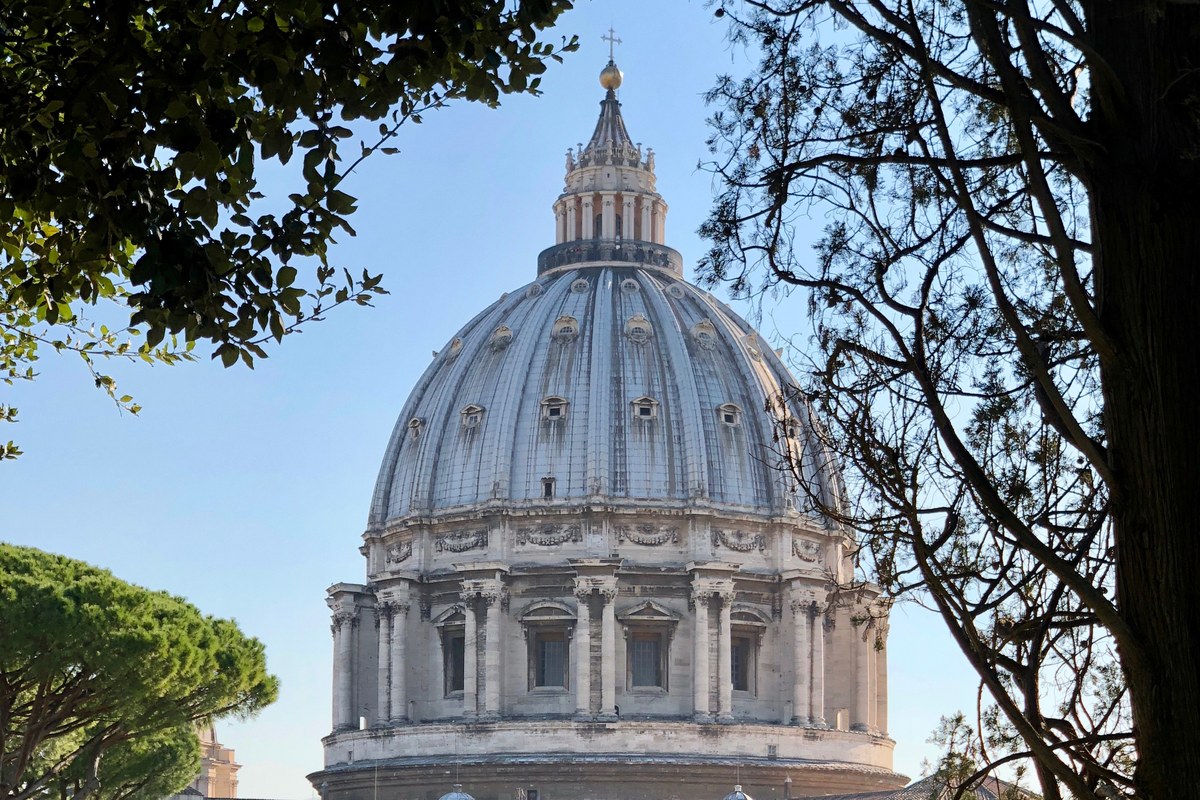
For Eastern Christians in particular, Hagia Sophia occupies a place that has little parallel in the West — closer, perhaps, to what Saint Peter's Basilica represents for Roman Catholicism, but layered with the added weight of loss and memory. It was here, according to a story recorded in the medieval Primary Chronicle, that envoys sent by Prince Vladimir of Kievan Rus' to evaluate different faiths reported that during the liturgy at Hagia Sophia they "knew not whether we were in heaven or on earth" — an account credited, in Orthodox tradition, with tipping Vladimir's choice of Christianity for his people, and with it the eventual conversion of Rus'.
The building's engineering also left a permanent mark on how later architects thought about sacred space. Ottoman architects, most famously Mimar Sinan, studied Hagia Sophia closely when designing the great imperial mosques of Istanbul, adapting its dome-on-pendentives solution into a mature Ottoman architectural vocabulary you can still trace across the city's skyline. In a real sense, Hagia Sophia is the shared ancestor of both a major line of Christian church design and a major line of Islamic mosque design — a rare case of one building shaping two entire religious architectural traditions from opposite directions.
For readers curious about other landmark churches and pilgrimage sites across the Christian world, our guide to notable Catholic churches rounds up many of them in one place.
Visiting today
Hagia Sophia sits in Istanbul's historic Sultanahmet district, directly across a plaza from the Blue Mosque, and remains one of the most visited landmarks in Turkey. As an active mosque, it observes prayer times during which non-Muslim tourist access to the main floor is restricted, though the upper galleries — home to some of the best-preserved mosaics — have historically remained viewable outside of those windows. Whatever its formal status at a given moment, it continues to draw visitors less for any single feature than for the sheer improbability of the whole structure: a 1,500-year-old building that has changed hands, changed faiths, and changed uses more times than almost any other on earth, and somehow still stands.
Trivia
Is Hagia Sophia a church or a mosque?
Why is Hagia Sophia's dome considered an engineering marvel?
What happened to Hagia Sophia's Christian mosaics after it became a mosque?
What does the name Hagia Sophia mean?
How long did it take to build Hagia Sophia?
Related Reading