Wawel Cathedral

A cathedral built on a martyr's grave
The story of Wawel Cathedral begins, according to Polish tradition, with a murder inside an earlier church on the same site. In 1079, Stanislaus, Bishop of Krakow, was killed — by the king's own hand, some accounts insist, or on his direct order — during a violent falling-out between the Polish crown and the Church, reportedly while Stanislaus was celebrating Mass. However exactly it happened, Stanislaus was quickly venerated as a martyr, and his cult grew rapidly enough that he was formally canonized by Pope Innocent IV in 1253, becoming one of Poland's principal patron saints.
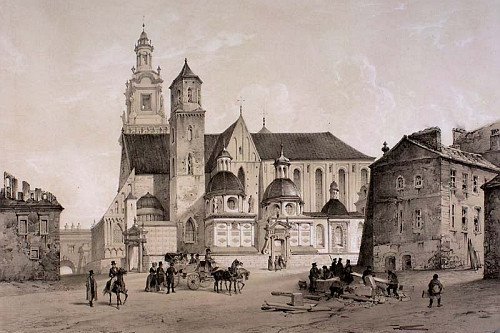
View of Wawel Cathedral and Royal Castle, Krakow, c. 1843 — public domain.
The cathedral standing on Wawel Hill today is the third built on this spot, a Gothic structure raised in the 14th century after fire destroyed its Romanesque predecessor. It was consecrated in 1364, and almost from that point forward, it functioned as far more than a parish church — it became, in effect, the coronation church and royal necropolis of the Kingdom of Poland, a role it would hold for the next four hundred years.
Where kings were crowned and buried
Beginning with King Wladyslaw I the Elbow-high in 1320 and continuing almost without interruption until the coronation of Stanislaw August Poniatowski in 1764, nearly every Polish monarch was crowned inside Wawel Cathedral. Many of the same monarchs were later buried there too, in an accumulating complex of side chapels, crypts, and freestanding tombs that turned the cathedral, over centuries, into something close to a walkable timeline of Polish royal history.
The most visually striking addition is the Sigismund Chapel, built in the 1510s and 1520s under King Sigismund I the Old, widely regarded as one of the finest examples of Renaissance architecture outside Italy — a domed, golden-roofed structure so architecturally significant that art historians sometimes describe it as the purest Florentine Renaissance building north of the Alps. Alongside the royal tombs, the cathedral's crypts also hold national heroes with no royal blood at all: Tadeusz Kosciuszko, the military leader who fought in both the American Revolutionary War and Polish uprisings, and General Wladyslaw Sikorski, Poland's wartime prime minister-in-exile, among others — a reflection of how the cathedral gradually expanded its role from purely royal church to a broader resting place for the nation's most honored figures.
At the physical and spiritual center of the building sits the shrine of Saint Stanislaus himself: an elaborate silver reliquary tomb, cast in the 17th century, holding the relics that made this hill a pilgrimage site long before any king was crowned here. Visitors moving through the cathedral pass the royal tombs on their way to a martyred bishop's shrine at the heart of it all — a physical layout that quietly reasserts, built into the very architecture, which authority the church considered ultimately more enduring than the crown.
A future pope's cathedral
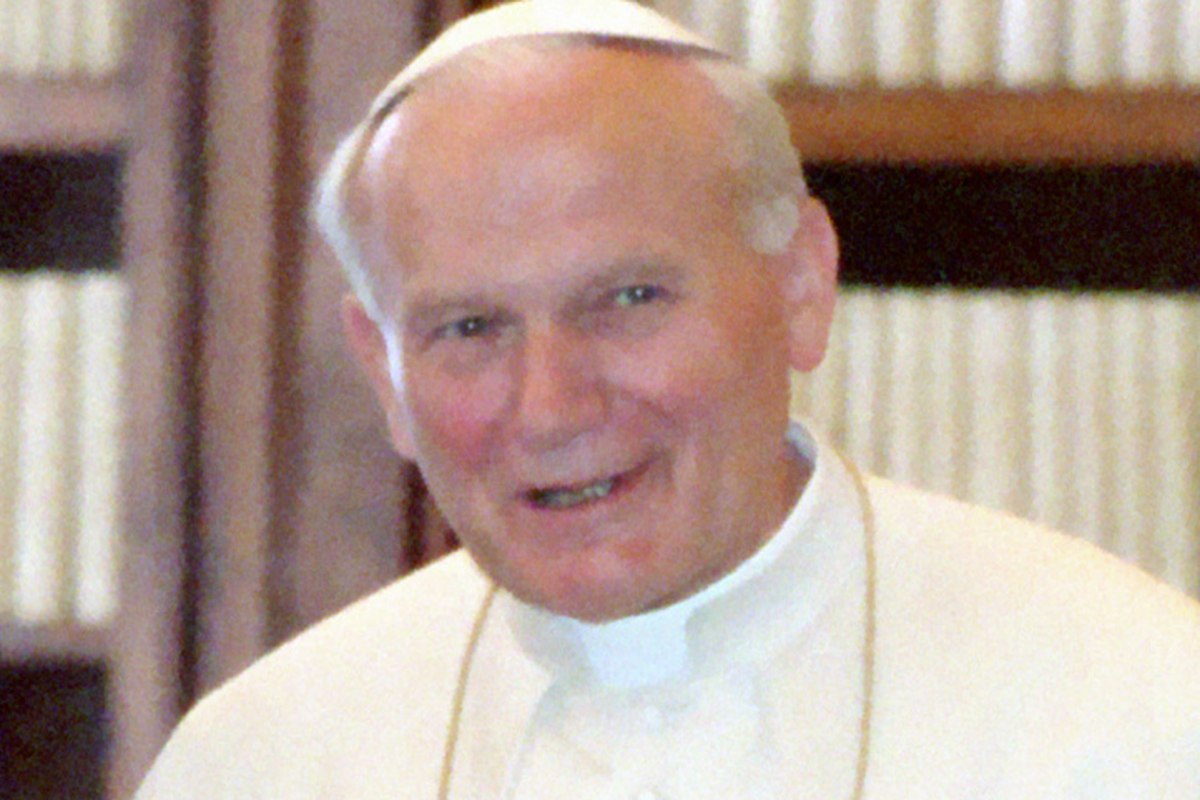
Wawel Cathedral carries a more recent and, for many Poles, even more personal significance through its connection to Pope John Paul II. Long before his election in 1978, Karol Wojtyla celebrated his first Mass as a newly ordained priest in the cathedral's St. Leonard's Crypt in 1946, and he later served as Archbishop of Krakow, presiding over the same building where centuries of his country's kings had once been crowned. That personal history has made the cathedral a place of particular devotion for Polish Catholics, layering a modern papal connection onto an already deep well of national and religious memory. Poland's rich tradition of devotion runs through many such sites; our broader guide to notable Catholic churches covers other landmark churches worth knowing across the Christian world.
Treasures beyond the tombs
Alongside its royal and religious history, Wawel Cathedral holds a cathedral treasury packed with centuries of accumulated regalia and liturgical objects — coronation swords, vestments, and ceremonial items connected to individual monarchs, many displayed to visitors as part of the broader Wawel Hill museum complex. The cathedral's exterior is similarly layered with history in a more informal way: legend holds that a set of enormous prehistoric bones, said locally to belong to a dragon, hang chained near the entrance, tied to Krakow's own founding legend of the Wawel Dragon supposedly slain beneath the very hill the cathedral now stands on. Whether visitors take that story literally or not, it's a reminder that this hilltop was considered significant, and already wrapped in myth, long before any church was built on it at all.
Architecturally, the cathedral is something of a layered scrapbook itself — Romanesque foundations, a Gothic core, and Renaissance and Baroque chapels added by successive kings eager to leave their own mark beside their predecessors', so that walking around its exterior means passing through nearly every major period of European church architecture in a single circuit. That patchwork quality, rather than undermining the building's coherence, is part of what makes it such a vivid physical record of eight hundred years of continuous royal and religious use.
Visiting today
Wawel Cathedral remains an active church within the fortified Wawel Hill complex that also houses the Royal Castle, and it continues to host major state and religious ceremonies alongside its role as one of Poland's most visited historic sites. Visitors can climb the cathedral's largest tower to see the Sigismund Bell up close, tour the royal crypts beneath the main nave, and stand before Saint Stanislaus's silver tomb at the literal and symbolic center of Polish national memory — a small hilltop church that has, remarkably, remained at the center of the country's story for very nearly its entire recorded history.
Trivia
Who is buried in Wawel Cathedral?
Why is Saint Stanislaus important to Wawel Cathedral?
Did Pope John Paul II have a connection to Wawel Cathedral?
How many Polish monarchs were crowned at Wawel Cathedral?
What is the Sigismund Bell at Wawel Cathedral?
You May Also Like
Related Reading