Jonah and the Whale

A mission going the wrong direction
The Book of Jonah opens with an unusually blunt command: go to Nineveh, the great capital of the Assyrian empire, and preach against its wickedness. Jonah's response isn't hesitation or argument — it's flight. He heads to the port city of Joppa, finds a ship sailing for Tarshish (likely a city in what is now southern Spain, functionally the far edge of the known world from Israel's perspective), pays the fare, and boards, described plainly as fleeing "away from the Lord" (Jonah 1:3). Whatever his reasons at this point in the story, the geography alone makes the point: Nineveh lay to the northeast; Tarshish lay in the opposite direction entirely. Jonah wasn't looking for a detour. He was trying to put as much distance as possible between himself and his assignment.
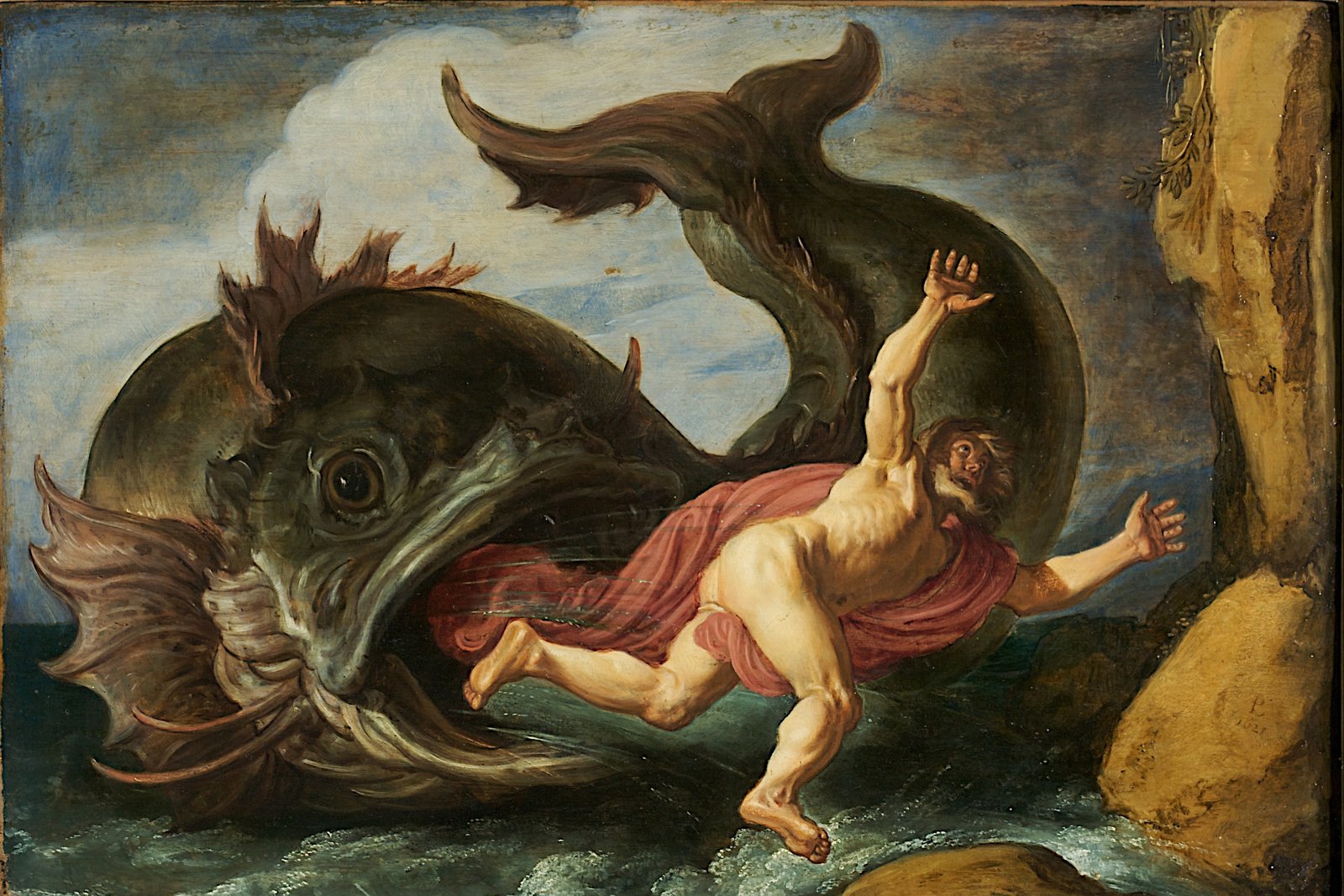
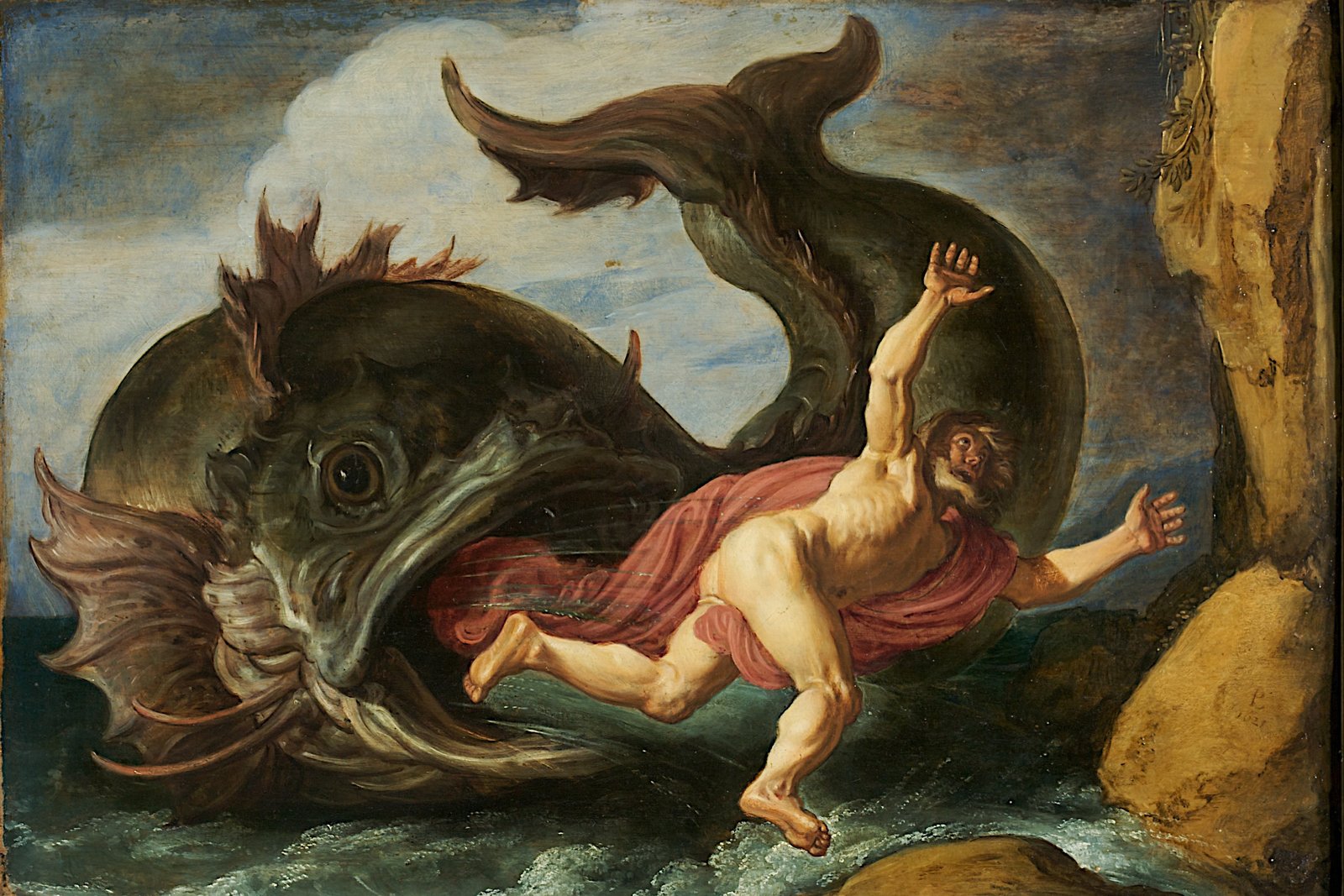
Pieter Lastman, "Jonah and the Whale," 1621, Kunsthalle Bremen. Public domain.
A storm the sailors didn't deserve
The ship is barely underway before a violent storm hits, severe enough that the professional crew — men who would have weathered plenty of Mediterranean storms in their working lives — grow terrified and start throwing cargo overboard to lighten the ship. Jonah, meanwhile, is asleep below deck, apparently undisturbed by a storm that has an entire crew convinced they're about to die. The captain wakes him and orders him to pray to his god, and the crew casts lots — an ancient method of divination used to identify who among them has brought the disaster — and the lot falls on Jonah. Under questioning, he admits who he is and what he's running from. Notably, it's Jonah himself who proposes the solution: throw him into the sea, and the storm will stop. The sailors try everything else first, rowing hard to get back to land, unwilling to take a man's life if they can avoid it — but eventually they have no choice. "They picked up Jonah and hurled him into the sea, and the sea stopped raging" (Jonah 1:15). Their reaction afterward is striking: "seized with great fear of the Lord," pagan sailors who'd never worshiped Israel's God "offered sacrifice to the Lord and made vows" (Jonah 1:16) — an unexpected moment of conversion tucked into the margins of Jonah's own story of running away.
Three days that shouldn't have been survivable
What happens next is the detail most people know even without reading the book: "the Lord sent a great fish to swallow Jonah, and he remained in the belly of the fish three days and three nights" (Jonah 2:1, NABRE). The text doesn't dwell on the mechanics of survival inside a fish — its interest is entirely in what Jonah does while he's there. He prays, and the prayer recorded in chapter 2 reads less like a request for rescue and more like someone already certain of it, thanking God in advance: "But I, with thankful voice, will sacrifice to you; What I have vowed I will pay: deliverance is from the Lord." (Jonah 2:10, NABRE). After the prayer, the fish — on God's command — vomits Jonah out onto dry land, and the mission he tried to outrun is given to him a second time, this time without an argument.
A city that repented faster than anyone expected
Jonah finally goes to Nineveh, and the size of the task is enormous — the text calls it "an enormously large city" requiring three days just to walk across (Jonah 3:3). Jonah barely gets started: after only "a single day's walk," he announces, "Forty days more and Nineveh shall be overthrown" (Jonah 3:4). What follows is one of the most sudden mass conversions in the Old Testament. "The people of Nineveh believed God; they proclaimed a fast and all of them, great and small, put on sackcloth" (Jonah 3:5, NABRE) — and even the king joins in, stepping down from his throne and issuing a decree that every person and animal in the city fast and turn from evil. Seeing their change of heart, God relents from the destruction he had threatened. It's the outcome the story has been building toward — and, remarkably, the outcome Jonah least wanted.
Angrier about mercy than about almost dying
The final chapter reveals what had been driving Jonah's flight from the very beginning. He's furious that Nineveh was spared, and he tells God so directly: he'd fled to Tarshish in the first place because he knew God is "I knew that you are a gracious and merciful God, slow to anger, abounding in kindness, repenting of punishment." (Jonah 4:2) — and he hadn't wanted that mercy extended to a brutal enemy empire. God's response is a small, almost domestic parable: he grows a plant to shade Jonah, then lets it wither, and when Jonah mourns the plant's loss more than he ever mourned for a hundred thousand people, God presses the point home: "You are concerned over the gourd plant which cost you no effort... And should I not be concerned over the great city of Nineveh, in which there are more than a hundred and twenty thousand persons who cannot know their right hand from their left, not to mention all the animals?" (Jonah 4:10-11, NABRE). The book ends there, unresolved — Jonah's answer to God's question is never recorded, leaving the challenge open to every reader who has ever wanted mercy for themselves but hesitated to extend it to someone they'd rather see punished. Our guide to Old Testament stories every Catholic should know places Jonah's account alongside the other major prophetic narratives that shaped Israel's understanding of God's mercy.
A sign Jesus himself pointed to
Jonah's time in the fish takes on additional meaning in the New Testament, where Jesus refers to it directly as a foreshadowing of his own death and resurrection: "Just as Jonah was in the belly of the whale three days and three nights, so will the Son of Man be in the heart of the earth three days and three nights" (Matthew 12:40, NABRE). That connection is a major reason the story has remained so central to Christian imagination for two thousand years — not simply as a tale of a reluctant prophet, but as an Old Testament sign pointing forward to Christ's own three days in the tomb before rising again.
Trivia
Why did Jonah run away instead of going to Nineveh as God commanded?
How did Jonah end up in the sea?
How long was Jonah inside the fish?
Did the people of Nineveh actually listen to Jonah's warning?
Was Jonah happy that Nineveh repented and was spared?
Related Reading