The Difference Between a Diocese and a Parish

Two different scales of the same structure
Catholic Church governance is organized geographically, in overlapping layers, and the diocese and the parish sit at two very different points on that scale. The Church's own internal legal system, canon law, codified most recently in the 1983 Code of Canon Law, defines both with specific technical precision, even though everyday conversation often blurs the distinction between them.
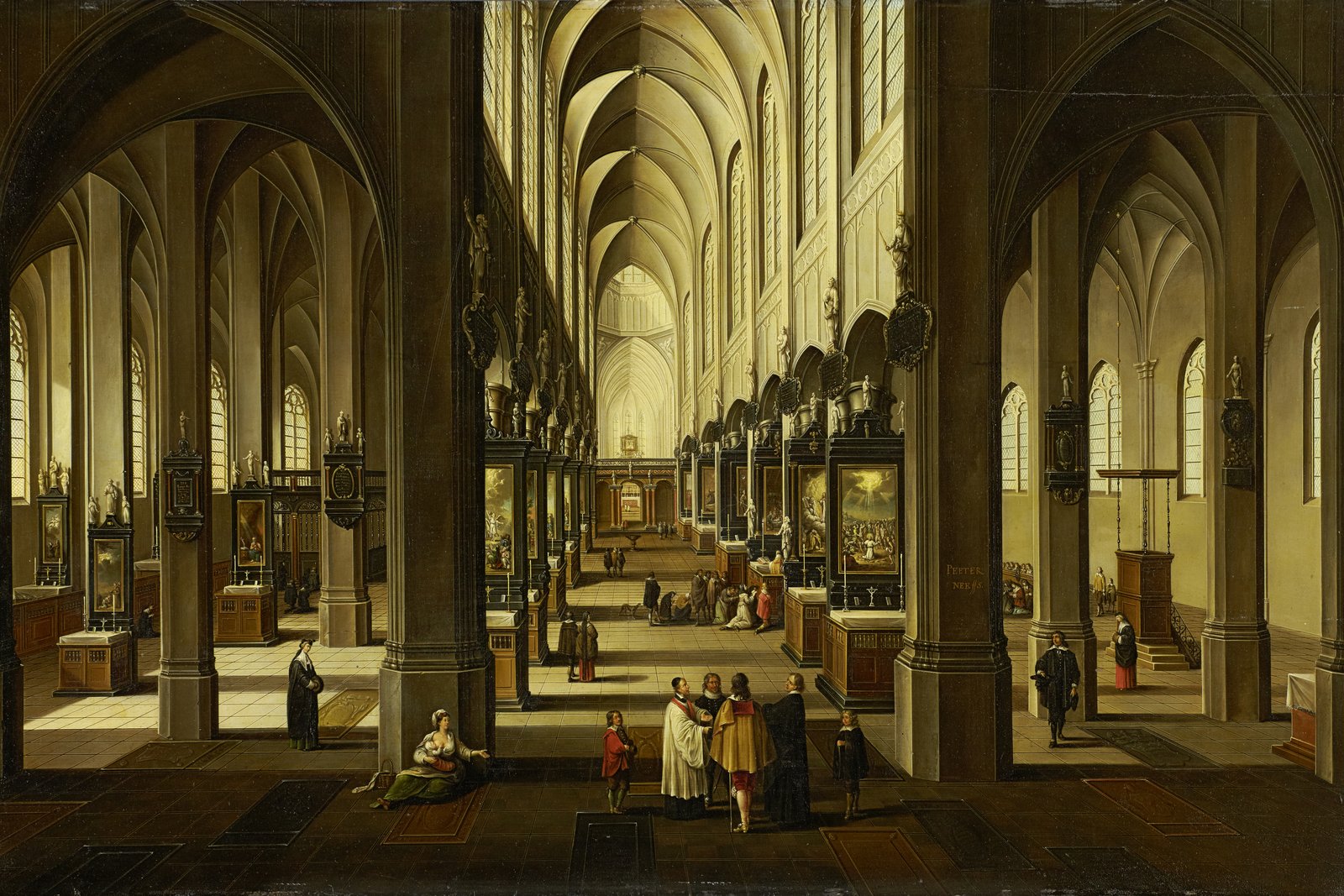
Pieter Neefs the Younger, Interior of Antwerp Cathedral, c. 1655-1667 — public domain.
What a diocese is
A diocese (canon law's more technical term is a "particular church," while the older, still-common word "bishopric" means the same thing) is a defined territory entrusted to the pastoral care of a bishop, who exercises what canon law calls "ordinary" authority over it — meaning authority that belongs to the office itself, not delegated from elsewhere on a case-by-case basis. A diocese typically contains dozens, sometimes hundreds, of individual parishes, along with schools, hospitals, religious houses, and other Catholic institutions operating within its boundaries.
The bishop is responsible for the overall spiritual governance of the diocese: ordaining priests, confirming Catholics (in most dioceses, Confirmation is ordinarily reserved to the bishop, though he can delegate it), appointing pastors to parishes, and representing the diocese's communion with the wider Church and the Pope. Most Catholics interact with their bishop only occasionally — a Confirmation Mass, perhaps a diocesan event — since day-to-day parish life is normally handled by parish clergy rather than the bishop directly.
Archdioceses and ecclesiastical provinces
Some dioceses carry the elevated title of archdiocese, led by an archbishop rather than a bishop. This designation typically reflects historical significance, population, or metropolitan importance rather than a difference in basic sacramental authority — an archbishop is not "more of a bishop" in a doctrinal sense, but the title usually carries an additional administrative role as the head of an ecclesiastical province, a grouping of several neighboring dioceses (called suffragan dioceses) that fall under the archbishop's limited coordinating role, short of direct governing authority over those other dioceses' internal affairs.
What a parish is
A parish, by contrast, is a much smaller subdivision — canon law defines it as "a certain community of the Christian faithful stably constituted within a particular church," normally organized around a specific geographic territory and centered on one church building (Canon 515). Most Catholics identify far more directly with their parish than with their diocese, since it's where they attend Mass, receive most sacraments, and build ongoing community relationships.
A parish is normally led by a pastor, almost always a priest, appointed by the bishop and directly accountable to him. The pastor handles the parish's day-to-day spiritual and administrative life — celebrating Mass, hearing confessions, running parish programs — while remaining, structurally, under the bishop's overall authority for the diocese as a whole.
Other layers in between
Between the diocese and the individual parish, many dioceses also organize territory into intermediate groupings that rarely come up outside canon law itself. A deanery (also called a vicariate forane in some regions) gathers a handful of neighboring parishes under a dean, a priest appointed by the bishop to coordinate clergy meetings, share resources, and serve as a local point of contact between those parishes and the diocesan offices — a layer of structure most parishioners never notice unless their pastor mentions it. Above the diocese itself, the worldwide Church is further organized into episcopal conferences, national or regional bodies of bishops (such as the USCCB, the United States Conference of Catholic Bishops) that coordinate pastoral policy across many dioceses at once, though each diocese remains, in canon law, an independent particular church rather than a branch office of the conference. And beyond that sits the universal Church itself, in communion with the Pope as Bishop of Rome — the structural principle that ties every diocese on earth, no matter how small or remote, into one body.
Eastern Catholic parallels
The diocese-parish structure described here reflects the Latin (Western) Church, the largest of the twenty-four individual Churches that make up the full Catholic Church. The Eastern Catholic Churches — Byzantine, Maronite, Chaldean, and others, each with its own liturgical tradition while remaining in full communion with Rome — use closely related but distinctly named structures: an eparchy functions as the Eastern equivalent of a diocese, governed by an eparch (the Eastern equivalent of a bishop), and a parish still refers to the local worshipping community, though eparchies are sometimes grouped into larger territorial units called exarchates rather than ecclesiastical provinces. A Latin Catholic moving to a city with both a Latin diocese and an Eastern Catholic eparchy technically falls under the Latin diocese by default, though canon law permits Eastern Catholics living outside their traditional territories to remain formally registered with their own eparchy rather than the local Latin one.
The cathedral: where the two structures meet
Every diocese has exactly one cathedral — its principal church, distinguished from every other parish church in the diocese by containing the bishop's official chair, called the cathedra (Latin for "chair"), the word that gives "cathedral" its name. A cathedral is not necessarily the diocese's largest or most architecturally significant building, but it holds unique status as the bishop's own church, the physical seat of his authority over the whole diocese, and the site of the diocese's most solemn liturgical celebrations.
Why the distinction matters practically
Understanding this two-layer structure clarifies a lot of otherwise confusing Catholic terminology: why a bishop, not a parish priest, ordinarily confirms Catholics; why moving to a new city means finding both a new parish and, technically, coming under a new bishop's diocese; and why major decisions — like closing or merging parishes, a difficult but not uncommon reality in dioceses facing declining attendance or priest shortages — are ultimately the bishop's call, made at the diocesan level, even though the immediate, felt impact lands entirely at the parish level, among the people who call that particular church home.
Trivia
What is the basic difference between a diocese and a parish?
Who leads a diocese, and who leads a parish?
What is the difference between a diocese and an archdiocese?
How many parishes does a typical diocese contain?
What is a cathedral, and how does it relate to a diocese?
Related Reading