Byzantine Mosaics of Ravenna: Christian Art's Golden Age in Stone

A capital city, briefly
Ravenna's improbable place at the heart of Byzantine art history begins with politics, not aesthetics. As the Western Roman Empire crumbled in the early 5th century, the imperial capital relocated from Rome to Ravenna in 402, largely for its defensible position amid coastal marshes. After the Western Empire's collapse, Ravenna continued as the capital of the Ostrogothic Kingdom under Theodoric the Great, and then, following Emperor Justinian I's reconquest of Italy in the 6th century, became the seat of Byzantine rule on the Italian peninsula. Each of these regimes built and decorated churches in Ravenna to declare its own legitimacy, and each left behind mosaic decoration reflecting its particular moment — which is why the city's churches together form an unusually continuous visual record of roughly two centuries of dramatic political change, all told in glass and gold.
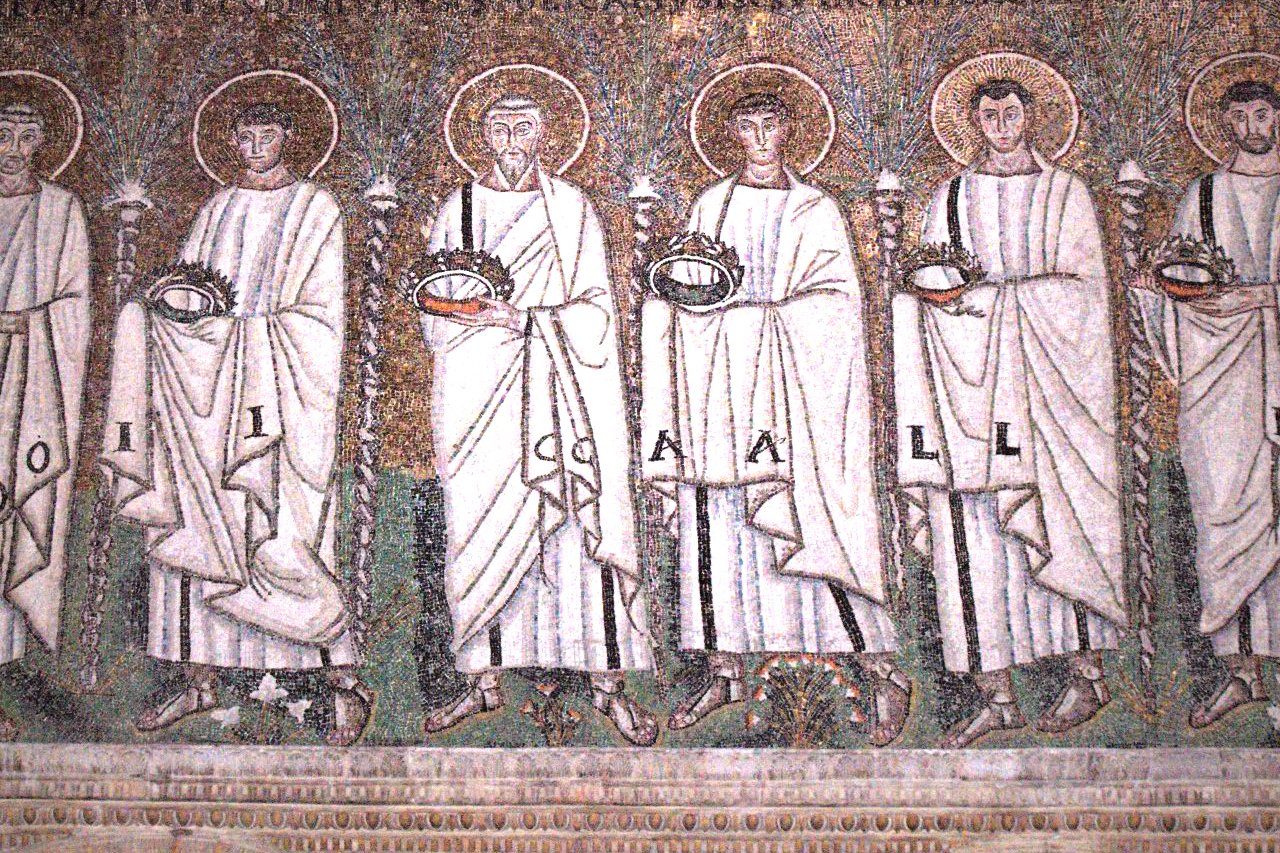
Basilica of Sant'Apollinare Nuovo, Ravenna, 6th century — photograph by Georges Jansoone, public domain.
How Byzantine mosaic actually worked
Byzantine mosaic art relied on tesserae — small individual pieces of colored material set into wet plaster to build up an image. What set Byzantine gold-ground mosaics apart from earlier Roman floor mosaics, which typically used stone or ceramic tesserae, was the introduction of glass tesserae, and especially gold tesserae, made by sandwiching an extremely thin layer of real gold leaf between two layers of glass. Craftsmen then set these gold tesserae at slightly uneven, deliberately irregular angles rather than in a perfectly flat plane, so that light from windows or candles would strike different pieces at different angles and scatter unpredictably across the surface — producing the shimmering, almost liquid quality of light that still astonishes visitors to Ravenna's churches today. This was a sophisticated understanding of how light and material interact, developed centuries before anyone had a scientific vocabulary to describe it.
San Vitale and an emperor who never visited
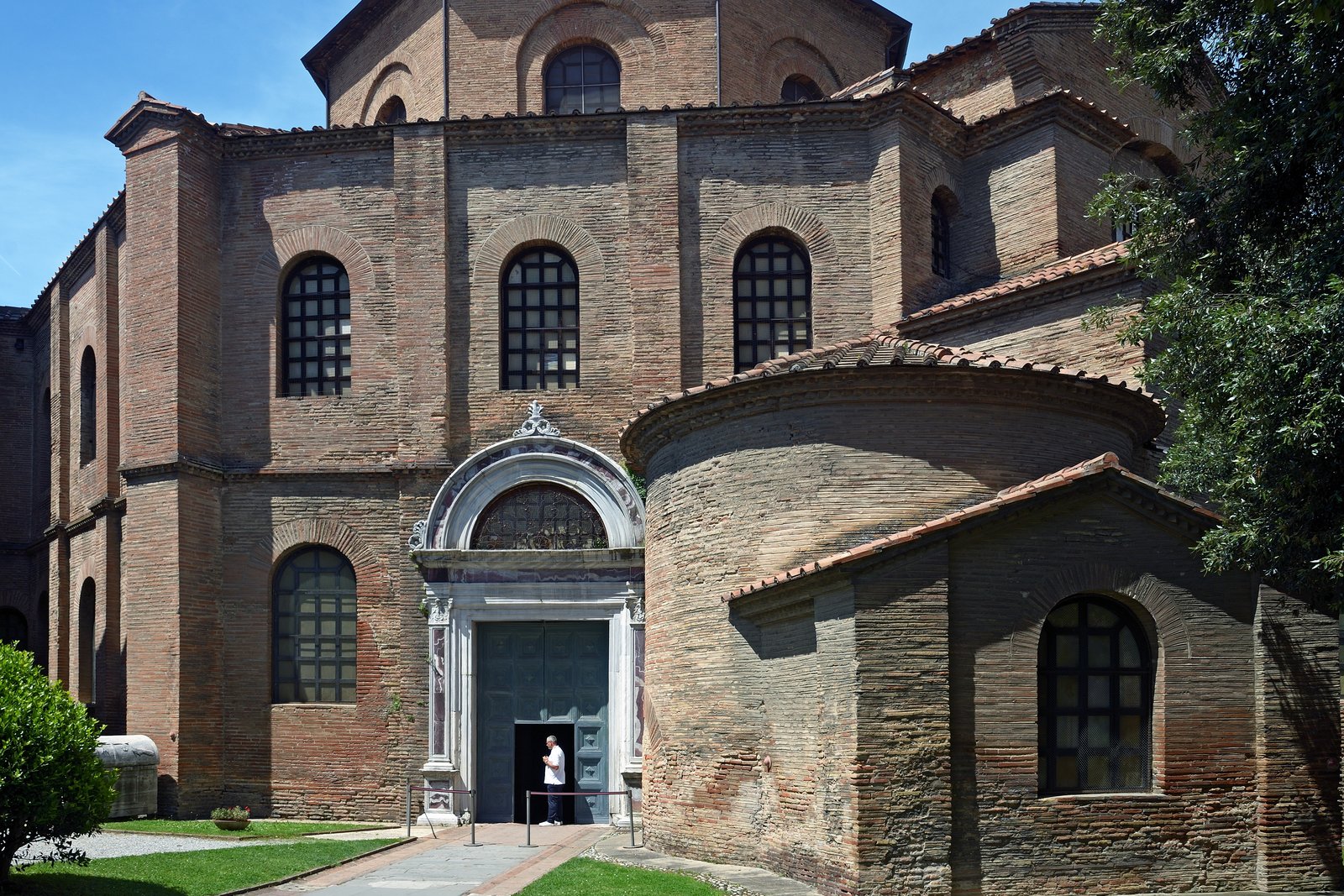
The Basilica of San Vitale, consecrated in 547, houses the most famous mosaics in Ravenna: two facing panels in the apse depicting Emperor Justinian I and Empress Theodora, each shown in formal ceremonial procession with their respective retinues of clergy, courtiers, and soldiers. The composition is deliberately hierarchical and frontal, with figures standing rigidly upright, their faces turned toward the viewer rather than interacting naturally with one another — a stylistic shift away from the more naturalistic, three-dimensional modeling of earlier Roman art, toward a flatter, more symbolic mode meant to convey spiritual and political authority rather than physical realism. Strikingly, Justinian himself never set foot in Ravenna; the mosaic functioned as propaganda in the most literal sense, a permanent visual assertion of imperial authority over newly reconquered Italian territory, installed in a city its subject would never personally see.
Sant'Apollinare Nuovo and the long procession of martyrs
The Basilica of Sant'Apollinare Nuovo, built somewhat earlier under Theodoric the Great and later modified after Justinian's reconquest, contains a different kind of mosaic program along its nave walls: two long, processional friezes, one showing twenty-two virgin martyrs moving toward an enthroned Madonna and Child, the other showing twenty-six male martyrs moving toward an enthroned Christ. Every figure in each procession is nearly identical in pose and dress, individualized mainly by a labeled name above each head — a visual technique that emphasizes the collective community of the redeemed moving as one body toward Christ, rather than celebrating any single figure's individual identity. Higher registers of the same nave contain earlier mosaic scenes from the life and miracles of Christ, among the oldest surviving narrative mosaic cycles depicting Gospel episodes anywhere in Christian art. Readers interested in how other cycles and traditions of Catholic visual art developed across the centuries can find a broader starting point in our guide to Catholic sacred art.
The Mausoleum of Galla Placidia
Smaller and less immediately monumental than San Vitale, the Mausoleum of Galla Placidia nonetheless holds some of Ravenna's most beloved mosaic work, including a deep blue, star-filled ceiling and a mosaic lunette depicting Christ as the Good Shepherd, seated among his flock in a green, pastoral landscape rather than the formal, gold-ground hierarchy typical of the city's later mosaics. Built in the 5th century as a burial chapel connected to the imperial court, though Galla Placidia herself was likely not actually buried there, the mausoleum's smaller scale and more naturalistic style offer a useful contrast to San Vitale's later imperial grandeur, showing how quickly Ravenna's mosaic art evolved over just a few generations.
A UNESCO legacy
In recognition of their exceptional and unusually well-preserved state, eight early Christian monuments across Ravenna, including San Vitale, Sant'Apollinare Nuovo, the Mausoleum of Galla Placidia, and the Neonian Baptistery, were collectively inscribed as a UNESCO World Heritage Site in 1996. UNESCO's citation specifically credits the city's mosaics as representing "a supreme artistic expression" from a critical period when early Christian art and Byzantine imperial art fused into a distinctive new visual language. Today, conservation teams continue delicate restoration work to protect the tesserae against humidity, structural settling, and centuries of accumulated grime — work that requires the same painstaking, piece-by-piece attention the original craftsmen used to set each individual tessera nearly fifteen centuries ago.
Why Ravenna still matters
What makes Ravenna extraordinary is not simply that its mosaics are old, but that they survive as a nearly unbroken visual record of a genuinely pivotal moment in Christian and Western history — the transition from the classical Roman world to the medieval Byzantine one, worked out in gold leaf and colored glass on the walls of a handful of churches in a small city on Italy's Adriatic coast. Few places let a visitor stand in one room and watch an entire civilizational shift happen in light.
Trivia
Why does Ravenna have so many Byzantine mosaics instead of Constantinople?
What are the mosaics in Ravenna made of?
What does the mosaic of Emperor Justinian in San Vitale show?
Are Ravenna's monuments recognized by UNESCO?
What subjects appear in the mosaics at Sant'Apollinare Nuovo?
Related Reading