Catholic vs. Protestant: The Main Differences, Explained Fairly

A shared root, a sixteenth-century break
For roughly fifteen centuries, Western Christianity had no Catholic-versus-Protestant divide to speak of — there was simply the Church, with its share of internal disputes, reform movements, and regional variation, but no lasting institutional split of this kind. That changed beginning in 1517, when a German monk and theology professor named Martin Luther published his Ninety-Five Theses, a set of academic propositions critiquing, among other things, the sale of indulgences. What began as an internal call for reform escalated, over the following decades, into a permanent break — the Protestant Reformation — as Luther and other reformers such as John Calvin and Huldrych Zwingli developed positions the Catholic Church could not accept, and vice versa.
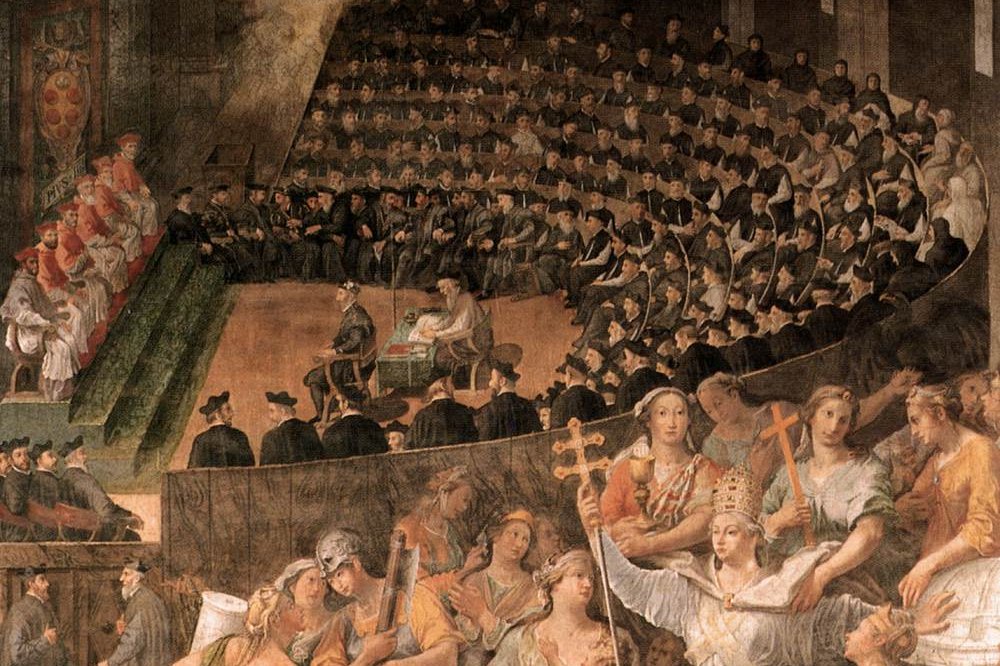
Pasquale Cati, The Council of Trent, 1588, Santa Maria in Trastevere, Rome — public domain.
The Catholic Church's own formal response came at the Council of Trent (1545-1563), which clarified and, in places, hardened Catholic teaching on the very questions the reformers had raised — Scripture and Tradition, justification, the sacraments — in deliberate contrast to Protestant positions. That council's decisions still shape the doctrinal landscape described below.
Scripture and Tradition
The deepest structural difference concerns where religious authority comes from. Catholic teaching holds that divine revelation comes to the Church through both Sacred Scripture and Sacred Tradition — an unwritten stream of apostolic teaching, worship, and practice handed down alongside the written text — and that both are authoritatively interpreted by the Church's Magisterium, its teaching office centered on the Pope and the bishops in communion with him.
Most Protestant traditions hold instead to sola scriptura: Scripture alone as the final, sufficient rule of faith, interpreted by individual believers (often guided by their own denomination's confessions and creeds) rather than by a centralized teaching authority claiming interpretive power over Scripture itself. This single difference cascades into most of the others below — it's the reason Catholics and Protestants can read the same New Testament and still land in different places on questions the text doesn't settle with perfect clarity on its own.
The sacraments
Catholic teaching holds that Christ instituted seven sacraments as sure channels of grace: Baptism, Confirmation, the Eucharist, Penance (Confession), Anointing of the Sick, Holy Orders, and Matrimony (CCC 1113). Central among these is the Eucharist, which the Church teaches becomes truly the Body and Blood of Christ through transubstantiation at the moment of consecration — a doctrine most Protestant traditions reject in favor of symbolic, spiritual-presence, or memorial understandings of Communion.
Most Protestant traditions recognize only two sacraments (often called "ordinances" instead) as directly instituted by Christ in Scripture: Baptism and the Lord's Supper. The other five Catholic sacraments are generally viewed by Protestants as meaningful practices — marriage, ordained ministry, and so on — but not as sacraments carrying the same instituted, grace-conferring status.
Papal and church authority
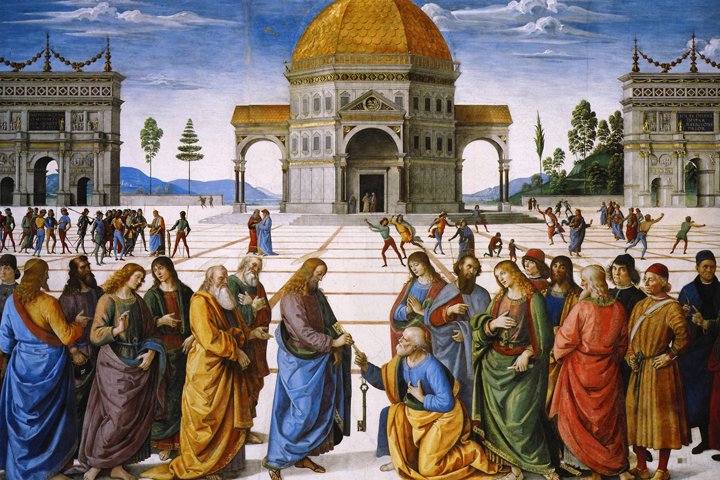
Catholic ecclesiology holds that the Bishop of Rome, the Pope, holds a unique office of authority traced back to Saint Peter, described by Christ as the "rock" on which he would build his Church (Matthew 16:18). For more on how that authority is understood to pass down through history, see Apostolic Succession, Explained.
Protestant traditions, without exception, reject the papacy's claimed authority over the universal Church, though they organize their own church governance in widely varying ways — from the episcopal structures of Anglican and some Lutheran churches, which retain bishops, to the congregational governance common among Baptist and many evangelical churches, where individual local congregations hold primary authority over their own affairs.
Justification: faith, works, and grace
The Reformation-era slogan sola fide — "faith alone" — captured a core Protestant conviction: that a person is justified (made right with God) through faith alone, as a free gift of grace, with good works following as its natural fruit rather than contributing to salvation itself. Catholic teaching, articulated at Trent and restated in the Catechism, holds that justification is a work of grace from first to last, but one that engages human freedom and cooperation — faith expressed and lived out through charity, not faith alone in isolation from a transformed life (CCC 1987-2005). It's worth noting that a 1999 joint declaration between the Catholic Church and the Lutheran World Federation found substantial common ground on this very question, showing the gap here is narrower today than the sixteenth-century rhetoric on both sides might suggest.
Mary and the saints
Catholic devotion to Mary and the saints — including asking their intercession in prayer, a practice explained in Why Do Catholics Pray to Saints? — along with specifically Catholic Marian dogmas like the Immaculate Conception, are generally rejected across Protestant traditions, which typically hold that prayer should be addressed to God alone. This isn't uniform, though: Anglican and Lutheran communities have historically retained more warmth toward Marian devotion and the veneration of saints than Reformed or evangelical traditions, which tend to minimize any devotional attention beyond Scripture and direct prayer to God.
Common ground that outlasts the divisions
None of these differences erase what Catholics and Protestants share: belief in the Trinity, the divinity of Christ, his death and resurrection, the authority of Scripture (even where its relationship to Tradition is disputed), and the hope of eternal life. Since the Second Vatican Council, the Catholic Church has formally pursued ecumenical dialogue with Protestant communities, aiming at eventual Christian unity while maintaining its own doctrinal convictions in the process — a reminder that the relationship between these traditions, however sharply divided on the points above, isn't simply one of opposition.
Trivia
What is the single biggest difference between Catholics and Protestants?
Do Catholics and Protestants believe different things about salvation?
Why do Catholics have seven sacraments while many Protestants recognize only two?
Do Protestants reject Mary and the saints entirely?
Is the split between Catholics and Protestants considered permanent?
Related Reading