Early Popes and Martyrs of Rome

An office that could get you killed
It's worth pausing on how strange this actually was. Today the papacy is a position people hold for years, sometimes decades, in full public view. For the Church's first three centuries, it was closer to a death sentence with a term limit attached. Rome's Christian community met in private homes and, later, in the maze of tunnels its dead were buried in — because gathering openly, admitting to being a follower of Christ, or simply refusing to offer sacrifice to the emperor's gods could get you arrested. Several Roman emperors treated Christianity as a threat to public order, and when the pressure came, it often came for the man leading the community first.
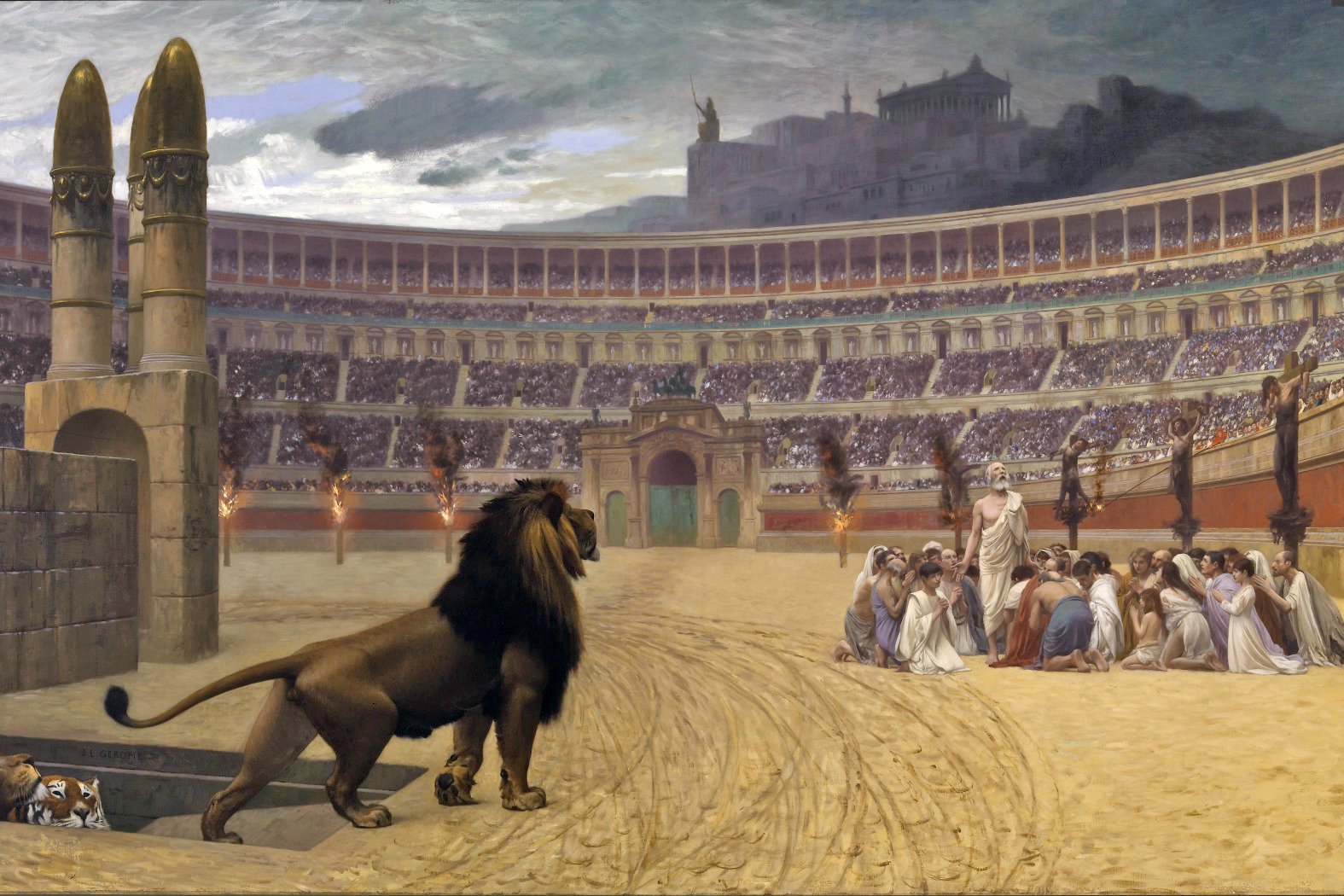
Jean-Léon Gérôme, The Christian Martyrs' Last Prayer, between 1863 and 1883, Walters Art Museum, Baltimore — public domain.
That doesn't mean every single pope from this era died a martyr's death — some governed for years and died naturally, and later legend occasionally dressed up a peaceful death in martyr's language it hadn't earned. But enough of them really did die for the faith that the pattern is unmistakable: leading Rome's Christians, for a very long stretch of the ancient world, was one of the most dangerous jobs a person could take on.
Popes who died as martyrs
- Pope Fabian — elected in 236 AD after a dove startled the assembly by landing on his head, a layman in Rome on business who found himself pope before the day was out; he was martyred under Emperor Decius's persecution in 250.
- Pope Sixtus II — seized mid-sermon in a Roman catacomb and beheaded on his own papal chair in 258, at the opening of one of Rome's fiercest anti-Christian purges under Emperor Valerian.
- Pope Cornelius — nearly split the Church with the North African bishop Cyprian of Carthage over how to treat Christians who had lapsed under persecution, then became his close ally; the two died within a year of each other around 253.
- Pope Pontian — condemned to the mines of Sardinia alongside the rival priest Hippolytus, who had broken away from him; the two reconciled in exile and both died there as martyrs.
- Pope Martin I — the last pope venerated as a martyr, arrested by imperial troops for defying an emperor's theology and worked to death in Crimean exile around 655.
- Pope John I — died in a Ravenna prison in 526 after the Arian Gothic king Theodoric sent him on a diplomatic mission to Constantinople and grew suspicious of his loyalty on his return.
Popes who built and shaped the early Church
Not every early pope's story ends on a cross or in a mine — some spent their years in office building the institutions and traditions that would let the Church survive what came next.
- Pope Callistus I — a former slave and convict sentenced to the mines of Sardinia before becoming pope, whose mercy toward repentant sinners outraged the strictest churchmen of his day; the catacomb bearing his name became one of Rome's most important early Christian burial sites.
- Pope Sylvester I — reigned through Christianity's turn from persecuted sect to favored imperial religion under Constantine, and his name still marks New Year's Eve across much of Europe.
- Pope Damasus I — survived a violent, disputed election to become pope, then commissioned Saint Jerome's Latin translation of the Bible (the Vulgate) and composed poetry honoring the martyrs buried in Rome's catacombs.
Deacons and clergy of the persecuted church
Not every leader of the early Roman church wore the bishop's ring. Some of the most vivid martyrdom stories from this period belong to the deacons and priests who served under the popes above.
- Saint Vincent of Saragossa — a Spanish deacon whose calm defiance under Roman torture made him one of the most widely venerated martyrs of the early Church, praised by name from Saint Augustine to the poet Prudentius.
- Saint Clement I — an early bishop of Rome tied by tradition to death by drowning with an anchor around his neck, giving sailors an unlikely patron and leaving behind one of the oldest surviving Christian letters outside the New Testament.
Martyrs of the catacombs and the wider persecution
Beyond the popes and their clergy, Rome's underground cemeteries hold the memory of countless ordinary believers and a few figures whose stories reach beyond the city itself.
- Saints Marcellinus and Peter — two Roman martyrs so revered that Charlemagne's own biographer sent monks to claim their relics centuries later; their names are still spoken today in the Roman Canon at Mass.
- Saint Justin Martyr — a pagan philosopher who studied Stoicism, Aristotle, and Plato before an old man he met on a beach pointed him toward Christ; he kept wearing a philosopher's cloak even after his conversion and was executed in Rome around 165.
- Saint Apollinaris — an early bishop and martyr of Ravenna, not Rome itself, but part of the same age of persecution; his relics and basilica helped make his city one of early Christianity's great artistic centers.
Why this history still matters
None of this is distant trivia. The reason Rome's basilicas sit where they sit, the reason certain names are still read aloud at every Catholic Mass, the reason "catacomb" is a word most people recognize at all — it all traces back to this same stretch of history. The martyrs above didn't die for an institution that already looked triumphant. They died for something still small, still illegal, still meeting in tunnels under the city — and their deaths are a large part of why it didn't stay that way.
Curious about the physical place where many of these martyrs were buried? Read more about the Catacombs of Rome, or browse the full Saints category for more early-Church history.
Trivia
Why did so many early popes die as martyrs?
What is a catacomb, and why are so many early Roman martyrs linked to them?
Did every early pope actually die a violent death?
What ended the age of the martyr-popes?
Are relics of these early martyrs still venerated in Rome today?
You May Also Like
Related Reading