The Vatican Necropolis

A cemetery buried on purpose
Long before there was a basilica on Vatican Hill, there was a hillside cemetery. In the first and second centuries, the area just outside Rome's walls near the Circus of Nero — where, according to Christian tradition, Peter the Apostle was martyred, crucified upside down at his own request because he considered himself unworthy to die as Christ had — filled up with modest mausoleums belonging to ordinary Roman families, both pagan and, increasingly, Christian. Rows of small brick tomb-houses lined a narrow street, decorated with mosaics, stucco reliefs, and inscriptions, a fairly typical burial ground for the period.
Ancient Roman street of mausoleums in the Vatican Necropolis beneath St. Peter's Basilica (Blue 439, CC BY-SA 3.0, Wikimedia Commons)
Then, in the 4th century, Emperor Constantine made an almost absurd decision. Rather than build his new basilica honoring Peter somewhere flat and convenient, he insisted on building it directly over the spot where Peter was already believed to be buried — even though that meant leveling an entire hillside cemetery and burying it under tons of fill to create a stable foundation. Whole rows of intact tombs were sealed underground rather than destroyed, essentially freezing a cross-section of Roman burial custom in place for over 1,600 years. It's a strange, costly decision unless you take seriously that, for Constantine, the location mattered more than the engineering difficulty.
The excavation Pius XII ordered in secret
The necropolis stayed buried and largely unknown until 1939, when Pope Pius XII — reportedly acting on a private wish expressed by his predecessor, Pius XI, to be buried close to Peter — authorized a discreet excavation beneath the basilica's grottoes. The work continued through the Second World War, conducted quietly by a small team of archaeologists working in tight, dangerous conditions directly under an active, functioning church.
What they found was more than they had hoped for: an entire ancient street of mausoleums, remarkably preserved by the very burial that had hidden them. At the western end of that street, tucked against a plain 2nd-century monument that early Christian writers had already identified as marking Peter's grave, excavators found a disturbed, shallow burial niche. Nearby, a wall covered in centuries of pilgrim graffiti — crosses, prayers, and fragments of Greek text some scholars have read as invoking Peter directly — suggested this spot had been quietly venerated long before Constantine ever built on top of it.
Bones recovered from the site were initially set aside and, for years, not connected to the tomb itself. It was the classicist and epigrapher Margherita Guarducci who, studying the graffiti wall in detail through the 1950s and 60s, argued that bones from a specific niche in the wall — originally misfiled among other remains — matched the profile of an elderly man and had likely been moved there deliberately in antiquity for safekeeping. In 1968, Pope Paul VI publicly announced that the Church considered these to be the relics of Saint Peter, a conclusion that remains, honestly, more a matter of historical and archaeological judgment than of ironclad proof — but one resting on a genuinely unusual convergence of continuous veneration, physical evidence, and textual tradition rare for any figure from antiquity.
Why the necropolis matters beyond the bones
Setting the identification of Peter's remains aside, the Vatican Necropolis is significant simply as one of the best-preserved windows into how ordinary Romans — not emperors, not senators, but merchants, freedmen, and families of modest means — buried and commemorated their dead in the centuries when Christianity was shifting from a persecuted minority faith to the religion of the empire. Some tombs are decorated with unmistakably pagan imagery: garlands, portraits of Roman gods, scenes from mythology. Others, dug slightly later in the same ground, carry unmistakably Christian symbols — anchors, fish, and one striking mosaic often interpreted as an early depiction of Christ as the sun god Helios, driving a chariot across the sky, a rare visual record of the two traditions overlapping in the same burial ground.
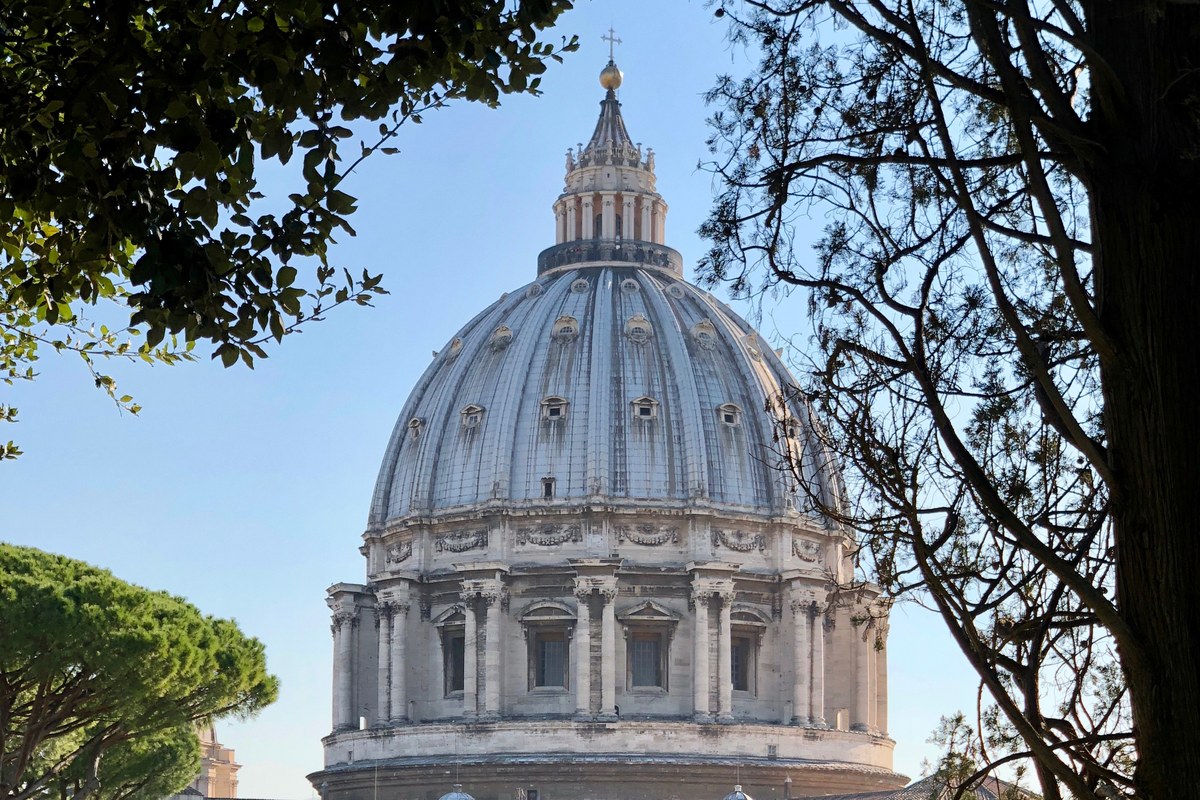
It's also a striking physical reminder of just how literally the Catholic tradition takes the idea of apostolic continuity. St. Peter's Basilica isn't simply named for Peter or built in a city associated with him — it was built, at enormous cost and difficulty, on the specific spot where his body was already believed to lie, with later structures stacked directly on top of earlier ones across four centuries and three successive buildings. For more on the basilica that now rises above the necropolis, see our guide to St. Peter's Basilica, and for other landmark churches worth knowing, our broader guide to notable Catholic churches.
Visiting the Scavi
Access to the necropolis is deliberately limited. Unlike the basilica above it or the grottoes housing papal tombs, the excavated street of tombs can only be visited on a guided tour arranged in advance through the Vatican's Ufficio Scavi (Excavations Office), with groups kept small and children under 15 not admitted, largely due to the confined, low-ceilinged passages. Photography is generally restricted inside the necropolis itself. For visitors who do secure a spot, the tour ends at a small window looking directly onto the niche where Peter's bones are now kept — a modest, almost anticlimactic final view, at the end of a walk through nearly two thousand years of buried history, directly underneath the busiest church in the Christian world.
Trivia
What is the Vatican Necropolis?
Did archaeologists really find Saint Peter's bones?
Why is it called the Scavi?
Can visitors go down into the Vatican Necropolis?
What is the graffiti wall near Peter's tomb?
You May Also Like
Related Reading