Founders of Catholic Religious Orders

A wave of new communities
Walk through the roll call of religious orders still running schools, hospitals, and missions today, and an unusual number of them trace back to a fairly compact stretch of history — roughly the 1500s through the early 1800s. This wasn't a coincidence. The Council of Trent had just pushed the Church to take clergy education and pastoral care more seriously. Europe's cities were swelling with poor families whose children had nowhere to learn to read. Wars, revolutions, and piracy were leaving orphans, prisoners, and captives with no one organized to help them. Into that gap stepped an unusually large number of individual men and women who didn't wait for someone else to solve the problem.
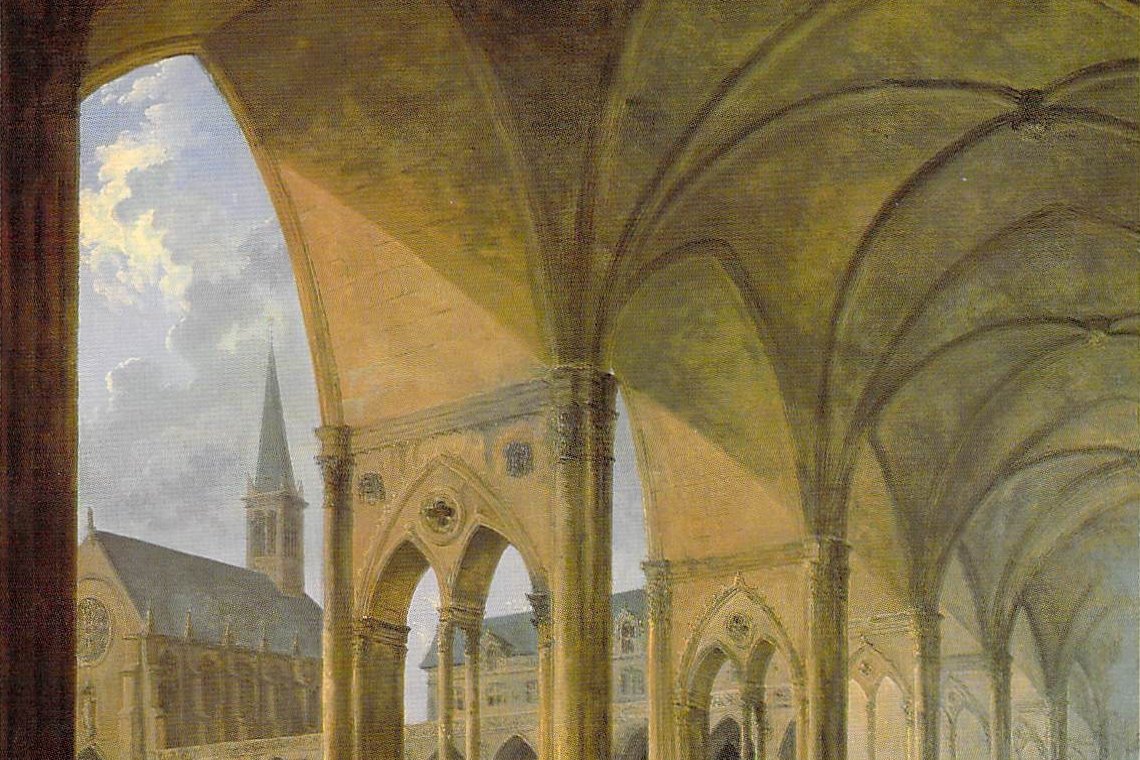
Hubert Robert, The Cloister of the English Augustinian Nuns, Paris, late 18th century — public domain.
What's striking about their stories is how similar the pattern is, even across two and a half centuries and several countries. Almost none of them began with a five-year plan to found an order. A priest started teaching a few poor boys for free. A widow started visiting the sick in her neighborhood. A nobleman gave away his inheritance to found a fund for a very specific kind of suffering he'd personally seen. The "order" came later, as a way of making sure the work would outlive its founder.
Educators
Few needs were as urgent, and as widely ignored, as basic education for poor children — and several founders below built their entire life's work around fixing exactly that.
- Saint Joseph Calasanz — a Spanish priest who opened one of Europe's first free public schools in a Roman slum, convinced poor children deserved an education as much as anyone else's.
- Saint Jean-Baptiste de La Salle — a wealthy cathedral canon who gave up his fortune to teach poor children in French instead of Latin, pioneering a classroom model still recognizable in schools today.
- Saint Angela Merici — a farmer's daughter from Lombardy who founded the first women's teaching order in the Church, reshaping Catholic education for centuries afterward.
- Saint Marcellin Champagnat — a French priest whose visit to a dying teenager who knew almost nothing of the Catholic faith convinced him to found an entire teaching order, starting with just two disciples.
Missionaries and the sick-poor
Other founders looked past their own parish entirely — toward captives overseas, plague victims, and the sick and dying no one else would touch.
- Saint Vincent de Paul — a peasant-born priest who organized ordinary laywomen into door-to-door charity workers, then built an entirely new kind of religious community around them.
- Saint John Eudes — a missionary who personally nursed plague victims twice and helped rebuild lives for former prostitutes, and went on to found the devotions to the Sacred Heart and Immaculate Heart.
- Saint Eugene de Mazenod — a nobleman's son who fled the French Revolution as a child and grew up poor in exile, then founded a missionary order dedicated to society's most abandoned people.
- Saint Peter Nolasco — founder of the Mercedarians, an order built around ransoming Christian slaves from North African captivity, whose members took a fourth vow committing themselves to that mission personally.
- Saint Anthony Zaccaria — a physician turned priest who founded the Barnabites, preached in the streets of Renaissance Milan, and pushed for more frequent, more reverent reception of the Eucharist.
- Saint John Leonardi — a pharmacist's apprentice from Tuscany whose reforming zeal got him exiled from his own city twice, before he helped found the Vatican's office for overseeing foreign missions.
- Saint Paul of the Cross — an Italian layman who spent forty days alone in a cave until a vision convinced him to found an order built entirely around meditating on Christ's suffering.
Founders of women's orders
Women religious founders of this era often faced additional pressure from Church authorities to cloister their communities more strictly than they had originally planned — and still built lasting institutions regardless.
- Saint Jane Frances de Chantal — a widowed mother of four who stepped over her own son's body lying across the doorway to answer a call to religious life, then founded an order for women other communities had turned away.
Organizing the Church's own law
Not every founder on this list built a new community from nothing — one reorganized the scattered legal tradition the whole Church relied on.
- Saint Raymond of Penyafort — a Catalan canon lawyer who organized centuries of scattered Church law into one usable code, and became the patron saint of lawyers along the way.
Why their orders outlasted them
What ties these very different people together isn't a shared theology of religious life so much as a shared instinct: seeing an unmet need and building the structure to meet it permanently, rather than solving it once and moving on. That's also why so many of these communities are still working today, centuries after their founders died — a Vincentian charity, a De La Salle classroom, or a Mercedarian mission is still, in a real sense, that same founder's original act of attention to one struggling person, now multiplied across generations.
Interested in the wider world these founders lived in? Browse the full Saints category for more on the priests, nuns, and laypeople who shaped Catholic history.
Trivia
Why did so many new religious orders appear between the 1500s and 1800s?
What's the difference between a religious order and a religious congregation?
Did women found and lead religious orders themselves during this period?
Are these founders' orders still active today?
What is a 'fourth vow' like the one Saint Peter Nolasco's order took?
You May Also Like
Related Reading