The Angel of the Annunciation

A Messenger Sent to an Unknown Town
Luke sets the scene with deliberate precision: "In the sixth month, the angel Gabriel was sent from God to a town of Galilee called Nazareth, to a virgin betrothed to a man named Joseph, of the house of David, and the virgin's name was Mary" (Luke 1:26-27, NABRE). The "sixth month" ties the scene to the episode just before it — the announcement of John the Baptist's conception to the elderly priest Zechariah in the Jerusalem Temple, the most sacred building in Judaism. Gabriel appears there too, and identifies himself: "I am Gabriel, who stand before God" (Luke 1:19).
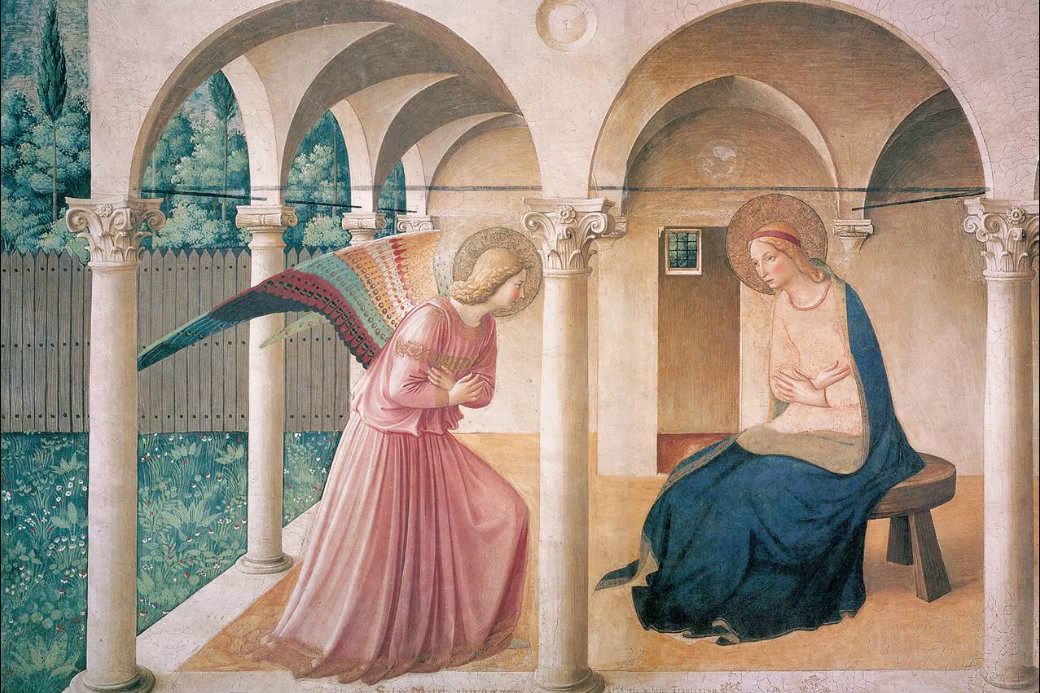
Fra Angelico, The Annunciation, c. 1438-1450, Museo di San Marco, Florence — public domain.
The contrast Luke builds between the two annunciations is not accidental. Zechariah is a priest, in the Temple, performing the incense offering — the setting could hardly be more central to Jewish religious life. Mary is a teenage girl, betrothed but not yet married, in Nazareth, a town so minor it appears nowhere in the Old Testament, Josephus's histories, or the Talmud. The Gospel of John later records the apostle Nathanael's blunt reaction on hearing where Jesus is from: "Can anything good come from Nazareth?" (John 1:46). Gabriel's mission there is itself a kind of statement about where God chooses to act.
What Gabriel Says, and What It Means
The dialogue Luke records runs to thirteen verses, longer and more developed than any other angelic speech in the New Testament. Gabriel's opening greeting — "Hail, favored one! The Lord is with you" (Luke 1:28) — unsettles Mary, and Luke says so directly: she is "greatly troubled" and turns the words over in her mind, trying to understand what kind of greeting this is. Gabriel's response follows the pattern angels use throughout Scripture when they appear to frightened people: "Do not be afraid."
What follows is not vague reassurance but a specific, theologically dense announcement. The son Mary will bear will be called Jesus; he will be "great" and called "Son of the Most High"; he will receive "the throne of David his father" and rule "over the house of Jacob forever" (Luke 1:32-33). This is messianic language, drawn directly from the promise God made to David through the prophet Nathan centuries earlier — that his throne would be established forever (2 Samuel 7:16). A first-century Jewish audience hearing this would have recognized immediately that Gabriel was describing the long-awaited Messiah.
Mary's question — "How can this be, since I have no relations with a man?" (Luke 1:34) — is not doubt in the way Zechariah's earlier question was (his led to nine months of silence as a consequence). Gabriel's answer explains the mechanism without dispelling the mystery: "The holy Spirit will come upon you, and the power of the Most High will overshadow you" (Luke 1:35). The Catechism of the Catholic Church treats this moment as the pivot of salvation history, the point at which "the Word became flesh" begins (CCC 484-486).
Tradition, Theology, and What the Church Actually Teaches
It is worth separating carefully what Scripture records from what later piety added. The biblical text gives us Gabriel's name, his mission, and his words — nothing more about his appearance, his manner, or the physical details so beloved of painters (the lily, the dove, the beam of light). Those elements are the product of centuries of Christian art and devotional tradition, not scriptural description. Luke does not tell us whether Mary saw a winged figure or simply heard a voice; artists from Fra Angelico to Leonardo da Vinci made their own choices in filling that silence.
What the Church does teach as doctrine, rather than artistic convention, is Mary's free consent. Her final words to Gabriel — "Behold, I am the handmaid of the Lord. May it be done to me according to your word" (Luke 1:38) — are understood in Catholic theology as a genuinely free "yes," offered without coercion, that theologians going back to the early Church Fathers have contrasted with Eve's disobedience in Eden. Saint Irenaeus, writing in the 2nd century, called Mary's obedience the undoing of Eve's — a formula the Church has repeated ever since, though always as theological reflection built on the text, not a separate revealed fact.
Gabriel's Larger Role in Scripture
Gabriel appears in exactly four passages across the entire Bible, and the Annunciation is the last and most consequential of them. In the Book of Daniel, Gabriel twice appears to interpret visions for the prophet — once explaining the vision of the ram and the goat (Daniel 8:15-26), and once delivering the prophecy of the seventy weeks (Daniel 9:20-27), a passage later Christian interpreters read as pointing toward the timing of the Messiah's coming. In the New Testament, Gabriel's appearance to Zechariah and then to Mary forms a matched pair — two impossible pregnancies announced by the same angel within six months of each other, one to an elderly, childless priestly couple, the other to a young virgin.
Because Gabriel's role each time is to explain and interpret — never to fight, as Michael does, or to guide a journey, as Raphael does in the Book of Tobit — Christian tradition has long associated him with the ministry of the word: revelation, announcement, communication of God's plans. That association is why Gabriel became, in later centuries, an informal patron of messengers, broadcasters, and postal workers, though this is a devotional custom rather than a formally defined patronage.
A Feast Nine Months Before Christmas
The Church places the Solemnity of the Annunciation on March 25 — exactly nine months before Christmas — a date chosen deliberately to mark the moment of Christ's conception, not his birth. The feast is genuinely ancient: it is attested in the Eastern Church by the 5th century and was firmly established in Rome by the 7th. In places where March 25 falls during Holy Week or the Easter octave, when the Church's liturgical attention is fixed on Christ's death and resurrection, the celebration is moved to the following week — a rare accommodation that shows how seriously the date itself is treated.
For a fuller look at Gabriel's identity across the whole of Scripture, see Saint Gabriel the Archangel; readers curious about the church built over the traditional site of this encounter can read about the Basilica of the Annunciation in Nazareth. Michael's very different angelic mission, one of conflict rather than announcement, is covered in Saint Michael the Archangel.
Trivia
Who is the angel of the Annunciation?
What did Gabriel actually say to Mary?
Why is Gabriel's appearance to Mary called the Annunciation?
Does the Bible say Gabriel is an archangel?
Is the Annunciation a Catholic feast day?
Related Reading