Angels Ministering to Jesus in the Wilderness


A forty-day fast, and a devil who won't leave him alone
All three Synoptic Gospels place this episode immediately after Jesus's baptism, as the very first thing that happens once he begins his public ministry. "Jesus was led by the Spirit into the desert to be tempted by the devil," Matthew writes, adding that "he fasted for forty days and forty nights, and afterwards he was hungry" (Matthew 4:1-2, NABRE) — a deliberately understated way of describing what must have been an extraordinary physical and spiritual ordeal. Mark compresses the whole scene into two verses, noting starkly that "the Spirit drove him out into the desert, and he remained in the desert for forty days, tempted by Satan. He was among wild beasts, and the angels ministered to him" (Mark 1:12-13, NABRE).
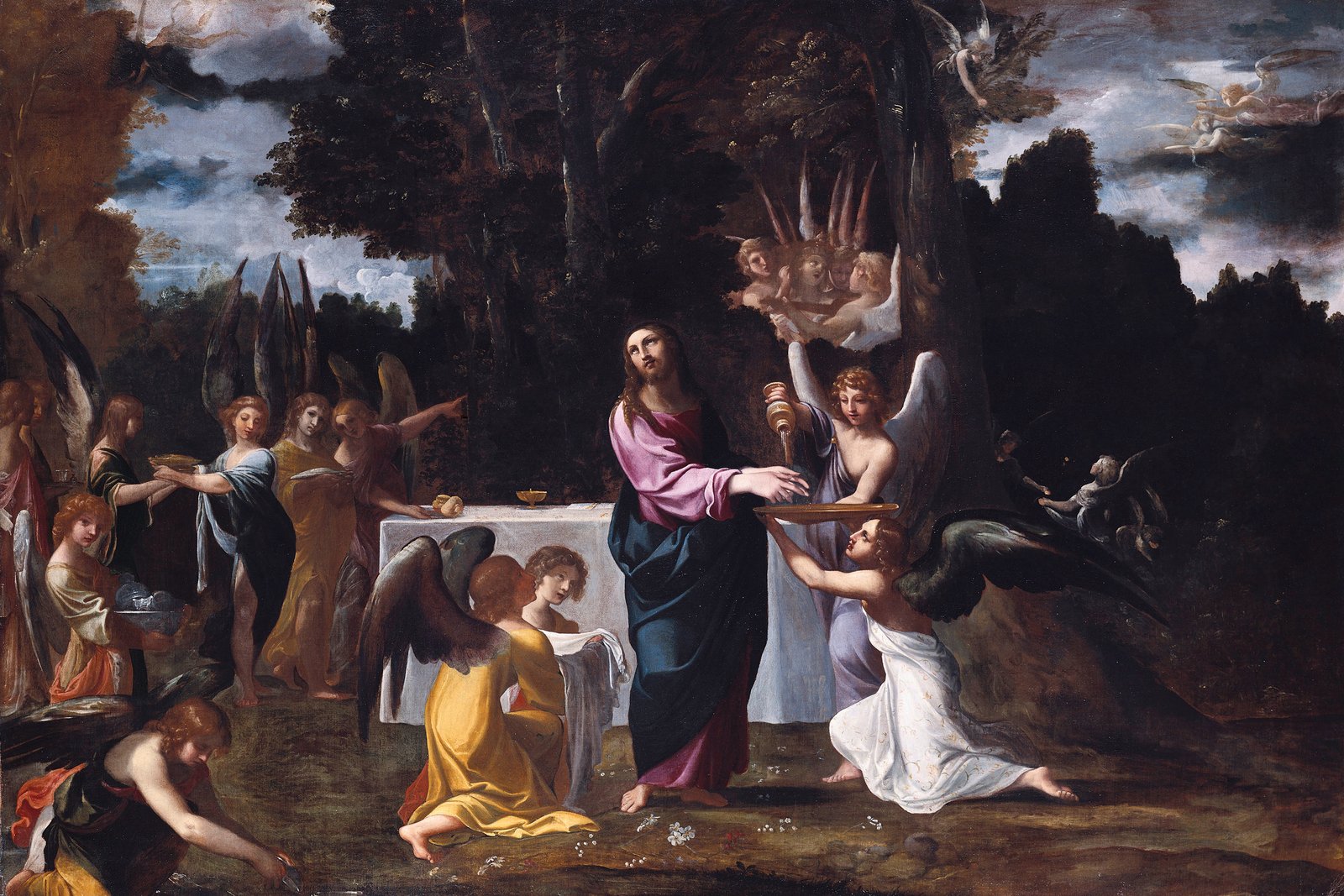
Ludovico Carracci, Christ in the Wilderness, Served by Angels, c. 1610 — public domain.
What follows in Matthew and Luke is the well-known sequence of three temptations — to turn stones into bread, to test God by throwing himself from the Temple, and to gain worldly power by worshiping the devil — each one met with a quotation from Deuteronomy. It's a scene theologians have long read as Jesus deliberately succeeding where Israel, tested in its own wilderness wandering for forty years, had repeatedly failed. But it's the very next detail, easy to skim past, that this article is really about.
"Angels came and ministered to him"
Once the temptations are finished and the devil withdraws, Matthew adds a single quiet sentence: "Then the devil left him and, behold, angels came and ministered to him" (Matthew 4:11, NABRE). No description of what the angels looked like, no dialogue, no extended vision — just a plain statement that once the trial ended, angelic care began. Mark's earlier, more compressed version folds the detail into his summary of the whole forty days rather than placing it strictly at the end, but the basic content is the same: angels attending to Jesus's needs after an extended period of extreme physical deprivation and spiritual testing.
The Greek verb translated "ministered" — diēkonoun — is the same root word that eventually gives Christian vocabulary the term "deacon," and it carries a strong practical, hands-on sense: serving, waiting on, providing for someone's needs, rather than simply appearing or delivering a message. Most readers and commentators take this to mean the angels provided Jesus with food, rest, or other basic physical comfort after his fast — a detail the text itself leaves tactfully unstated, in keeping with the Gospels' general restraint about describing angelic appearances in vivid, embellished detail.
Interestingly, Luke's version of the same episode, though it follows Matthew and Mark closely through the three temptations themselves, ends differently: "When the devil had finished every temptation, he departed from him for a time" (Luke 4:13, NABRE) — with no mention of angels at all. Scholars generally treat this as one of several small points where the Synoptic Gospels, drawing on shared but not identical source material, simply diverge in what details they choose to include.
An echo of Elijah in the desert
This scene has a clear and often-noted parallel earlier in Scripture: the prophet Elijah's own flight into the wilderness in the First Book of Kings. Exhausted and suicidal after fleeing the wrath of Queen Jezebel, Elijah collapses under a solitary tree and asks to die. An angel wakes him, provides him with bread and water, lets him sleep again, and eventually sends him on a forty-day journey to Mount Horeb — a story that shares the wilderness setting, the number forty, and the basic pattern of angelic care arriving after extreme physical and emotional exhaustion. Readers interested in angelic care in other Old Testament settings may also want to see The Angel Strengthening Elijah for that fuller story.
Early Christian commentators were quick to draw this connection, reading Jesus's wilderness experience as deliberately echoing and completing a familiar biblical pattern: the servant of God tested in the desert, and angels sent afterward not to remove the difficulty in advance but to restore and sustain the one who endured it.
Why this small detail matters
It would have been easy for the Gospel writers to end the temptation narrative simply with the devil's departure — the dramatic climax has already happened, and the temptation is resolved. Instead, all but Luke choose to add this brief, almost domestic image of angels quietly caring for Jesus's physical needs. Christian reflection on the passage has often taken this as a small but meaningful theological statement: that divine testing in Scripture is regularly followed by divine care, and that even Christ himself, in his full humanity, was ministered to rather than simply expected to recover unaided. It's a modest scene, easy to read past in two verses, but one that has quietly shaped how generations of readers imagine the relationship between hardship, faith, and the angels believed to attend to both.
Trivia
What do the Gospels actually say about angels ministering to Jesus?
Why don't Matthew and Mark agree on exactly when the angels appeared?
Does Luke's Gospel mention angels in the temptation account?
What does 'ministered to him' likely mean in this context?
Are there other Old Testament scenes of angels providing for someone in the wilderness?
Related Reading