Catholic Prayer Guide — Devotions Through the Centuries

A toolkit, not a single method
Ask ten devout Catholics how they pray and you'll likely get ten different answers, and none of them would be wrong. The Catechism itself doesn't hand down one required technique — it describes prayer broadly, as vocal prayer, meditation, and contemplation, three complementary modes rather than a strict ladder everyone must climb in order (CCC 2700-2724). That flexibility isn't a modern accommodation; it reflects two thousand years of the Church absorbing and preserving prayer forms from wildly different times and places, from fourth-century Egyptian hermits to a sixteenth-century Spanish soldier-turned-mystic to ordinary parents saying grace over a weeknight dinner.
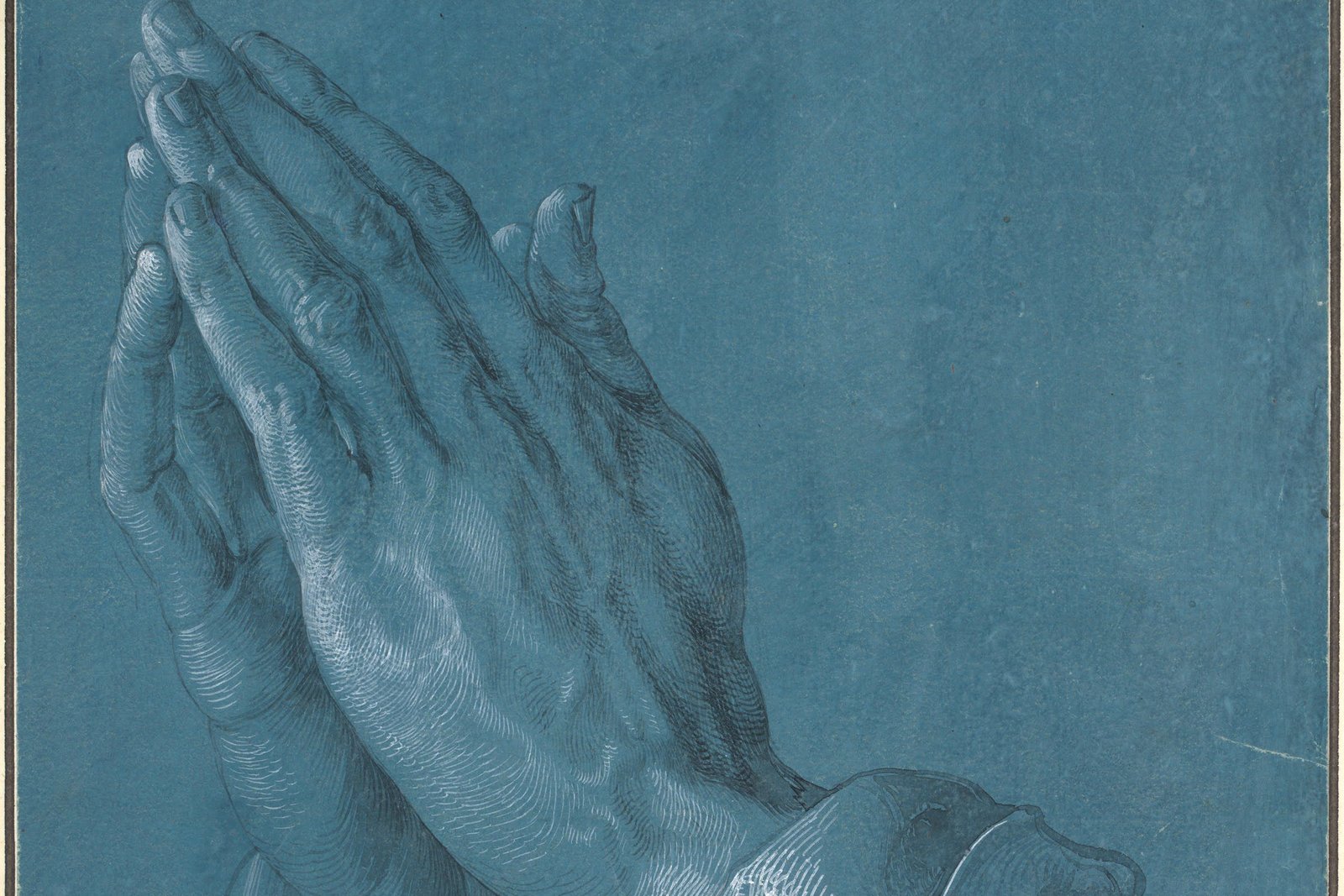
Albrecht Dürer, Praying Hands (Betende Hände), 1508, Albertina, Vienna — public domain.
What follows is a guided survey of that toolkit — not exhaustive, but enough to show the real range available to anyone building (or rebuilding) a prayer life.
Ancient and Eastern-rooted prayers
Some of the oldest Christian prayer practices are also the shortest — built for repetition rather than length, meant to be carried through an ordinary day rather than set aside as a separate task.
- The Jesus Prayer — "Lord Jesus Christ, Son of God, have mercy on me, a sinner," repeated quietly, often paired with the breath, a practice with roots in the Desert Fathers and especially treasured in Eastern Christian spirituality.
- Gregorian Chant — not a private prayer exactly, but a form of sung prayer stretching back over a millennium, still used in monastic and parish liturgy as a way of praying with the whole body's voice, not just silent thought.
- The Sign of the Cross, Explained — the single most common Catholic gesture, tracing the Trinity and the crucifixion across the body in seconds, and treated by the Church as genuine prayer in itself, not merely a preface to one.
What these three practices share is brevity married to repetition. None of them demand a set-aside block of quiet time; each one is portable enough to carry into a commute, a chore, or a sleepless hour, which is exactly why traditions built around endurance — desert monasticism, monastic choir life, a gesture repeated at every single Mass — settled on forms this compact in the first place.
Ignatian and reflective prayer
A different strand of Catholic prayer asks for stillness and self-examination rather than repetition — a habit of noticing where God has already been present.
- The Examen Prayer of Saint Ignatius — a structured daily review developed by the founder of the Jesuits, walking back through the day to notice where God showed up and where the day went wrong.
- Lectio Divina, Explained — an ancient monastic practice of slow, repeated reading of a short Scripture passage, sitting with it rather than rushing through it, listening for what speaks personally in the moment.
- The Prayer of Saint Francis (Peace Prayer) — "Lord, make me an instrument of your peace" — a prayer of self-offering rather than petition, asking to become the answer to someone else's need rather than only asking for one's own.
- Confession and Ongoing Conversion — examination of conscience carried into the sacrament itself, turning private reflection into a formal, grace-filled encounter.
- Why Catholics Confess to a Priest — the reasoning behind sacramental confession as its own distinct form of prayerful accountability, not a private conversation with God alone.
Ignatius of Loyola built the examen for people with genuinely busy lives — soldiers, students, working men, not only monks with hours of enclosed silence available. That's part of why it has aged so well: it asks for perhaps fifteen minutes, once a day, rather than a lifestyle overhaul, and it treats ordinary daily events — a conversation, a frustration, an unexpected kindness — as real material for prayer rather than distractions from it.
Prayer in daily and family life
Not every prayer is contemplative or historic. Much of Catholic prayer life happens in the ordinary texture of a week — at a kitchen table, during a hard season, or while quietly discerning what comes next.
- Prayers for the Family — grace before meals, bedtime blessings, and other small, repeated household prayers that build faith into a family's daily rhythm rather than reserving it for Sunday alone.
- Praying in Hard Times — prayer stripped down to its most honest form, for moments when eloquence isn't available and the only real prayer left is simply staying present to God in the difficulty.
- Spiritual Life for the Busy Adult — practical ways to sustain a prayer life inside a schedule that doesn't have room for a monastic horarium, built around small, realistic commitments rather than an all-or-nothing standard.
- How to Know Your Vocation — prayer used as active discernment, listening for direction at a genuine crossroads rather than only as comfort or routine.
None of these four require a special setting — a chapel, a retreat, a quiet weekend away. They're built for kitchens, cars, hospital waiting rooms, and ordinary Tuesday evenings, which is exactly the point: most of a Catholic's prayer life happens outside of Sunday Mass, in the unremarkable hours that make up the rest of the week.
Finding the prayer that fits the season you're in
There's no ranking here — the Church has never taught that the Rosary outranks the Jesus Prayer, or that lectio divina is more "advanced" than grace before dinner. Different forms of prayer answer different needs at different points in a life. A short, repeated invocation carries someone through a hard commute or a sleepless night in a way that a twenty-minute examen can't. A slow reading of Scripture opens up depths that a quick vocal prayer was never built to reach. And a family's shared grace at the table teaches children what a lifetime of theology classes might not: that prayer is simply how a household that believes in God talks to him, together, without needing to make it complicated.
Building a personal prayer life, in the end, usually looks less like choosing one method forever and more like keeping a full toolkit close at hand — and reaching for whichever tool actually fits the moment in front of you.
Trivia
What is the simplest, oldest form of Catholic prayer?
What's the difference between the Rosary and lectio divina?
Does the Catholic Church require a specific form of daily prayer?
What is the Ignatian examen, and how is it different from the Rosary or the Jesus Prayer?
Why do Catholics still pray with their bodies — kneeling, making the Sign of the Cross, folding hands?
Related Reading