El Greco's Burial of the Count of Orgaz: Heaven Meets Toledo

A legend made visible
The story behind El Greco's most famous painting is, on its own, one of the more striking miracle legends in Spanish devotional tradition. Gonzalo Ruiz de Toledo, Lord of Orgaz, was a wealthy and devout nobleman in fourteenth-century Toledo, remembered especially for his generosity toward the Church of Santo Tomé, which he helped fund and enlarge during his lifetime. According to the tradition that grew up around his death in 1323, as his body was being lowered into its tomb, Saint Augustine and Saint Stephen — the great early Christian bishop-theologian and the first Christian martyr, described in the Acts of the Apostles — descended from heaven in person and, with their own hands, helped lower his body into the grave, a direct and visible sign of divine favor toward a genuinely good man. Nearly two hundred sixty years later, the parish of Santo Tomé commissioned El Greco to commemorate that legend on a monumental scale, to hang directly above the count's own tomb within the church.
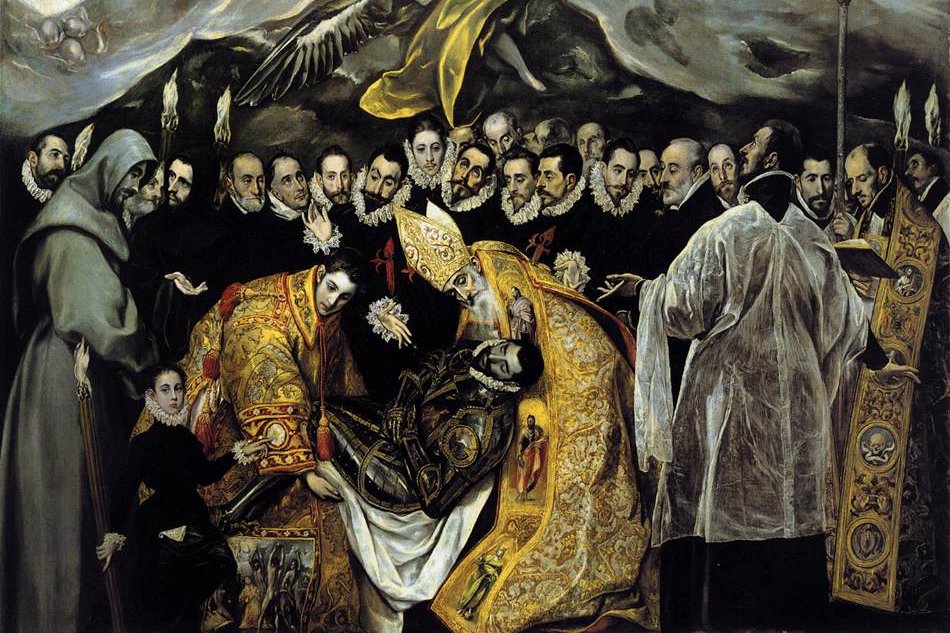
El Greco, "The Burial of the Count of Orgaz," 1586-1588, Church of Santo Tomé, Toledo — public domain.
Two registers, one continuous event
What makes the resulting painting so remarkable is not simply its storytelling but its structure. El Greco divided the huge canvas cleanly into two horizontal registers. The lower half depicts the funeral itself in relatively restrained, naturalistic color: a crowd of somberly dressed contemporary Toledan noblemen, clergy, and dignitaries, many recognizable as identifiable portraits of real sixteenth-century figures, gathered around the body as Saint Augustine and Saint Stephen — richly robed in ornate, gleaming vestments that stand out sharply against the muted crowd — gently lower the count into his tomb. The upper half explodes into something else entirely: heaven itself, rendered in El Greco's characteristic elongated, almost weightless figures, swirling clouds, and an intense, otherworldly light, with Christ enthroned at the summit, flanked by the Virgin Mary and Saint John the Baptist, angels and saints arranged around them in a composition that seems to strain and stretch upward rather than sit still.
A deliberate contrast in style
The visual contrast between the two halves is not a technical inconsistency — it is the entire point. El Greco painted the earthly register with comparative sobriety and careful individualized portraiture, grounding the scene in recognizable, specific human likeness, while reserving his most extreme, expressive Mannerist distortion — the attenuated limbs, the flame-like drapery, the compressed and swirling space — for the heavenly register above. The effect is to make heaven genuinely feel like a different order of reality altogether, one governed by different visual rules than the solid, grounded world of the mourners below, even as the two halves remain visually and compositionally unified by a continuous flow of gesture and gaze running from bottom to top. For readers interested in how other painters used dramatic technique to collapse the distance between the sacred and the everyday, our guide to Catholic sacred art offers further examples.
A painter in the crowd
Among the individualized portraits filling the earthly half of the composition, most art historians identify one figure — standing upright among the mourners, looking directly out toward the viewer rather than at the scene itself — as a self-portrait of El Greco. This was a fairly established convention among Renaissance and Mannerist painters, who often inserted themselves as witnesses within their own large religious commissions, both as a form of personal signature and as a way of positioning the viewer alongside the painter as a fellow observer of the sacred event unfolding. A young boy standing near the front of the group, sometimes identified as El Greco's own son Jorge Manuel, points toward the scene while a piece of paper visible in his pocket bears El Greco's signature and the date 1578, functioning as an unusually personal authenticating detail within an otherwise formal devotional commission.
Crete, Venice, and Toledo combined
El Greco — born Domenikos Theotokopoulos on the island of Crete, then under Venetian rule — trained first in the Byzantine icon-painting tradition before relocating to Venice and later Rome, absorbing Venetian color and Roman Mannerist figure distortion along the way, before finally settling permanently in Toledo, Spain, where he would spend the rest of his career. The Burial of the Count of Orgaz is widely considered the clearest single demonstration of everything that fusion produced: the spiritual intensity and gold-inflected color inherited from his Byzantine training, the rich painterly color of Venice, and the elastic, elongated figure style of Roman and Florentine Mannerism, all combined into a single coherent and unmistakably personal visual language found nowhere else in European painting of the period.
Still watching over the same tomb
Unlike so many major religious paintings that were eventually removed to museums, El Greco's Burial of the Count of Orgaz has never left the Church of Santo Tomé, and it still hangs directly above the very tomb it commemorates. Visitors to Toledo can stand in the same small side chapel where the painting was first installed in the 1580s, looking at essentially the same view a sixteenth-century parishioner would have seen — one of the few great masterworks of Spanish painting still functioning exactly as originally intended, in the exact physical space it was built to occupy.
Trivia
Who was the Count of Orgaz, and why was his burial considered miraculous?
Why is the painting divided into two distinct halves?
Does the painting include a portrait of El Greco himself?
Where can the Burial of the Count of Orgaz be seen today?
How does the painting reflect El Greco's personal artistic style?
Related Reading