Knock Shrine, Ireland

An unusual apparition in the rain
Knock is a small village in County Mayo, in the west of Ireland, and on the evening of August 21, 1879, it became the site of one of the more distinctive Marian apparitions in Catholic history — distinctive not for any dramatic message or miracle claim, but for its complete silence. Around fifteen parishioners, ranging from young children to elderly villagers, reported seeing a luminous apparition appear against the south gable wall of the local parish church: figures they identified as the Virgin Mary (dressed in white, with a golden crown, her hands raised as if in prayer), Saint Joseph, and Saint John the Evangelist, positioned beside what appeared to be an altar bearing a lamb and a cross, with angels reportedly visible around the scene.
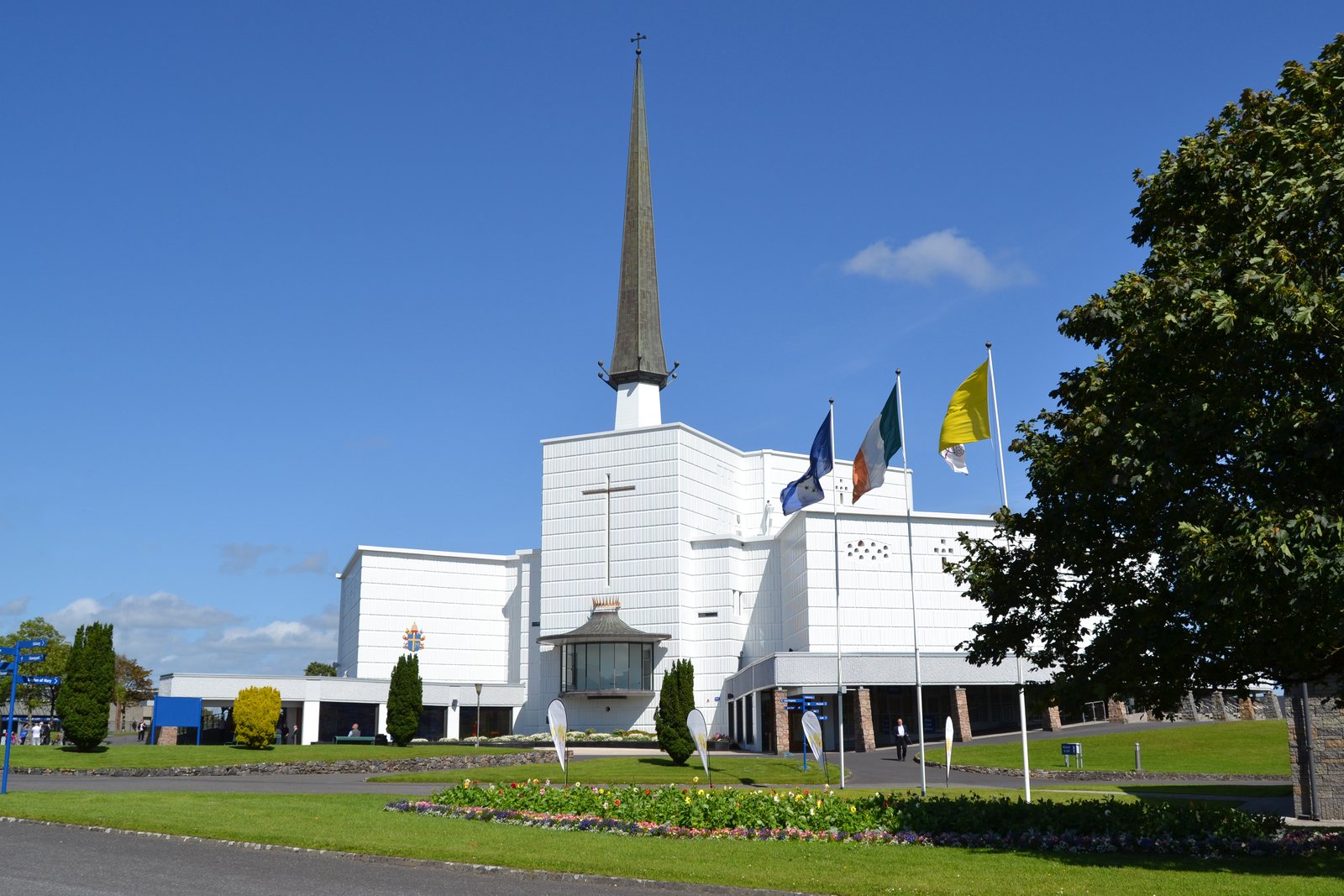
Photograph by Sinéad Mallee, Knock Basilica, 16 July 2017 — CC BY-SA 4.0, Wikimedia Commons.
What made the Knock apparition especially notable, both to contemporaries and to later Church investigators, was that the figures never spoke and gave no message of any kind — witnesses simply stood in the pouring rain, at various points over roughly two hours, watching the vision in silence until it eventually faded. This absence of any explicit message, unlike apparitions such as Lourdes or Fátima that involved direct verbal communication, set Knock apart within the broader tradition of Marian apparitions and would become, over time, part of its particular spiritual character — an apparition inviting quiet contemplation rather than responding to any specific instruction.
Investigation and growing credibility
Local church authorities moved relatively quickly to investigate the reports, convening a commission within weeks of the apparition to interview the witnesses individually. That 1879 commission found the testimony satisfactory and consistent, a conclusion that lent the reports early institutional credibility even as broader Church authorities remained appropriately cautious, as is standard practice with reported apparitions. A second, more thorough commission was convened in 1936, by which point several of the original witnesses, then elderly, were reinterviewed and reportedly maintained their original accounts without significant alteration or embellishment — a consistency investigators considered notable given the decades that had passed.
Devotion to Our Lady of Knock grew steadily through the following decades, particularly from the mid-twentieth century onward, aided by improved transportation and growing international interest in Irish Catholic pilgrimage sites. The shrine received a major boost in international recognition and pilgrim traffic following a visit by Pope John Paul II in 1979, marking the apparition's centenary — a visit widely covered internationally and one that significantly raised Knock's profile as a pilgrimage destination both within Ireland and among the global Irish Catholic diaspora.
Building a shrine around the gable wall
The original parish church where the apparition occurred has been carefully preserved, with the specific gable wall where the vision appeared now enclosed within a dedicated structure known as the Apparition Chapel, protecting the site while allowing pilgrims to stand at the precise spot the witnesses described. As pilgrim numbers grew substantially through the later twentieth century, the modest capacity of the original church and surrounding grounds proved increasingly inadequate, prompting construction of a much larger basilica.
The Basilica of Our Lady, Queen of Ireland, consecrated in 1976, was built specifically to accommodate the shrine's growing pilgrim traffic, with a circular design and capacity for large congregations reflecting its role hosting major pilgrimages and outdoor Masses throughout the year. Ireland's own patroness role for Mary under this title reinforced the basilica's national significance, positioning Knock as a pilgrimage site of importance not merely regionally but for the whole of Catholic Ireland.
Knock today: an international Marian shrine
In 2017, Pope Francis formally designated Knock an international Marian shrine — placing it among a small number of officially recognized international pilgrimage sites worldwide and reflecting both the sustained credibility of its 1879 apparition and its established role drawing pilgrims from well beyond Ireland's own borders. The shrine complex today includes not only the basilica and preserved apparition chapel but a museum documenting the history of the 1879 events and subsequent investigations, along with facilities supporting the substantial numbers of sick and disabled pilgrims who travel to Knock specifically seeking healing, a tradition that has grown alongside the shrine's broader devotional life.
Knock International Airport, built in the 1980s specifically to accommodate the volume of pilgrim traffic to the shrine — an unusual undertaking for what remains, apart from the shrine itself, a modest rural village — stands as a concrete measure of just how far Knock's transformation has traveled since that quiet, rain-soaked evening in 1879, when fifteen villagers watched a silent vision on their parish church wall and told no one, at first, quite what to make of it.
Pope John Paul II visited Knock in 1979, on the apparition's centenary, kneeling in prayer before the original gable wall in a visit widely credited with cementing the shrine's national significance for a new generation of Irish Catholics; Pope Francis followed with his own visit in 2018 during the World Meeting of Families, continuing a pattern of papal attention that has done as much as any single factor to raise Knock's profile on the wider world stage.
Trivia
What was witnessed at Knock in 1879?
Has the Knock apparition been officially recognized by the Catholic Church?
How many people witnessed the apparition at Knock?
What can pilgrims see at Knock Shrine today?
Related Reading