The Basilica of Saint Anthony, Padua

A basilica built almost overnight by medieval standards
Anthony of Padua died on June 13, 1231, at a small convent in Arcella, just outside Padua, where he had gone to rest after months of exhausting preaching and fasting. He was thirty-five years old, already famous across northern Italy as one of the most gifted preachers the young Franciscan order had produced — a former Augustinian canon from Lisbon who had joined the Franciscans hoping for missionary martyrdom in Morocco, only to be redirected by illness and, eventually, by his extraordinary talent for public preaching, toward a very different kind of vocation. Read more about his life and ministry in our article on Saint Anthony of Padua.
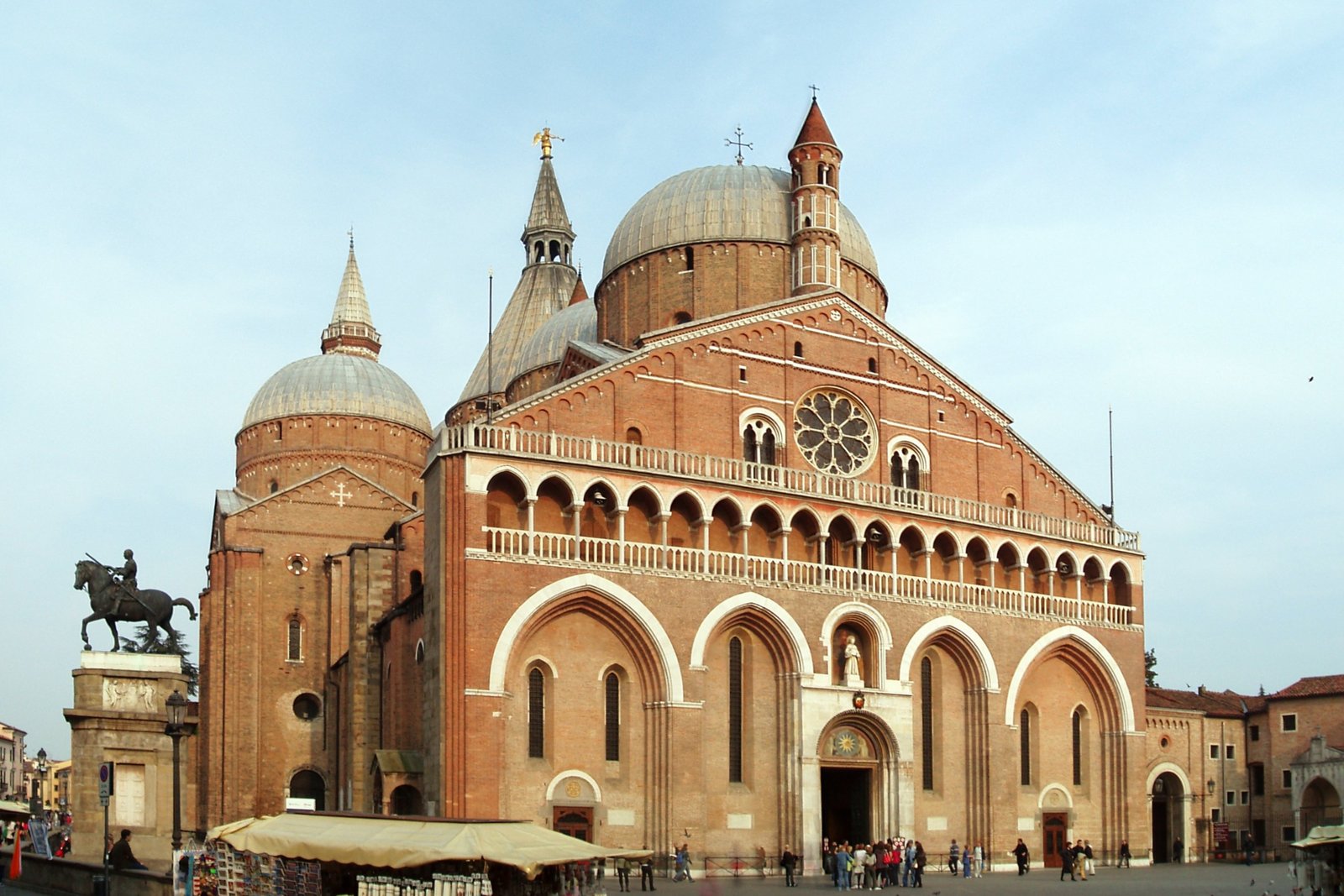
Photograph by Stefan Lew, Basilica di Sant'Antonio da Padova, 2007 — Public domain, Wikimedia Commons.
The people of Padua wanted him buried within the city, and a small chapel there, already dedicated to Mary, became his resting place. What happened next was unusually fast for medieval church-building: within about a year of Anthony's death, construction began on a much larger church to house his tomb and accommodate the pilgrims who had begun arriving almost immediately, drawn by reports of miracles at the grave. Anthony was canonized less than a year after his death, in May 1232 — one of the fastest canonizations in Church history at the time — which only accelerated the building project and the flow of pilgrim traffic.
A building that borrows from everywhere
The basilica that rose over the following decades reflects Padua's position as a crossroads of medieval trade and culture. Its exterior is topped by a cluster of domes reminiscent of Byzantine architecture — most obviously evocative of Venice's own Basilica of San Marco — while its ground plan and structural bones are Romanesque and Gothic, with slender bell towers flanking the domes. The combination gives the building a distinctive silhouette unlike almost any other church in Italy, one that has become instantly recognizable across the Veneto skyline.
The interior grew more elaborate over the centuries that followed as the shrine's wealth and prestige increased. The Chapel of the Reliquaries, added in the seventeenth century, was built specifically to house Anthony's tongue, jaw, and vocal cords — relics preserved after the opening of his tomb in 1263, an event presided over by the Franciscan minister general (and future cardinal) Bonaventure, who according to tradition addressed the perfectly preserved tongue directly, marveling that it had spoken so often and so well of God. The high altar itself, redesigned in the 1450s, carries bronze reliefs and freestanding bronze figures by Donatello, among the greatest sculptors of the early Italian Renaissance — work that placed the basilica at the center of significant artistic patronage from its earliest centuries.
Why Padua became a destination
Anthony's reputation rested on two pillars that made him an unusually appealing figure for ordinary pilgrims: his preaching, which contemporaries described as capable of moving even hardened sinners and hostile crowds to tears, and a growing folk tradition crediting him with finding lost things and people — a role that, centuries later, would make "Saint Anthony, Saint Anthony, please look around" one of the most familiar prayers in popular Catholic practice. That approachability, combined with the drama of the incorrupt-tongue relic, turned Padua into one of medieval Europe's steadiest pilgrimage destinations, drawing traffic that helped fund the basilica's continued expansion for generations.
The shrine also became closely associated with charitable giving. In the late nineteenth century, a French woman named Louise Bouffier began the custom of donating bread to the poor in thanksgiving for favors she credited to Anthony's intercession, a practice that spread internationally and became known as "St. Anthony's Bread" — donation programs, still active at many Franciscan parishes today, that trace their origin directly back to devotion centered on this basilica.
A living shrine, not a museum
The Basilica of Saint Anthony remains, by any measure, one of the most active pilgrimage sites in the Catholic world. It is formally designated a Pontifical Basilica and is one of only a small number of churches worldwide the Holy See recognizes as an international shrine, a status reflecting both the volume of pilgrims it receives — several million visitors annually, from every part of the globe — and its ongoing role as a working religious community, staffed by Conventual Franciscan friars who continue the order Anthony himself belonged to.
Visitors today can view Anthony's tomb, now behind the basilica's left aisle, typically covered with handwritten notes, photographs, and petitions left by pilgrims asking for his intercession — a custom so enduring that the marble around the tomb has had to be replaced periodically due to the volume of hands touching it in prayer. The Chapel of the Reliquaries remains open for veneration of the tongue and jaw relics, and the basilica's museum and cloisters preserve centuries of art and manuscripts documenting the site's history. Alongside its religious function, the basilica anchors Padua's identity as a city — locals still refer to it simply as "il Santo," as though there were no need to specify which saint they mean.
Nearly eight centuries after Anthony's death, the basilica that rose so quickly to house his tomb continues to do exactly what it was built for: giving a place, physical and permanent, to the devotion of people who never met him but have never stopped asking for his help.
Trivia
Why is Anthony of Padua's tongue considered a relic?
Where is the Basilica of Saint Anthony located?
How long did it take to build the basilica?
Is the Basilica of Saint Anthony still an active pilgrimage site?
What art can visitors see inside the basilica?
Related Reading