How to Identify Saints in Art

A visual alphabet anyone could read
For most of Christian history, the majority of people who saw a church's paintings, statues, and stained glass couldn't read the Latin or vernacular inscriptions that might otherwise have identified each figure. Artists solved this problem with attributes — specific objects, animals, or details consistently paired with a particular saint across countless works by different hands in different centuries, functioning as a kind of visual shorthand anyone raised in the tradition could decode at a glance. Learning to read a handful of the most common attributes turns a wall of interchangeable robed figures, like the crowd surrounding Christ in Dürer's Adoration of the Trinity shown above, into a room full of individuals with distinct stories. This guide to sacred art covers some of the most frequently seen attributes and the saints they identify.
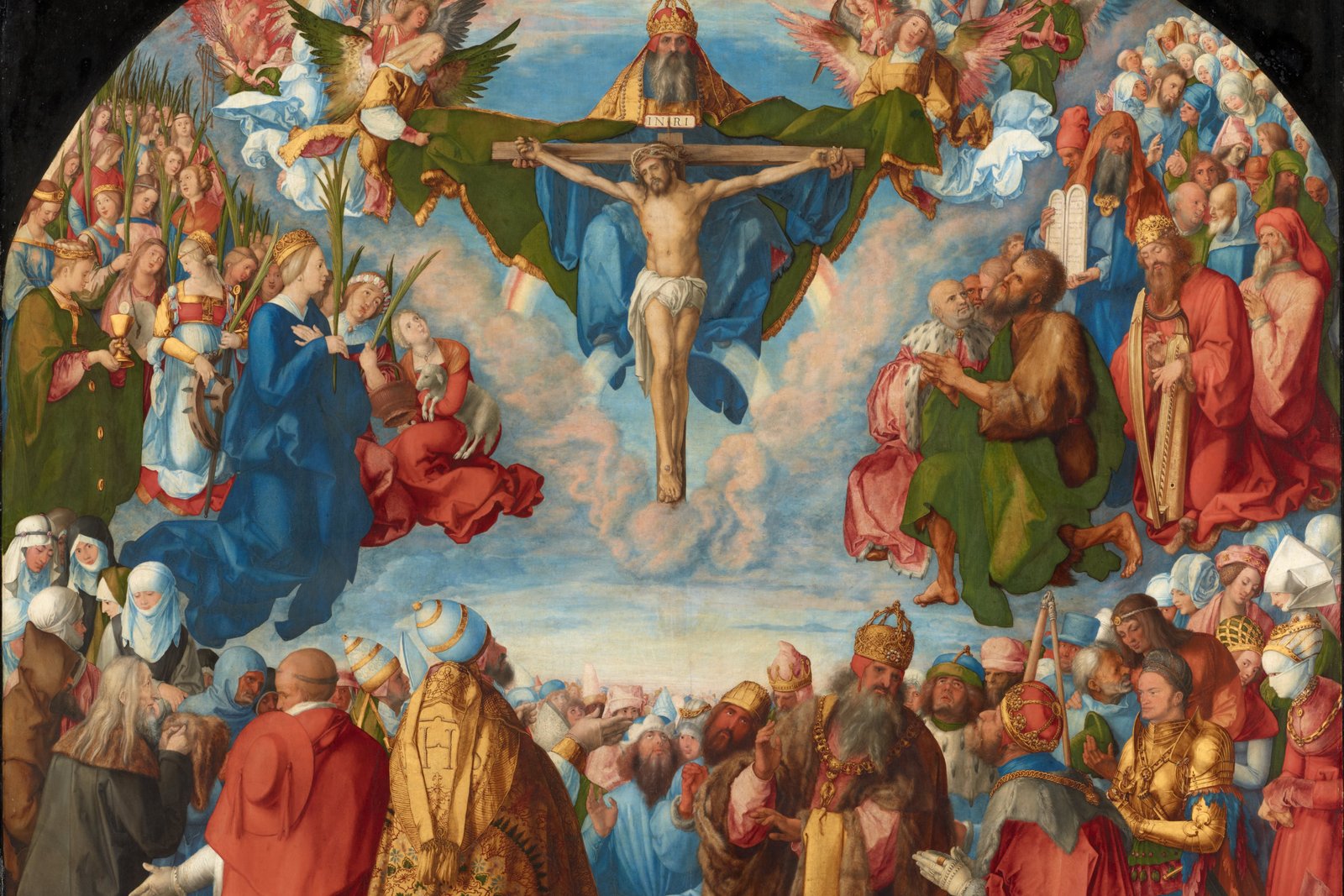
Albrecht Dürer, "Adoration of the Trinity" (Landauer Altarpiece), 1511, Kunsthistorisches Museum, Vienna — public domain.
Keys: Saint Peter
Few attributes are as unambiguous as a set of keys, almost always shown as two large keys, sometimes crossed. They belong to Saint Peter the Apostle, referencing Christ's words to him, "I will give you the keys to the kingdom of heaven" (Matthew 16:19, NABRE) — a passage read as establishing Peter's unique authority among the apostles. The keys appear on Peter in virtually every painting that includes him, from the earliest catacomb art through Renaissance altarpieces, making him one of the easiest figures to spot in any crowded scene.
Sword: Saint Paul
A sword, usually held upright, marks Saint Paul the Apostle, referencing the tradition that he was executed by beheading in Rome — a method of death fitting his status as a Roman citizen, which spared him the crucifixion inflicted on Peter. Paul and Peter are frequently painted as a matched pair, flanking Christ or standing together at a church's entrance, and their attributes make the pairing easy to read even from a distance: keys on one side, a sword on the other.
Wheel: Saint Catherine of Alexandria
A spiked wheel, often shown broken, identifies Saint Catherine of Alexandria. According to her legend, Roman authorities sentenced her to be executed on a breaking wheel, but it shattered before the sentence could be carried out, and she was beheaded instead. The wheel remained her standard attribute regardless, and it gave its name to the "Catherine wheel," a spinning firework still named after her legend today.
Gridiron: Saint Lawrence
A gridiron — a flat metal grate used for grilling — marks Saint Lawrence, a deacon of the early Roman church traditionally said to have been martyred by being roasted alive on one. The gridiron is one of the more visually startling attributes precisely because it names the martyrdom instrument directly rather than symbolizing it obliquely, and it appears consistently enough that spotting one in a saint's hand is close to a guarantee of Lawrence's identity.
Arrows: Saint Sebastian
A young man's body pierced by multiple arrows, often shown bound to a post or tree, identifies Saint Sebastian. According to tradition, Sebastian survived this initial execution attempt, was nursed back to health, and was ultimately martyred by other means afterward — but artists overwhelmingly chose the arrow-pierced scene as his defining image, making it one of the most immediately recognizable martyrdom attributes in all of Christian art.
Lion: Saint Jerome
A lion resting peacefully nearby, sometimes with a thorn visibly removed from its paw, marks Saint Jerome, the scholar who translated the Bible into Latin. The lion comes from a popular legend, likely borrowed from an older story originally told about a different desert hermit, in which Jerome removes a thorn from a lion's paw and the grateful animal remains at his side afterward. Jerome is often shown additionally with a cardinal's red hat (an anachronism, since the position didn't exist in his lifetime) and a skull, marking his scholarly and penitential character.
Tower: Saint Barbara
A tower, usually with three windows, identifies Saint Barbara. Her legend describes her father imprisoning her in a tower to keep her from converting to Christianity, and the three windows she is said to have insisted on adding represent the Trinity, a small architectural detail turned into a profession of faith within her own legend.
Eyes on a plate: Saint Lucy
A plate or dish bearing a pair of eyes is one of the more startling attributes in Christian art, belonging to Saint Lucy of Syracuse. Her name derives from the Latin word for light, and later legend connected that name to a story of her eyes being removed during her persecution, making her a patron invoked for eye ailments and vision — the plate of eyes serves as both attribute and etymology in a single image.
Lamb: Saint Agnes
A small lamb, usually held in the arms, marks Saint Agnes of Rome. The attribute plays on her name's phonetic closeness to the Latin agnus, meaning lamb, even though her name actually derives from a separate Greek root meaning "pure" or "chaste" — a case where a symbol took hold through wordplay as much as through any detail of her actual martyrdom.
Jar of ointment: Saint Mary Magdalene
A jar or vase, sometimes shown being poured out, identifies Saint Mary Magdalene, referencing Gospel accounts of a woman anointing Christ's feet with costly perfumed oil. She's also frequently shown with long, loose hair and rich clothing in earlier scenes, then simpler dress in later penitential scenes, reflecting a tradition — since revised by modern biblical scholarship — that conflated her with other unnamed women in the Gospels.
Reading a whole altarpiece at once
Once a handful of attributes become familiar, a crowded composition like Dürer's Adoration of the Trinity stops looking like an undifferentiated mass of robed figures and starts reading like a roster: keys here, a sword there, a wheel, a gridiron, a tower, spread across the canvas exactly where the artist meant them to be found. That's the whole purpose attributes were built to serve — not decoration, but identification, durable enough that a viewer standing in front of the same painting five hundred years later can still read it correctly today.
Trivia
Why do saints in paintings hold specific objects?
Why does Saint Peter always hold keys?
Why is Saint Catherine of Alexandria shown with a wheel?
How can you tell the difference between two saints who share a similar attribute?
Are these attributes based on historical fact or legend?
You May Also Like
Related Reading