The Russian Icon Painting Tradition

A monk-painter about whom almost nothing is documented
Remarkably little is known for certain about Andrei Rublev's life. He was likely born around 1360-1370 and became a monk, first at the Trinity Sergius Lavra monastery near Moscow and later at the Andronikov Monastery in Moscow itself, where he died around 1427-1430. The scattered documentary evidence — a handful of chronicle entries, a few securely attributed commissions — gives historians only fragments to work with, yet Rublev's reputation as the supreme master of the Russian icon tradition was established within a century of his death and has never seriously been challenged since.
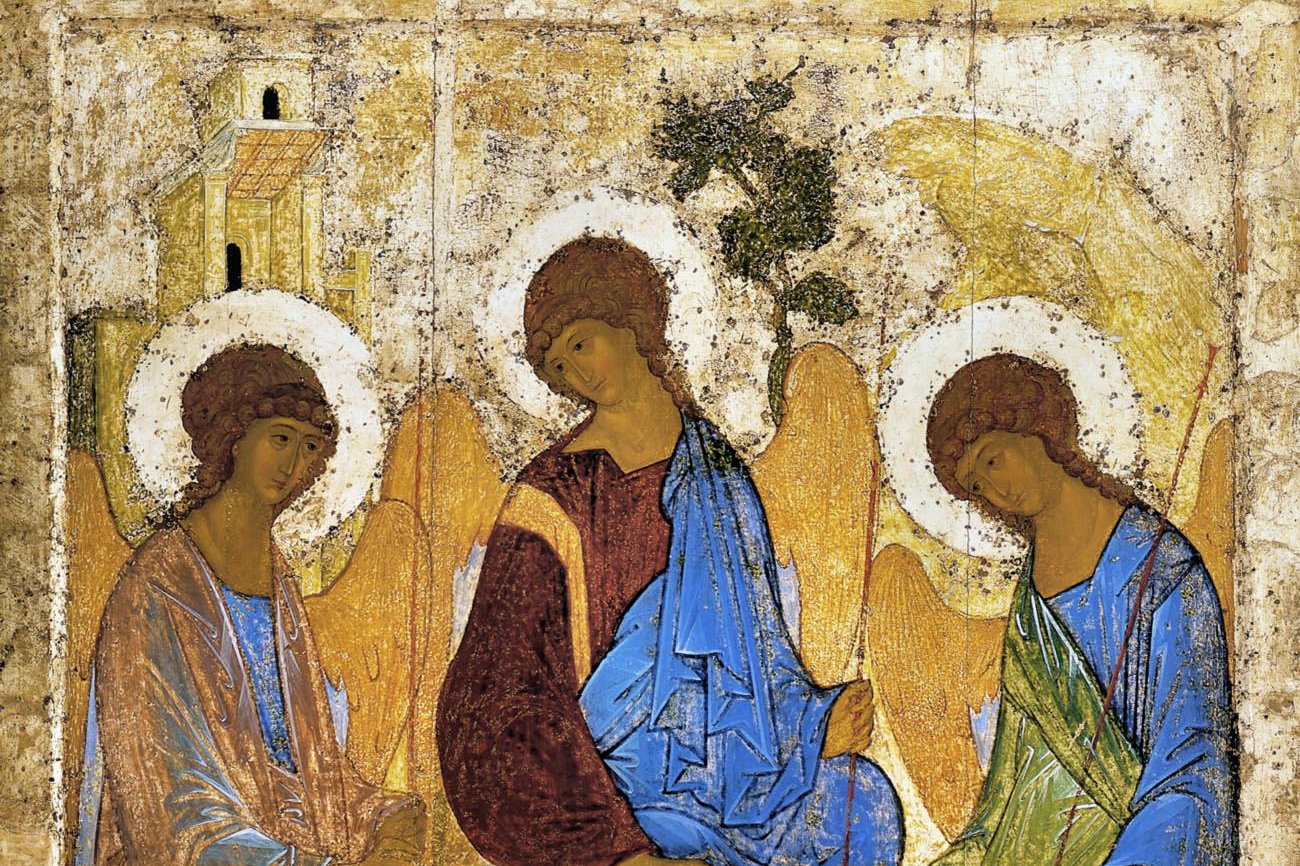
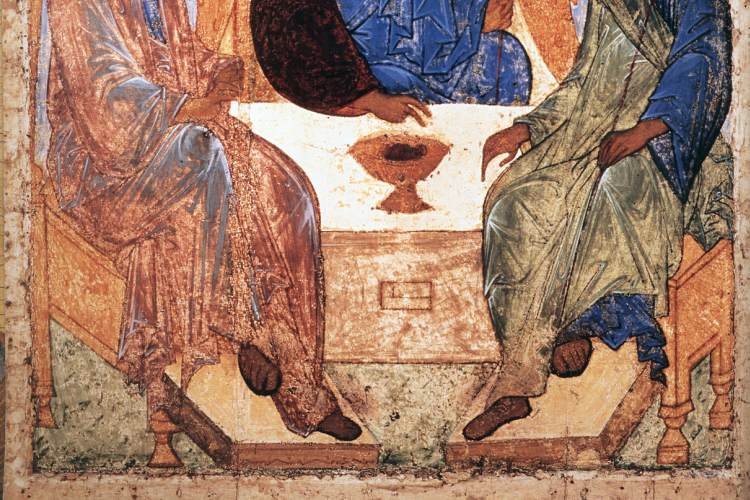
Andrei Rublev, "The Trinity," c. 1425-1427, Tretyakov Gallery, Moscow — public domain.
That reputation rests overwhelmingly on a single surviving work: the icon known simply as The Trinity, painted sometime between 1408 and the mid-1420s, most likely for the Trinity Sergius Lavra, the monastery Rublev had once called home.
Three visitors at Mamre, read as the Trinity
The icon's subject is drawn from Genesis 18, in which three visitors appear to Abraham at the Oak of Mamre; Abraham addresses them at times in the singular and at times in the plural, a grammatical oddity that patristic and later Christian interpreters read as an early, veiled hint of the Trinity appearing within the Old Testament narrative itself. Earlier Byzantine and Russian icons of this subject, often called the "Hospitality of Abraham," typically included Abraham and Sarah serving the three visitors at a table laden with food, keeping the narrative details of the Genesis account clearly visible.
Rublev's version does something more radical: he removed Abraham and Sarah entirely, leaving only the three angelic figures seated around a table bearing a single chalice. By stripping away the surrounding narrative, Rublev shifted the icon's focus away from the biblical story as an event that happened to Abraham and toward a more direct, symbolic meditation on the inner life of the Trinity itself.
A circle of inclined heads
The composition's most celebrated feature is its underlying geometry. The three figures are arranged so that the outline connecting their forms traces a near-perfect circle, and each figure's head is inclined gently toward the others, creating a continuous, unbroken visual rhythm of mutual attention rather than three separate, self-contained portraits. Many theologians and art historians have connected this arrangement to the doctrine of perichoresis — a Greek theological term describing the mutual indwelling and communion of the three Persons of the Trinity, each fully present within the others without division or confusion.
Whether Rublev consciously set out to illustrate this specific theological concept, or whether later viewers have read a sophisticated doctrine into a composition arrived at partly through visual instinct, remains genuinely debated among scholars. What isn't debated is the icon's unusual formal unity: color, gesture, and geometry are all working together with a coherence rare even among the finest surviving Byzantine and Russian icons.
Soft color in a tradition built on gold
Rublev's palette is another distinguishing feature. While gold backgrounds and grounds remained standard across the Byzantine-derived icon tradition, Rublev used an unusually delicate, luminous range of blues, soft golds, and a distinctive translucent blue-green sometimes called "Rublev blue" for the central angel's robe, a color later painters would try, without full success, to reproduce exactly. The overall effect is notably gentler and more atmospheric than the sharper, more severe coloring typical of many earlier Byzantine icons, contributing to the sense of quiet, contemplative communion the composition as a whole conveys.
From monastery wall to museum, and briefly back again
The icon remained at the Trinity Sergius Lavra for roughly five hundred years, venerated as a holy object rather than displayed as a work of art in the modern sense. After the Russian Revolution, Soviet authorities removed it, along with many other religious artworks, and it entered the collection of the State Tretyakov Gallery in Moscow, where it has been preserved and studied as one of the treasures of Russian art history. In a notable and widely reported exception, the icon was returned temporarily to the Church for veneration in 2023 to mark the anniversary of Rublev's death, before returning to museum conservation care — a rare instance of a major icon moving between religious and secular custodianship in the modern era.
A formal declaration of holiness
In 1988, the Russian Orthodox Church formally canonized Andrei Rublev as a saint, an unusually direct institutional recognition that treats his artistic achievement and his spiritual life as inseparable — a parallel some Western readers will recognize from the Catholic Church's own beatification of Fra Angelico as patron of artists, though the two traditions arrived at similar conclusions through very different theological and artistic vocabularies. Where Fra Angelico worked within the naturalistic, increasingly spatial world of the Italian Renaissance, Rublev worked entirely within the flattened, symbolic language of Byzantine-derived iconography — yet both painters are remembered as men whose technical mastery was understood by their own traditions as an expression of holiness rather than separate from it.
Rublev's Trinity remains the single most reproduced and most frequently copied icon in the Russian Orthodox tradition, still used today as a model in icon-painting workshops that continue, deliberately, to work within the same inherited conventions Rublev himself inherited and transformed six hundred years ago.
Trivia
Who was Andrei Rublev?
What does Rublev's Trinity icon actually depict?
Why is the composition of the Trinity icon considered theologically significant?
How does Russian icon painting relate to Byzantine icon tradition?
Where is Rublev's Trinity icon kept today?
Related Reading