IHS and Christ Monograms Explained

Letters instead of pictures
Long before Christian art felt free to depict Jesus's face directly, believers under Roman persecution needed ways to mark a tomb, a ring, or a meeting place as Christian without displaying anything an outsider could easily recognize. Monograms — symbols built from overlapping letters — filled that gap, and several of them outlasted the persecutions entirely to become permanent fixtures of Catholic sacred art, still appearing on vestments, chalices, and church façades today.
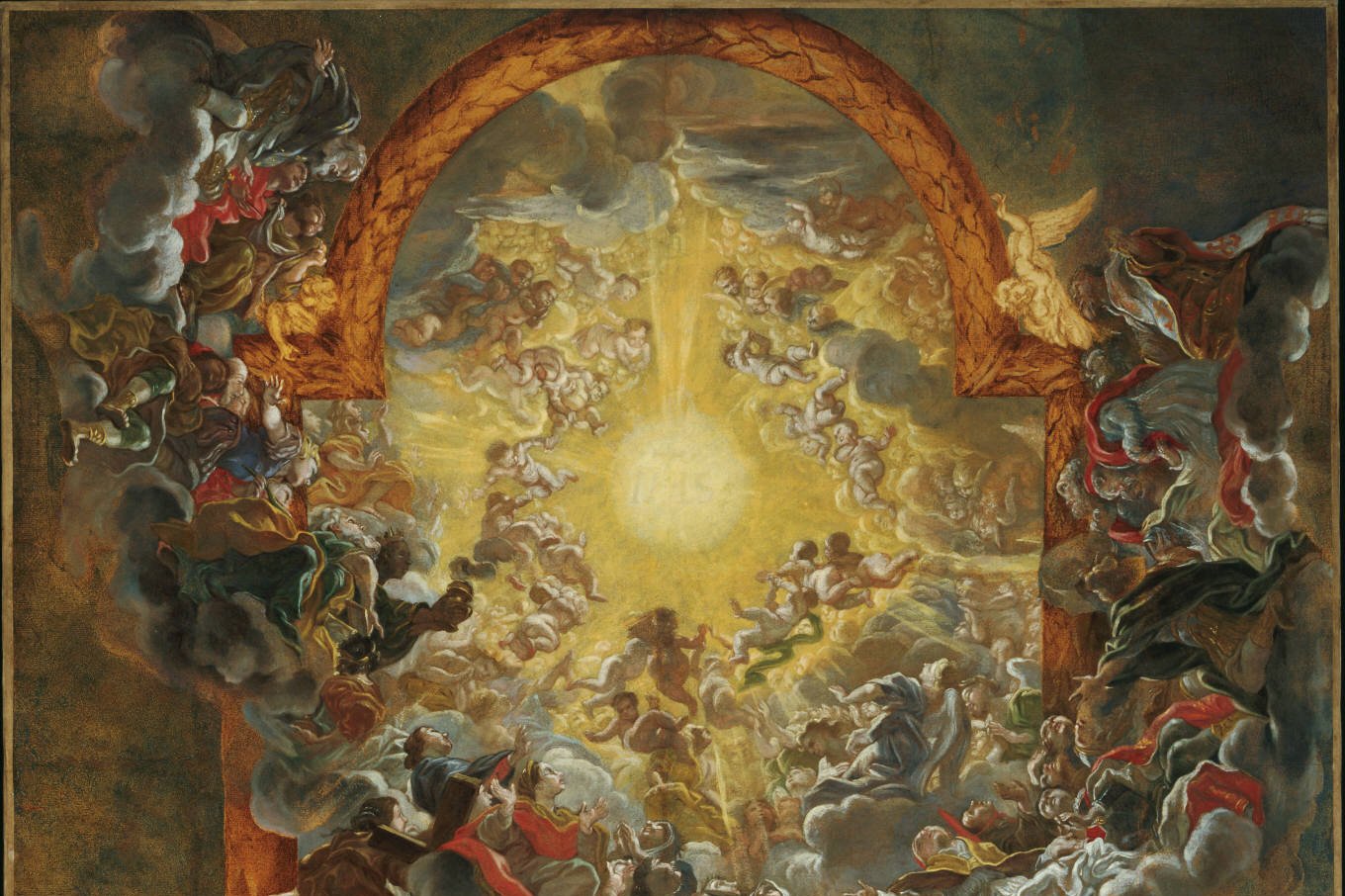
Giovanni Battista Gaulli (Baciccio), "The Triumph of the Name of Jesus," 1676-1679, ceiling fresco, Church of the Gesù, Rome — public domain.
IHS: a Greek word wearing a Latin disguise
The most common Christ monogram seen in churches today is IHS, and its story is really a story about translation. Jesus's name in Greek is spelled ΙΗΣΟΥΣ, and its first three letters — iota, eta, sigma — were commonly used as shorthand for the full name in early Greek manuscripts. When those Greek letters were transliterated into the Latin alphabet, iota became I, eta became H, and sigma became S, producing "IHS." The catch is that once fewer people in the medieval West read Greek fluently, the Greek origin of the abbreviation faded from common knowledge, and people began inventing new Latin explanations for letters they assumed had always been Latin to begin with. The two backronyms that stuck are Iesus Hominum Salvator ("Jesus, Savior of Mankind") and In Hoc Signo ("in this sign"), a phrase recalling the emperor Constantine's reported vision of a cross in the sky before the Battle of the Milvian Bridge in 312. Both readings are pious traditions layered onto the symbol centuries after the fact, not the monogram's actual etymology — but both help explain why IHS carried such devotional weight once it caught on.
That popularity owes an enormous debt to one preacher in particular. In the early fifteenth century, the Franciscan friar Saint Bernardine of Siena began ending his sermons by holding up a wooden tablet bearing the IHS monogram surrounded by rays of light, urging listeners to venerate the Holy Name of Jesus directly rather than the rival civic and factional emblems that were fueling violence in Italian cities at the time. The device spread quickly through his preaching tours, and by the time Saint Ignatius of Loyola founded the Society of Jesus in 1540, IHS was a natural choice for the new order's official seal — which is why it appears on Jesuit institutions across the world today, nowhere more spectacularly than in the swirling ceiling fresco of the Church of the Gesù in Rome, painted by Giovanni Battista Gaulli between 1676 and 1679, where the monogram appears to blaze with actual light pouring down on a crowd of saints and angels below.
Chi-Rho: the older of the two
While IHS dominates later church art, the Chi-Rho is considerably older and, in its earliest form, arguably the first specifically Christian symbol to circulate widely. It is built from the first two letters of "Christ" in Greek — Χριστός — with chi (Χ) and rho (Ρ) drawn on top of each other so that the rho's descender runs down through the center of the chi's crossing lines. Archaeologists have found the symbol scratched into the walls of the Roman catacombs, including the Catacombs of Callixtus and Domitilla, dating from at least the early third century, well before it had any imperial associations at all. Its more famous moment came later: Constantine reportedly saw the symbol in a vision before the Battle of the Milvian Bridge and subsequently had it painted on his soldiers' shields, a story preserved by the early Christian writers Eusebius and Lactantius. From that point the Chi-Rho spread rapidly through Roman-era Christian art, appearing on sarcophagi, coins, and mosaic floors throughout the fourth and fifth centuries, frequently enclosed in a circle — a shape that both framed the letters decoratively and, some scholars argue, echoed pre-Christian solar imagery reinterpreted in a Christian key.
Alpha and Omega: bookending eternity
A third monogram-like device, Alpha and Omega, isn't built from Christ's name at all but from the first and last letters of the Greek alphabet. Their symbolic use comes directly from the Book of Revelation, where God declares, "I am the Alpha and the Omega," says the Lord God, "the one who is and who was and who is to come, the almighty" (Revelation 1:8, NABRE), and the title is later applied explicitly to Christ as well: "I am the Alpha and the Omega, the first and the last, the beginning and the end" (Revelation 22:13, NABRE). In early Christian art, the two letters are frequently placed flanking a cross or a Chi-Rho, turning a single image into a compact statement about Christ's eternity — no beginning before him, no end after him. The same pairing shows up constantly in the catacomb inscriptions alongside the Chi-Rho, often carved onto a single tomb marker as a complete profession of faith in just a few letters.
Why the letters still matter
None of these monograms describes what Christ looked like — that wasn't the point. Each one gave persecuted or simply humble believers a way to name him precisely, compactly, and permanently, whether scratched into stone by someone who could be killed for the gesture or gilded across a Baroque ceiling by an artist working in full daylight centuries later. Saint Paul had already described the reason such devotion to the name itself made sense: "God greatly exalted him and bestowed on him the name that is above every name, that at the name of Jesus every knee should bend" (Philippians 2:9-10, NABRE). The letters are shorthand, but the reverence behind them has never been small.
Trivia
What does IHS actually stand for?
What is the Chi-Rho symbol?
What do Alpha and Omega mean as a Christian symbol?
Why is IHS associated with the Jesuits?
Related Reading